

Mindfulness in everyday life as a tool against stress and hustle
Mindfulness in everyday life – what does that actually mean? Quite simply: experiencing the moment consciously, without judging it. Instead of rushing through the day on autopilot, we pause. This isn't an extra task for your to-do list, but an incredibly effective way to stand up to that constant feeling of stress and overwhelm. You don't need to carve out any extra time for it; you simply weave mindfulness into what you're already doing.
Why mindfulness in everyday life is no longer a luxury
Our world is fast, loud, and demands constant availability. So stress quickly comes to feel like the normal state of things, doesn't it? But this isn't a permanent condition we should simply accept. Mindfulness here is far more than a fleeting trend – it's a fundamental skill for staying mentally clear and not burning out.
The numbers speak a clear language: nearly a quarter of people in Germany suffer from permanent stress. At the same time, the desire for a way out is growing. Around 15 million people already meditate or want to firmly integrate mindfulness into their lives. Their success proves them right: a full 95 percent of those who practice it feel positive changes. You'll find more on the background and studies in this article on deutschland.de.
From autopilot to conscious choice
Think about your typical morning. Your first reach is almost automatically for your smartphone, even before the coffee has finished brewing, right? This is exactly where mindfulness comes in. It's about recognizing such unconscious patterns and consciously choosing a different action – no matter how small. You break out of the autopilot that otherwise steers you through the day unnoticed.
Mindfulness is not a technique but a way of being, a way of living. It means seeing things as they really are. - Jon Kabat-Zinn
This attitude opens your eyes to the small, often overlooked details of life: the full flavor of your coffee, the warmth of the sun on your skin, or the feeling of truly listening to a conversation partner instead of already formulating your own reply.
Scientifically grounded and measurably effective
This isn't esoteric nonsense; it's well founded. Modern MRI studies show that regular mindfulness training demonstrably changes the brain. Areas responsible for our stress regulation, concentration, and empathy are strengthened. So you're not only training your mind, you're actively reshaping your brain structure. If you want to dive deeper into this fascinating topic, take a look at the science behind the Zenbox and the underlying concepts in our article on it.
Anchoring mindfulness in everyday life really is no magic trick. It's about:
- Finding small anchors: Take three conscious breaths before a meeting. It only takes a few seconds, yet it changes everything.
- Using existing routines: For once, take in your commute to work fully consciously – the sounds, the smells, the people.
- Activating your senses: Eat your lunch slowly and really taste it, instead of wolfing it down on the side at your desk.
With these small, conscious shifts in focus, you create little islands of calm and clarity – right in the middle of your packed everyday life.
Beginning the day consciously instead of starting in stress mode
The alarm goes off and the race begins. Before your feet even touch the floor, your hand flies to the smartphone. Emails, messages, the day's first alarming headlines – stress mode is already active before the day has really begun. Sound familiar?
How you start your day often lays the foundation for everything that follows. A rushed morning routine, driven by digital stimuli and the pressure of the to-do list, puts your nervous system on alert from the very first minute. That's the autopilot that so often steers us through everyday life unnoticed.
The simple switch from reactive to conscious mode
But there's another way. And for that, you don't have to throw your entire morning routine overboard. The key lies in so-called micro-habits: tiny, conscious actions that cost hardly any time but unfold an enormous effect. They're like little anchors that pull you out of the carousel of thoughts and let you arrive in the here and now.
Instead of reaching for your phone right after waking up, why not try this:
- Breathe for one minute: After the alarm rings, simply stay lying down for one single minute. Eyes closed, and focus only on your breath. Feel how your belly rises and falls. That's all there is to it.
- Brush your teeth mindfully: Give this everyday act your full attention. Feel the bristles on your teeth, taste the toothpaste, hear the sound of the brush. Your thoughts will wander – simply bring them gently back, again and again.
- The first sip of the day: Whether water, tea, or coffee – take the first sip fully consciously. How does the cup feel in your hand? What temperature is the drink? What do you really taste?
Such small moments of mindfulness in everyday life break the familiar cycle of stress. They create an inner foundation of calm from which you can begin your tasks far more serenely and focused.
The following infographic makes clear how widespread stress is, how great the interest in counter-strategies like mindfulness is, and what positive effect this practice even has on our brain.
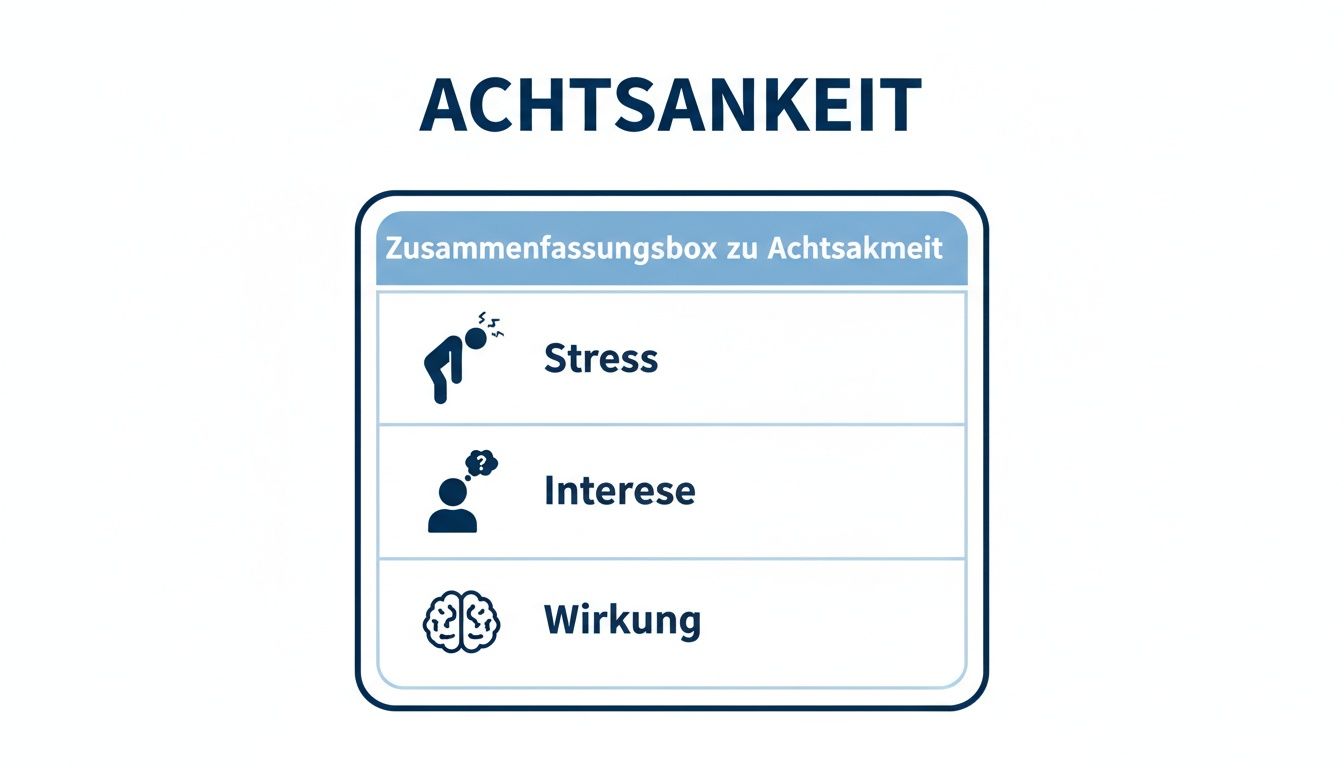
You can see it nicely here: the need for mental tools to cope with stress meets a strong interest in mindfulness-based methods – and their effectiveness is even neurobiologically demonstrable.
Your morning routine: hectic or mindful
To make the difference truly tangible, let's look at two typical scenarios in direct comparison. They're often the same activities, but the inner attitude behind them changes everything.
Comparison of the morning routine: hectic vs. mindful
This table contrasts the differences between a hectic and a mindful morning routine, to highlight the practical benefits.
| Activity | Typical routine (stress-inducing) | Mindful routine (stress-reducing) |
|---|---|---|
| Waking up | Hit snooze several times, immediately reach for the phone and check emails/social media. | Let it ring once, stay lying down briefly, take three conscious breaths and stretch the body. |
| Breakfast | Quickly drink a coffee and read the news on the side, or eat breakfast at the desk. | Sit down calmly, consciously taste every bite, and enjoy the meal without distraction. |
| Commute to work | Mentally run through appointments and to-dos already, listen to music or a podcast to distract yourself. | Consciously take in your surroundings: the sounds, the air, the people on the street. |
The table makes clear that it isn't about more time, but about a different quality of attention.
The decisive difference doesn't lie in what you do, but in how you do it. A mindful start gives you back control over your day, instead of letting it control you.
You don't have to change everything at once. Just pick a single small thing and begin with that. Simply observe how your feeling in the morning and throughout the day changes. Often it's the smallest adjustments that achieve the greatest effect in the end.
How to strengthen your focus at work with mindfulness
The modern workplace can often feel like an epicenter of distraction. Notifications keep popping up, meetings are squeezed in spontaneously, and the pressure to keep several balls in the air at once quickly leaves a feeling of being torn. This is exactly where mindfulness in everyday life becomes an incredibly valuable tool – not just for your well-being, but also for noticeably better work results.
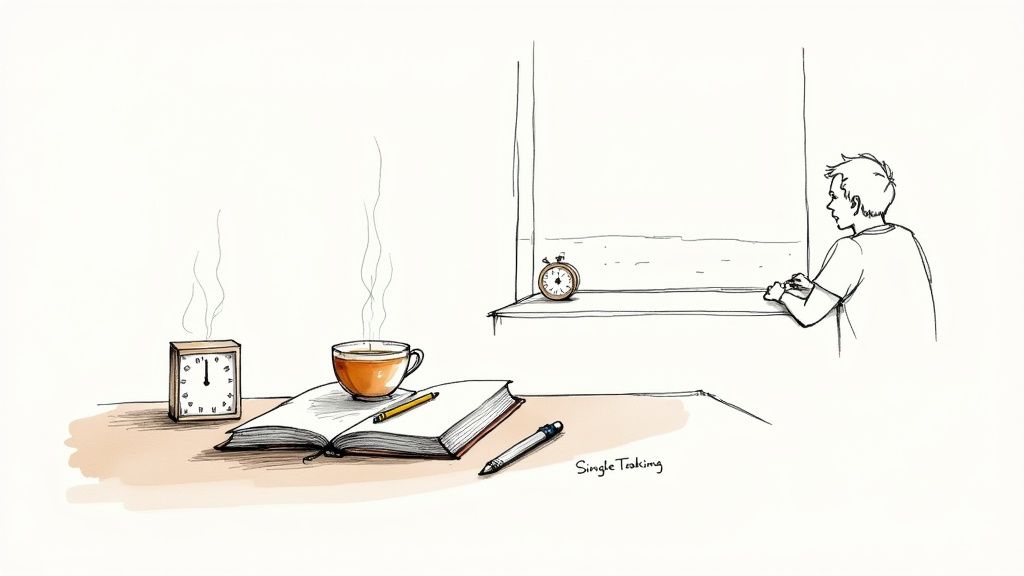
We all grew up with the myth that multitasking makes us more productive. The truth is: this approach is a fallacy. Constantly jumping back and forth between tasks fragments our attention and in the end only leads to superficial work. The mindful counter-design? Single-tasking. It means making the conscious decision to devote yourself fully and completely to a single thing.
So instead of typing an email while on the phone, you focus fully on the conversation. Only afterward, with undivided attention, do you write the email. You'll notice that this method not only reduces errors but also gives you back a deeper concentration and a strong sense of control.
Small mindfulness exercises right for your desk
You don't have to turn your entire working day upside down to become more mindful. Often it's the small, targeted exercises that take only a few minutes that make the biggest difference. They bring you back from the reactive autopilot into a conscious, clear state.
Why not try one of these simple techniques when the bustle becomes too much:
- The 3-minute breathing pause: Between two appointments, simply sit up straight, close your eyes for a moment, and focus for three minutes only on your breath. Feel how the air flows in and out. Your thoughts will wander, that's completely normal. Simply notice it and gently steer your focus back to the breath.
- The conscious walk to lunch: Instead of running through the next meeting in your head on the way to the canteen, take in your surroundings consciously. How does the ground feel under your feet? What sounds do you hear? Is the air warm or cold on your skin?
- The mindful coffee: Enjoy your next cup of coffee or tea as if it were the first of your life. How does the drink smell? What temperature do you feel? What subtle nuances of flavor can you discover?
These brief moments of pausing are like a little reset for your brain. They help you clear your head, so that afterward you can devote yourself to your next task clearly and focused again.
The key doesn't lie in doing more, but in being more present with what you do. True productivity arises from deep focus, not from hurried busyness.
Especially in a working world where stress is omnipresent, such small anchors are worth their weight in gold. Current figures show that around 82 percent of Germans feel stressed. For working people this is an alarm signal, because mental illnesses are already the second most common cause of illness-related absences. Mindfulness training can here demonstrably lower the risk of burnout and increase performance, as you can read in this article on the stress epidemic in Germany.
Real breaks instead of just digital distraction
A break only brings real recovery when it allows your brain to truly switch off. Quickly reaching for the smartphone to scroll through social media feeds unfortunately does the exact opposite. It's simply another form of sensory overload.
If you catch yourself reaching unconsciously for your phone often, that could be a sign. In our post „Are you addicted to your smartphone?“ we go into this topic in more detail.
Instead, try to consciously shape your breaks as time for regeneration. Simply look out the window for a few minutes and watch the clouds drift by. Lean back, close your eyes, and listen to the sounds around you. These moments of stillness aren't lost time – they're a valuable investment in your concentration and your long-term well-being.
Strengthening relationships through conscious presence
Do you know the feeling? You're sitting with the family at the dinner table or meeting up with friends, but in your head the thoughts are racing: work, the endless to-do list, the next push notification on your phone. Physically you're there, but mentally miles away. It's precisely this mental absence that gnaws at the connections to the people who mean the most to us.
Mindfulness in everyday life is the key here. It's about turning mere physical presence into a genuine, palpable presence. In doing so we give the people around us the most precious thing we have: our full and undivided attention.
The almost forgotten art of listening
The first step to deeper relationships is to really listen again. Far too often we listen with only half an ear while inwardly already polishing our reply. Active listening is the opposite: it means giving the other person the space to share themselves completely. Without interruption, without hasty judgment.
- Take the smartphone out of the equation: Create a distraction-free zone. When you're talking with someone, the phone goes silent – ideally out of sight and reach.
- Maintain eye contact: A simple but powerful signal. It says: „I'm fully with you, I hear you.“
- Ask instead of judge: Instead of immediately presenting your own opinion, ask clarifying questions. „How did that feel for you?“ or „Can you explain to me what exactly you mean by that?“
This small shift in focus alone – away from you, toward the other person – can fundamentally change the quality of your conversations.
Creating consciously shared moments
Mindfulness can be wonderfully built into shared experiences and so strengthens the feeling of connection. It takes no elaborate events. It's about consciously sharing perfectly ordinary moments with one another.
Genuine connection doesn't arise from grand gestures. It grows from the sum of small, attentive moments in which we give each other our full presence.
Why not give the following a try:
- A shared walk in nature. Take turns telling each other what you're perceiving right now with your senses: a particular birdsong, the smell of damp earth, the play of light on the leaves.
- Cooking together, entirely without digital distraction. Focus only on the ingredients, the movements, and doing it together. You'll see, the meal tastes twice as good afterward.
- Consciously enjoying a cup of tea or coffee. Entirely in silence, without talking on the side or looking at your phone. Even five minutes can create a surprisingly deep connection.
Such shared islands of calm not only help to reduce conflicts, but also counteract the feeling of isolation. Everyday stress unfortunately often rubs off on our private lives. In fact, a study shows that 60 percent of people are familiar with loneliness, which frequently goes hand in hand with stress and exhaustion. Conscious moments strengthen empathy and communication and so solidify our social bonds. Anyone who wants to delve deeper can read more about the background of mindfulness as an enrichment for everyday life and discover further fascinating insights.
Ending the day mindfully for restful sleep
How we end our day decisively determines how we sleep. Far too often we take all the baggage with us to bed: the stress from work, the hustle of family life, and the never-ending carousel of thoughts. Instead of coming to rest, everything keeps spinning. That's the perfect breeding ground for restless nights and that feeling of waking in the morning utterly worn out. So a conscious wind-down to the day isn't a luxury, but a real necessity for deep recovery.
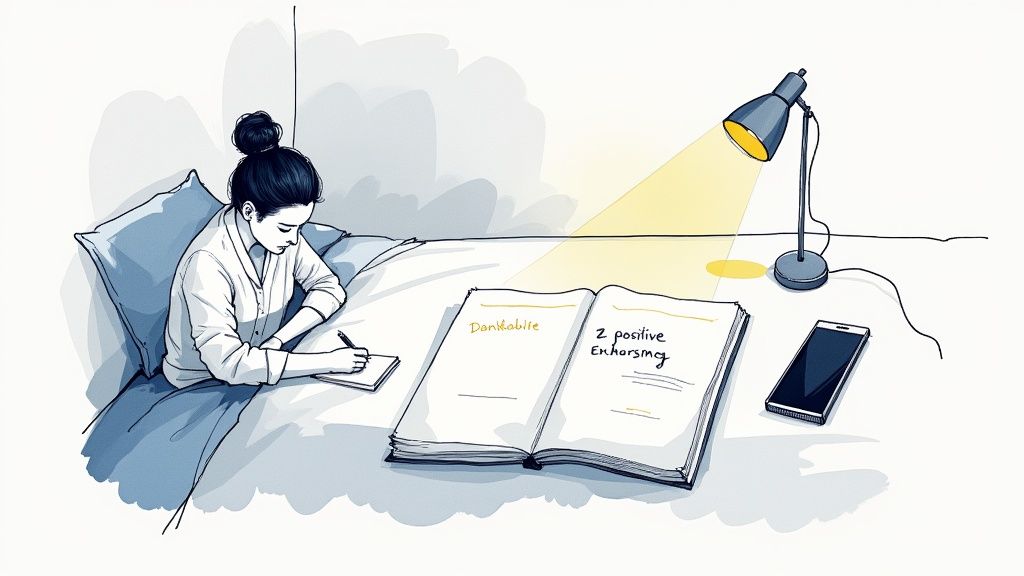
The key lies in sending the brain clear signals: „Hey, it's time to switch from the active ‚doing‘ mode into the passive ‚being‘ mode.“ One of the most effective methods I know is the concept of the „digital sunset.“
The digital sunset as an evening ritual
The idea is astonishingly simple: decide for yourself that one to two hours before going to bed you switch off all screens. No late-night scrolling through social media, no binge-watching the next series, and certainly no final check of work emails from bed. The blue light of the displays demonstrably disrupts the production of the sleep hormone melatonin and keeps our brain artificially awake.
Ending the day consciously means drawing a clear boundary between the hustle of the day and the calm of the night. It's the permission to let go and truly switch off.
If you notice that the smartphone is your biggest disruptive factor, a physical tool like The Zenbox Version 1 can be a real help. By locking your phone away and starting a focus time, you create a conscious barrier. That's a clear signal for your screen-free time and helps you build a new, healthier habit in a playful way.
Calming alternatives to screen time
Okay, but what do you do with the newly gained time? It's about finding quiet, analog activities that ground you and tune you in for the night. Here are a few practice-tested ideas that you can easily build into your evening:
- Keep a gratitude journal: Take five minutes and write down three things you were grateful for on this day. It shifts the focus away from problems and toward the positive – a real game-changer for your mood.
- Drink a cup of tea mindfully: Prepare yourself a soothing herbal tea and enjoy it without distraction. Focus fully and completely on the warmth of the cup, the aroma, and the taste.
- Gentle stretching exercises: A few soft stretches or yoga poses can work wonders to release the day's physical tension and prepare the body for the rest phase.
These small rituals don't have to be complicated at all. Just a few minutes can make a huge difference.
The body scan as a falling-asleep aid
When you're then lying in bed and the thoughts are still circling, a body-scan meditation is a wonderful method to bring body and mind to rest. The principle is simple: you slowly travel with your attention through your entire body, from the tips of your toes up to the crown of your head. As you do, you simply feel into the individual body parts – without wanting to judge or change anything.
This exercise has two unbeatable advantages: it distracts you from brooding thoughts and helps you track down physical tensions and consciously let them go. With every breath you sink deeper into the mattress and create the ideal precondition for a deep, restful sleep. And that is exactly the perfect basis for starting the next morning with new energy and more mindfulness in everyday life.
The most frequent questions about mindfulness in everyday life
When you begin to engage with mindfulness, it's completely normal for questions to arise. The path to more presence in the here and now is, after all, not a sprint but a personal journey of discovery. Here I've gathered some of the typical questions I'm asked again and again, to give you a little more clarity and confidence for your own practice.
Many people, when they think of mindfulness, immediately picture hours of meditating in the lotus position. But that's only a small part of the whole and often a stubborn misconception.
Do I have to meditate to be mindful?
No, absolutely not. Meditation is indeed a fantastic tool for training mindfulness in a targeted way, but it's by far not the only path. Mindfulness in everyday life means above all experiencing the present moment consciously and without judgment. You can do that truly anywhere and at any time.
Mindfulness happens, for example, when you:
- Enjoy your morning coffee with all your senses, instead of already writing the first email in your mind.
- Consciously feel, on the way to work, how your feet touch the ground.
- Truly listen to a friend, without already preparing your reply in your head.
It's precisely these small, conscious moments that are the heart of mindfulness. A formal meditation practice can of course deepen this ability, but it's not a mandatory prerequisite for benefiting from its advantages.
What do I do if my thoughts keep wandering?
This is perhaps the most important question of all. The short answer: Congratulations, you've just noticed what a mind does by nature – it thinks and wanders. The wandering of thoughts is therefore not a failure, but precisely the moment in which the actual practice begins.
Every moment in which you notice that your thoughts are elsewhere is a small success. It's your chance to gently steer your attention back to your anchor point – the breath, for example – without criticizing yourself.
Think of it like training a muscle. Every time you kindly bring your attention back, you strengthen your „focus muscle.“ So it isn't about having no thoughts, but about not being unconsciously carried away by them.
How long does it take until I notice the first changes?
This question is absolutely understandable. In our fast-paced world, we'd love to see results immediately. With mindfulness, however, there's no fixed timetable, because the effect is very individual. It depends above all on how regularly you build little islands of mindfulness into your day.
Some feel a subtle change after just a few days – perhaps they're a little less irritable or have a clearer head in the morning. For others it takes a few weeks until they notice a deeper inner calm or better concentration at work.
The most important thing is to approach the process without pressure. Be curious and patient with yourself. The greatest changes often happen gradually and show themselves above all in how you react to the small and large challenges of life.
With the Zenbox, it becomes easier for you to set digital distractions aside and take conscious time-outs. Shape your path to more focus and inner calm. Discover your Zenbox at https://www.thezenbox.de.