

Overcoming phone addiction: easier ways to reduce phone addiction, effective approaches
Phone addiction is officially not a disease, but it often feels like one. It is that compulsive pattern that keeps making us reach for the smartphone again and again – even when we don't actually want to. The result? A feeling of losing control, an inner restlessness when the device is out of reach, and noticeable negative consequences in our everyday lives.
What phone addiction really is and why it affects everyone
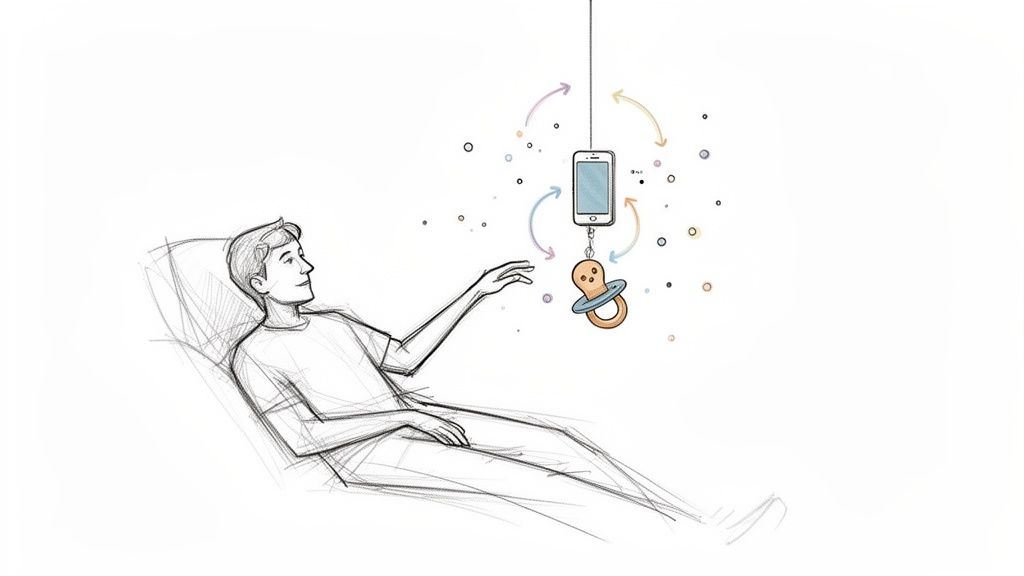
Phone addiction is not a label you stick only on a small group. It is much more a broad spectrum, ranging from mild distraction to compulsive use, and it is deeply rooted in our modern lives. Very few of us are clinically addicted, but almost everyone feels that creeping loss of control and the negative effects the smartphone brings with it.
You can think of the phone like a digital pacifier. As soon as boredom sets in, stress grabs hold of us, or we feel insecure, we reach for it almost automatically. It is a quick comfort, an instant distraction – a superficial solution to a deeper emotional need.
The dopamine loop: how our brain gets hooked
Every notification, every like, every new message – all of it triggers a tiny release of the happiness hormone dopamine in our brain. This reward system is incredibly powerful. Our brain learns the equation in a flash: "phone = good feeling". And before long it demands more and more of these small, digital rewards.
It is precisely this loop that tempts us to reach for the device constantly, often without any specific reason. We become conditioned to respond to ceaseless stimuli. This weakens not only our concentration, but also our ability to simply sit with silence or a moment without distraction.
Phone addiction does not begin only with excessive use. It starts the moment we lose the conscious decision – when reaching for the phone is driven by automatism and degenerates into an unconscious habit.
A problem that affects all generations
The omnipresence of smartphones is striking and runs through all age groups. In Germany, 82 percent of people aged 16 and over already use a smartphone. And it starts ever earlier: among 6- to 9-year-olds the figure is already 64 percent, while among 16- to 18-year-olds practically everyone owns one, at 98 percent.
These figures clearly show that problematic usage patterns are no longer a niche phenomenon, but a challenge for society as a whole. You can find more details on current smartphone use in Germany at de.statista.com.
This guide is meant to be your compass for finding a more conscious relationship with your digital companion again. Here you will learn how to:
- Recognize symptoms: Understand the warning signs in your own behavior.
- Apply strategies: Discover proven methods to reclaim control.
- Use physical tools: Learn how tools like the Zenbox create a conscious hurdle that digital solutions alone cannot offer.
Our goal is to put very practical tools in your hands so that you can rediscover your digital balance – not through radical abstinence, but through more awareness and control.
The creeping consequences of excessive smartphone use
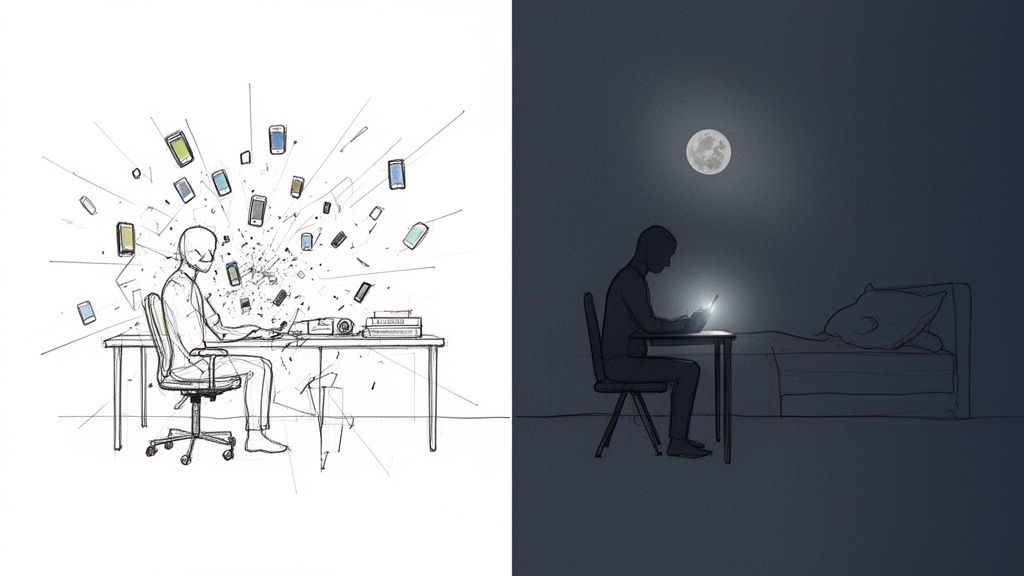
The consequences of phone addiction are a bit like a slow poison. They creep into our everyday lives, and we often only notice them once the damage is already done. What begins as a harmless distraction – just quickly checking emails – soon develops into a habit that undermines our productivity, our mental health, and even our relationships with other people.
Statistically, the average adult spends an incredible 4.4 hours on the smartphone every single day. That is almost a third of our waking time! Such intensive use naturally cannot pass without consequences, and it often leads to concentration problems, social withdrawal, and sometimes even genuine withdrawal symptoms. If you would like to dive deeper into the topic, you will find fascinating insights into the drug of the digital age at health-rise.de.
The invisible productivity killer
One of the first and biggest casualties of phone addiction is our ability to do deep, focused work – so-called “deep work”. Every single push notification, every short message rips us out of the flow. Picture your concentration like a deep, restful sleep: a brief, loud noise is enough to wake you up. And it takes quite a while before you can sleep that deeply again.
This constant switching between task and distraction has very concrete effects:
- Working from home: Just quickly scrolling through Instagram before the next task begins? The result is that we approach the new task with less mental energy and often more error-prone. Projects drag on unnecessarily.
- While studying: Anyone who keeps reaching for the phone while learning will notice that far less sticks. Efficiency drops dramatically, even though you spend just as much time at the desk.
Our constant availability fragments the day into countless small, inefficient snippets.
Mental health under continuous fire
Our psyche also suffers from excessive smartphone use, and the strains are manifold. The endless flood of information and the constant social comparisons on platforms like Instagram create a subtle but permanent level of stress.
The smartphone promises us constant connection, yet ironically it often leaves a feeling of emptiness and restlessness. The fear of missing out (FOMO) drives us to be online all the time and only fuels this stress cycle further.
It becomes particularly critical when we take the phone into bed with us. The blue light of the displays disrupts the production of our sleep hormone melatonin. The consequence: we fall asleep more poorly and sleep quality suffers. In the long term, this can lead to chronic fatigue, irritability, and even states of anxiety.
Social relationships put to the test
While smartphones connect us globally, they can slowly erode the relationships with the people right next to us. You surely know the phenomenon of “phubbing”: ignoring the person in front of you because you would rather look at your phone. A sad symbol of our times.
This behavior sends a clear message: “Whatever is happening on this screen is more important right now than you.”
The following table shows how this plays out in everyday life and what far-reaching consequences it can have.
Typical everyday consequences of phone addiction
This table shows the concrete effects of excessive smartphone use on various areas of life.
| Area of life | Negative effects | Everyday example |
|---|---|---|
| Partnership | Lack of emotional closeness and the feeling of not being heard. | One partner talks about their day while the other listens with only half an ear and scrolls through their newsfeed. |
| Family | Less quality time together and superficial interactions. | At a shared dinner, all family members are more occupied with their devices than with the conversation. |
| Friendships | A feeling of being undervalued and decreasing depth in conversations. | During a meet-up at a café, the conversation is constantly interrupted by notifications lighting up. |
This subtle form of neglect lets trust and emotional bonds erode. Although we are surrounded by people, phone addiction slowly isolates us. Restoring these connections requires a conscious decision and the willingness to simply put the device away sometimes.
Honestly assessing your own phone behavior
The first step toward a healthier relationship with the smartphone is always an honest stocktaking. Entirely without judging yourself for it. Many of us have the vague feeling of losing control, but have no idea where to start. Simply view the next paragraphs as a mirror that helps you understand your own behavior better and recognize the first warning signs.
This is not about immediately stamping yourself “addicted”. Rather, it is an invitation to honestly reflect on your own usage behavior. Take a brief moment and go through the following questions for yourself – as honestly as possible.
A short self-test for reflection
Think back to the last few weeks. Does any of the following situations sound familiar?
- The first reach in the morning: Does your hand automatically go to the phone within the first 15 minutes after waking, perhaps even before you have properly gotten up?
- The constant companion: Is your smartphone basically always within reach – even on the toilet or at a shared dinner?
- Restlessness without the device: Does it make you nervous, restless, or even irritable when the battery is dead, you have no signal, or you simply can't find the phone?
- Loss of the sense of time: Do you know this one? You only want to quickly look something up and realize half an hour later that you are still scrolling.
- “Phubbing” in everyday life: Do you sometimes catch yourself looking at the phone in the middle of a conversation with friends or family?
- Fleeing from the silence: Do you use your smartphone quite deliberately to immediately bridge unpleasant feelings, boredom, or every little bit of waiting time?
- Failed resolutions: Have you ever resolved to spend less time on the phone, but kept falling back into the old habits?
These questions are of course not a clinical diagnosis. They are more like food for thought. But if you find yourself in several of these points, it could be a sign that your smartphone is taking up more space in your life than you would like.
What loss of control and withdrawal symptoms really mean
To better classify your own phone addiction, three terms from addiction research can help, which transfer surprisingly well to our digital lives:
- Loss of control: This is the moment when reaching for the phone is no longer a conscious decision, but a pure reflex. You actually only wanted to check the time, but 20 minutes later you are stuck on Instagram. Control over the duration and frequency has slipped away from you.
- Withdrawal symptoms: This does not mean only physical discomfort. In the digital context, it often manifests as inner restlessness, nervousness, irritability, or even sheer fear of missing something important (FOMO) when the device is not there. It is that nagging feeling of having to check immediately.
- Building tolerance: Over time you need more and more of the “digital drug” to feel the same satisfaction. Where ten minutes of social media may once have been enough to chase away boredom, today it might take a whole hour.
A clear warning sign is when smartphone use continues, or even increases, despite obviously negative consequences – such as poorer sleep, concentration problems, or arguments in the relationship.
These phenomena are not a sign of weak willpower. They are the logical consequence of how our brain responds to the constant small rewards the smartphone serves up. If you are wondering whether you are addicted to your smartphone, you will find even deeper insights in our follow-up article. Recognizing these patterns in yourself is the all-important first step to regaining control.
Digital mindfulness as a path to more control
Anyone who has ever become aware that their own phone behavior might be problematic knows this frustrating feeling. But instead of practicing radical abstinence – which is usually doomed to fail anyway – there is a much more sustainable approach: digital mindfulness. This is not about demonizing the smartphone. Rather, it is about consciously becoming the boss of your own technology again. It is the art of using the device deliberately as a tool, instead of being unconsciously steered by it.
The key lies in switching off the autopilot. Every reach for the phone should once again be a conscious decision and not just a reflex to boredom, stress, or the next notification. With the right strategies, this conscious approach can be trained, and you regain control step by step.
The foundation: rebuilding your own everyday life
The most effective changes often start small, right in our daily routines. It is about creating conscious rules that interrupt the automatic reach for the phone and make more room for real offline moments again.
- Set up phone-free zones: Clearly define places where the smartphone is off-limits. The most important candidate is the bedroom, because the blue light demonstrably disrupts sleep and the morning flood of messages prevents a calm start to the day. The dining table should also become a technology-free zone again, to give real conversations a chance.
- Plan fixed offline times: Set yourself concrete time windows in which the phone is consciously put away. This can be the first hour after waking, to start the day focused, or the last hour before falling asleep, to truly come to rest.
- Cut notifications radically: Deactivate all push notifications that are not absolutely necessary. Every red dot, every sound, and every vibration is a targeted interruption that steals your attention. Without these constant stimuli, you decide again when you engage with an app.
These simple behavioral changes act like small guardrails. They gently but firmly keep you on the path to a more conscious relationship with your smartphone.
The following concept map illustrates the three central signs that can indicate problematic usage behavior.
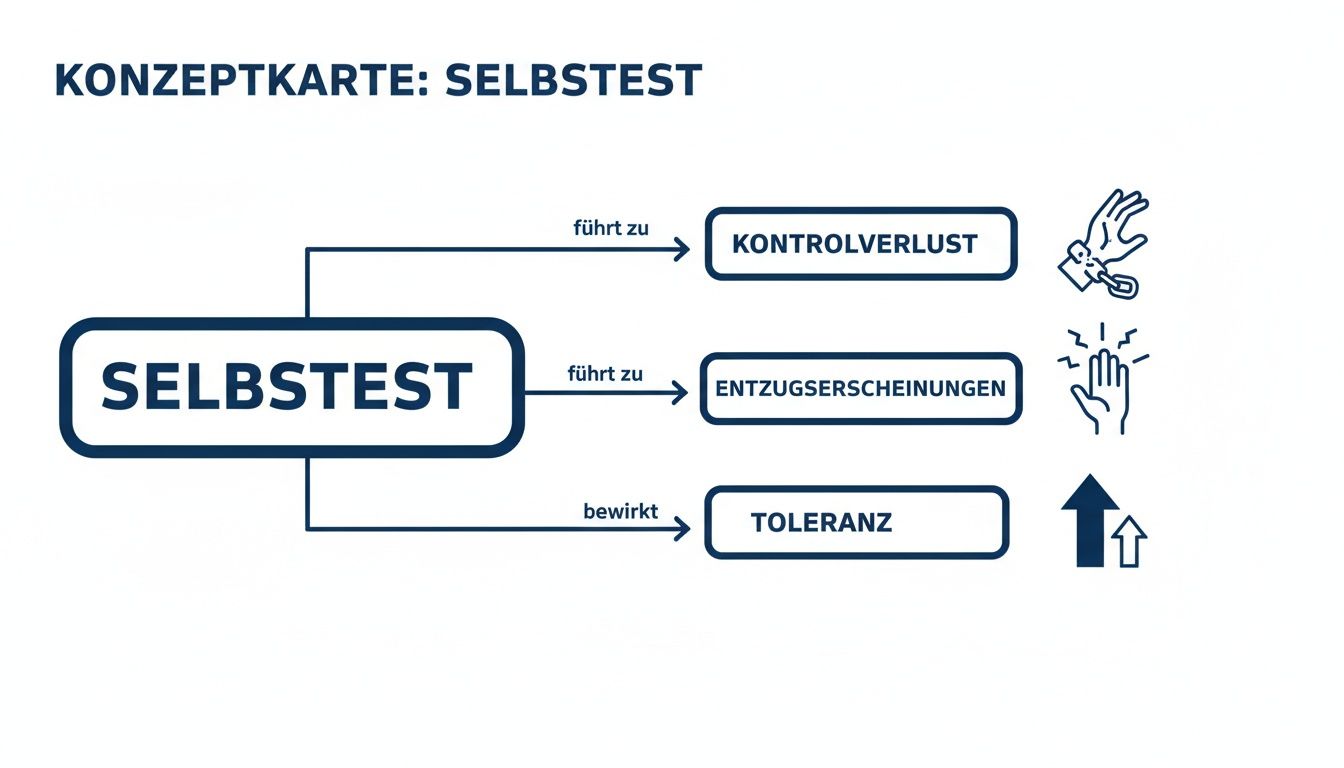
The graphic makes clear how loss of control, withdrawal symptoms, and rising tolerance interlock and can thus reinforce the cycle of problematic use.
Using digital helpers wisely
It sounds paradoxical, but technology itself can help us get its downsides under control. There is a whole range of clever settings and apps that act as digital bodyguards and support us in staying more focused.
Digital mindfulness means taking back the power. It is about creating conscious pauses and shaping technology so that it serves our well-being – and not the other way around.
Here are a few digital strategies you can implement right away:
- Grayscale mode: Switch your display to grayscale in the settings. A colorless screen makes endless scrolling through colorful feeds and apps psychologically far less appealing. The reward stimuli are thereby massively reduced.
- Use focus apps: Applications like Forest, Freedom, or the built-in focus modes in iOS and Android let you block distracting apps for a certain time. In this way you deliberately create undisturbed phases for work or relaxation.
- Tidy up the home screen: Banish all addictive apps like social media, news, or games from the home screen. Move them into a folder on the second or third page. This small extra step alone creates a hurdle and prevents the reflexive tap.
Physical tools: the real barrier
Software solutions are certainly helpful, but they have one decisive disadvantage: they can be bypassed with a few clicks. Sadly, the inner couch potato wins all too often when temptation is just a fingertip away. This is exactly where physical tools come into play, creating a real, tangible barrier.
The concept behind it is simple, but psychologically extremely effective. A physical action – such as consciously locking the device away – has a much stronger mental effect than merely activating an app. It is a clear signal to your brain: “Now it's focus time.”
A perfect example of this is the Zenbox. Instead of relying solely on your willpower, you quite consciously create a small hurdle. You have to get up and perform an active step to get to your smartphone again. This simple physical step breaks the automated cycle of impulse and instant gratification. The decision to interrupt your concentration thereby becomes much more conscious – and often less attractive too. You will also find more inspiration on how to use mindfulness in everyday life as a tool against stress and hectic on our blog.
Practical guidance for everyday life
Understanding the theory behind phone addiction is one thing. But real change only begins when we put this knowledge into practice in our everyday lives. It is about translating what you have learned into concrete, doable steps that fit your life situation exactly. Whether working from home, in the study stress of university, or in the middle of turbulent family life – for each of these areas there are proven strategies with which you can regain control over your attention.
Do not view the following tips as rigid rules, but as proven suggestions that you can adapt for yourself. The key often lies in starting small and building new habits that fit seamlessly into your daily routine.
Regaining focus when working from home
Working from home is fantastic because it is so flexible. But it is precisely this freedom that also carries the danger of work and private life blurring together. Most of the time, the smartphone is the biggest disruptor, tearing us out of important tasks and breaking our concentration again and again. What really helps here is the combination of the time-blocking method and a very conscious, physical barrier.
Plan your day in fixed time blocks. Assign each block a clear task, for example 90 minutes for “deep work” on an important project.
During these phases the phone takes a break. But do not just set it aside – create a real hurdle. This is exactly where the Zenbox plays to its strength as a physical barrier. When you consciously lock your smartphone away, you give your brain an unmistakable signal: now a disturbance-free time begins. This simple act breaks the unconscious reach for the device and sustainably strengthens the boundary between work and leisure.
The decisive psychological advantage of a physical solution lies in the “deliberate friction”. You have to perform a conscious action in order to let yourself be distracted, and that is exactly what breaks the automated impulse.
After your focus session, deliberately plan a short break in which you can also check messages. This way you keep control and no longer let your device set the pace.
Staying focused through your studies
For students, the smartphone is both a curse and a blessing. On the one hand it is an incredibly practical tool for research and organization, on the other hand the biggest source of procrastination. During long study sessions, the temptation to “just quickly” scroll through social media is huge.
To counter this urge, a simple but very effective technique has proven itself:
- Define clear learning goals: What exactly do you want to achieve in the next 60 minutes? Write this goal on a piece of paper.
- Create a distraction-free zone: Mute all notifications on your laptop and put your smartphone out of sight and reach.
- Use a timer: Set an alarm for 50 minutes. During this time you concentrate fully on your learning task.
- Reward yourself: After the 50 minutes, take a conscious break of 10 minutes. Now you can get up, stretch, and also briefly use your phone.
This structured rhythm not only helps you absorb the learning material more effectively, but also prevents mental exhaustion. The fixed breaks take away the pressure of always having to be reachable and make the phone-free time psychologically much easier to sustain.
Creating more real family time
In many families, the smartphone has become a silent companion, even during shared activities. The result is often superficial interactions and the feeling of not being truly connected with one another despite physical closeness. Especially for children and teenagers, this behavior is a problematic role model.
Current studies show how urgent the topic is. In Germany, over 900,000 children and teenagers already show problematic usage patterns with digital media. On weekdays they spend an average of 157 minutes on social media; on weekends this value climbs to 227 minutes. You can find more on these alarming figures in the current DAK study on media addiction, which you can read here.
To counteract this, families can set up clear rules that apply to everyone – including the parents.
- Phone-free meals: Introduce a “phone box” or a fixed place where everyone puts down their devices during the meal. This way dinner once again becomes a place for real conversations.
- Shared offline evenings: Plan fixed evenings in the week for activities without screens. This can be a games night, a shared cooking project, or simply a walk.
- Be a role model: The most important rule of all. When children see that their parents consciously do without the phone in order to spend time with them, they learn from an early age a healthy relationship with technology.
Such shared rituals not only strengthen family cohesion, but also promote everyone's media literacy and create valuable, undisturbed memories.
Frequently asked questions about phone addiction
At the end of this guide, a few very specific questions often remain open. That is why I have gathered here the answers to the most frequent and important questions that keep coming up in connection with phone addiction and digital mindfulness. Think of it as your little cheat sheet for everyday life.
We have taken a close look at the mechanisms, consequences, and solution strategies. Now it is time to translate this knowledge into solid answers that really help you.
Is every frequent smartphone use the same as phone addiction?
In short: no. High screen time alone does not make an addiction. The crucial point is the loss of control. The decisive question is not how many hours you spend on the phone, but why you do it and how you feel while doing so.
Perhaps your job requires intensive smartphone use, or you consciously immerse yourself in a hobby that takes place digitally. That is completely fine. It only becomes problematic when reaching for the device turns into an uncontrollable compulsion and you have the feeling that you can no longer freely decide to put it away.
Phone addiction begins where use no longer follows your free choice, but an inner urge takes over control. It comes down to whether you master the device or the device masters you.
Pay attention to the typical alarm signals that go far beyond mere usage duration:
- Withdrawal symptoms: Do you become restless, nervous, or irritable when the phone is not within reach?
- Building tolerance: Do you need more and more time on the screen to reach the same feeling of satisfaction or distraction?
- Negative consequences: Do important tasks, your social contacts, or your sleep suffer because of your phone use?
If you recognize such patterns in yourself, that is a strong indication that the use has become problematic – entirely independent of the number of hours on the clock.
What are the first steps to reduce my phone use?
The path to a healthier relationship with the smartphone does not start with a radical digital detox, but with small yet surprisingly effective changes in habit. Start with these three measures to quickly feel your first sense of success.
- Become an observer: Use the built-in screen time function (under iOS or “Digital Wellbeing” on Android) to get an honest overview. Which apps are your biggest time thieves? This awareness alone is often already the first impulse for a change.
- Turn down the noise: Deactivate all push notifications that are not absolutely vital. Every single notification is a targeted disturbance that pulls you out of the moment. Without this constant barrage, you decide again when you turn to an app.
- Create phone-free zones: Set up places and times where the smartphone is off-limits. The bedroom and the dining table are the perfect candidates to start with. In addition, consistently banish the device during the first hour after waking and the last hour before going to bed.
These simple rules help you break the power of habit and reclaim control bit by bit.
Why is a physical solution often more effective than an app?
Software solutions like focus apps or screen time limits are a good start, but they have an Achilles' heel: they can be bypassed with a few clicks. When the inner urge to scroll is strong enough, the inner couch potato almost always wins the fight against a digital hurdle.
A physical barrier, on the other hand, creates a real, tangible distance. You have to carry out a conscious action – for example getting up and going to a particular place – in order to get to your device.
This small detour is psychologically incredibly effective. It interrupts the automated cycle of impulse and instant reward and gives you that valuable moment of pausing. In this brief pause you can question your decision once more: “Do I really want this right now?”
This is exactly where a solution like the Zenbox comes into play. It creates a “deliberate friction”.
| Characteristic | Software solution (e.g. focus app) | Physical solution (e.g. Zenbox) |
|---|---|---|
| Ease of bypassing | Easy, often only a few clicks needed | Requires a conscious, physical action |
| Psychological effect | Low, the temptation remains within reach | Strong, since a real distance is created |
| Impulse control | Supports only weakly, easy to bypass | Actively strengthens by breaking automatisms |
The physical separation simply makes your resolution to stay focused more tangible and far more binding.
What can I do if I can't get my use under control on my own?
If you notice that all your efforts come to nothing and the excessive phone use massively impairs your quality of life, your relationships, or your work, it is a sign of strength to seek professional help. You do not have to get through this alone.
There are numerous points of contact that specialize in helping you. There you can explore the deeper causes of your phone addiction and develop effective strategies for everyday life.
Here are some possible points of contact:
- Addiction counseling centers: Many of these institutions have long since expanded their offering to include behavioral addictions such as media or phone addiction.
- Psychotherapists: A therapist can help you uncover and work through the psychological patterns behind the compulsive use.
- Your family doctor: He or she can give an initial assessment and refer you to the right specialist services.
Seeking support is not an admission of weakness. It is a courageous, active step to put your mental health and well-being first again and to regain control over your life.
Ready for the first, simple step toward more digital calm? The Zenbox was developed for exactly this: it creates a conscious, physical barrier that breaks the automatic reach for the phone. This way you rediscover focus and serenity in everyday life. Discover at https://www.thezenbox.de how a small, minimalist tool can make a huge difference.