

Treating phone addiction without losing your mind
The first step toward treating phone addiction is the most honest and often the most difficult one: admitting your own behavioral patterns to yourself. It is about breaking the cycle of unconscious use and taking back control. More often than not, it is the small, almost automatic habits that point to a bigger problem.
Phone addiction: When does usage become a problem?
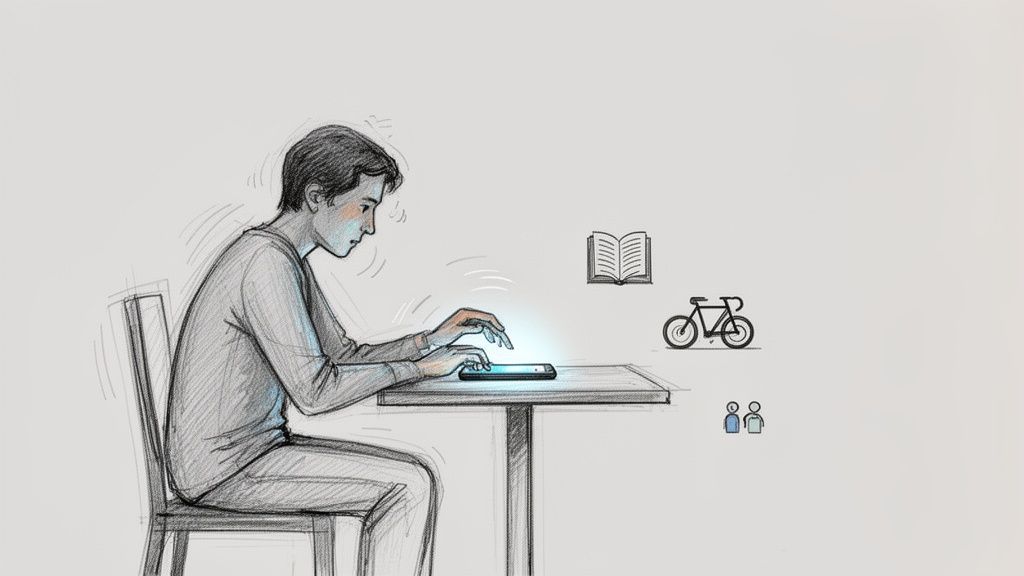
The line between heavy phone use and genuine dependency is a fluid one. It is less about pure screen time in hours and minutes, and far more about that nagging feeling of losing control. A thoughtful look at your own behavior is therefore the decisive starting point.
Do you recognize this? You are standing at the supermarket checkout and reflexively reach for your phone, without any reason to. Or you feel a vague restlessness rising when your battery drops below 20%. These are exactly the first warning signs worth taking seriously.
Physical and emotional warning signals
The signs of problematic use are varied and often show up both physically and psychologically. Many people only notice these changes once they consciously pay attention to them. Here are a few typical symptoms:
- Inner restlessness and irritability as soon as the smartphone is out of reach or the Wi-Fi cuts out.
- Neglecting hobbies and friends, because time on the screen feels more important. This often leads gradually into social isolation.
- Sleep problems, because the blue light of the display keeps the body awake or you scroll deep into the night.
- Difficulty concentrating at work or in daily life, because the constant stream of notifications steals your focus.
A clear warning signal is what is known as a “tolerance increase”: you need more and more time on your phone to feel the same level of satisfaction or distraction.
What is really behind the constant reach for the phone?
Reaching for the smartphone is often just a symptom of deeper underlying causes. Many people use it unconsciously as a quick escape from uncomfortable feelings like stress, boredom, or social insecurity.
Ask yourself honestly: in which situations do you reach for your phone most often? Is it during a stressful phase at work, in moments of loneliness, or when you feel uncomfortable in a group? Identifying these triggers is the key, because only then can you address the problem at its root. This process of self-reflection is fundamental to finding the right counter-strategies for yourself. Still unsure whether your behavior is already cause for concern? In our follow-up article you can learn more about whether you are addicted to your smartphone.
Among young people in particular, the topic is more present than ever. According to the latest JIM study, 95 percent of teenagers in Germany own their own smartphone. Daily online use recently climbed to an average of 231 minutes. Young people between 18 and 19 years old even reach an average of 261 minutes. These figures vividly show why the topic of treating phone addiction carries such great social relevance.
Effective immediate measures for more digital calm
When the smartphone dominates everyday life, what is needed first is quick, noticeable relief. This is not about banishing the phone from your life entirely – that is unrealistic. Rather, it is about regaining control. Often it is small, targeted adjustments that have an enormous effect right away and break the vicious cycle of constant distraction.
An end to the constant background noise
Probably the most effective first step toward cutting off the digital sensory overload is disabling almost all push notifications. Be aware: every red badge, every vibration, every sound is a deliberate psychological hook designed to demand your attention. Rigorously switch off everything that is not absolutely time-critical. Notifications from social media, news apps, and games can wait. Only calls and perhaps messages from a handful of important contacts should still come through.
Another surprisingly effective method is grayscale mode. Colorful app icons are deliberately designed to appeal to the reward system in our brain and tempt us to tap. In black-and-white mode, the phone loses much of its visual appeal. The endless social media feed suddenly feels far less captivating, and the urge to “just quickly” check noticeably fades. Give it a try!
Declutter your home screen
Just as important is a tidy home screen. It should be free of any time-wasting apps. Banish everything you open unconsciously into a hidden folder on the second or third page.
- No social media apps on the home screen: the automatic reach for the icon is immediately interrupted by the small hurdle of having to search.
- Keep only useful tools visible: place only apps like calendar, weather, or notes here – things that serve a clear purpose.
- Rethink widgets: avoid widgets that constantly display new content and tempt you to interact. A simple clock or weather widget is more than enough.
This simple trick breaks the unconscious routine and forces you to make a conscious decision every time before you open a distracting app.
Remember: every second you gain between the impulse and the action is a chance to regain control. It is about creating conscious friction.
Creating physical boundaries
Digital tricks alone are often not enough. Clear rules and physical boundaries are also needed to treat phone addiction. So consistently establish phone-free zones and times.
The most important place for this is the bedroom. Charge your smartphone overnight in another room and get yourself a classic analog alarm clock again. The blue light of the display demonstrably disrupts sleep, and the temptation to scroll through feeds first thing in the morning and last thing at night disappears completely.
The dining table should also be a no-go zone. To avoid conflicts with your partner or family, communicate the new rule as a wish for more shared, undisturbed time – not as a ban. Explain that you are trying to live more consciously and to appreciate these moments more again. Such suggestions often quickly find favor when the benefits for the relationship are front and center. Digital helpers can support you in cementing these new habits. Why not take a look at our app, which was developed precisely to help you reduce your screen time.
Sustainable habits instead of aimless scrolling
Simply dropping old patterns rarely works. It is more successful to replace them with new, positive routines. Anyone who wants to get their phone addiction under control should focus less on pure abstinence and instead actively fill their time with things that truly do them good. The first and most important step: consciously breaking the automatic reach for the smartphone.
How about starting the day differently for once? Instead of reaching straight for your phone after waking up, try a classic analog alarm clock. Then take just five minutes for a few lines in a journal or a couple of simple stretches. This conscious start sets an entirely different tone for the day than passively scrolling through endless feeds.
Creating conscious breaks and physical barriers
A truly decisive lever is fixed, clearly defined phone time windows. Instead of being permanently online and reachable, allow yourself, for example, a deliberate 20 minutes after dinner to check messages or scroll through social media. Outside of these self-set times, the device simply stays out of reach.
To keep such resolutions from getting lost in everyday life, physical hurdles are incredibly effective. They act like a stopper for our unconscious, almost reflexive behavior. This is exactly where small helpers come into play – ones that require a conscious decision before you can even open a distracting app.
The trick is to create friction. Every hurdle, however small, between the impulse (“I want to scroll!”) and the actual action gives you the valuable chance to pause and ask yourself: “Do I really want to do this right now?”
One clever tool for this is, for example, the Zenbox. This small NFC device works like a physical switch for your digital distractions. In the accompanying app you decide which apps you want to block, and you start focus mode by briefly holding your phone to the box.
This overview sums up the simplest yet often most effective immediate measures once more:
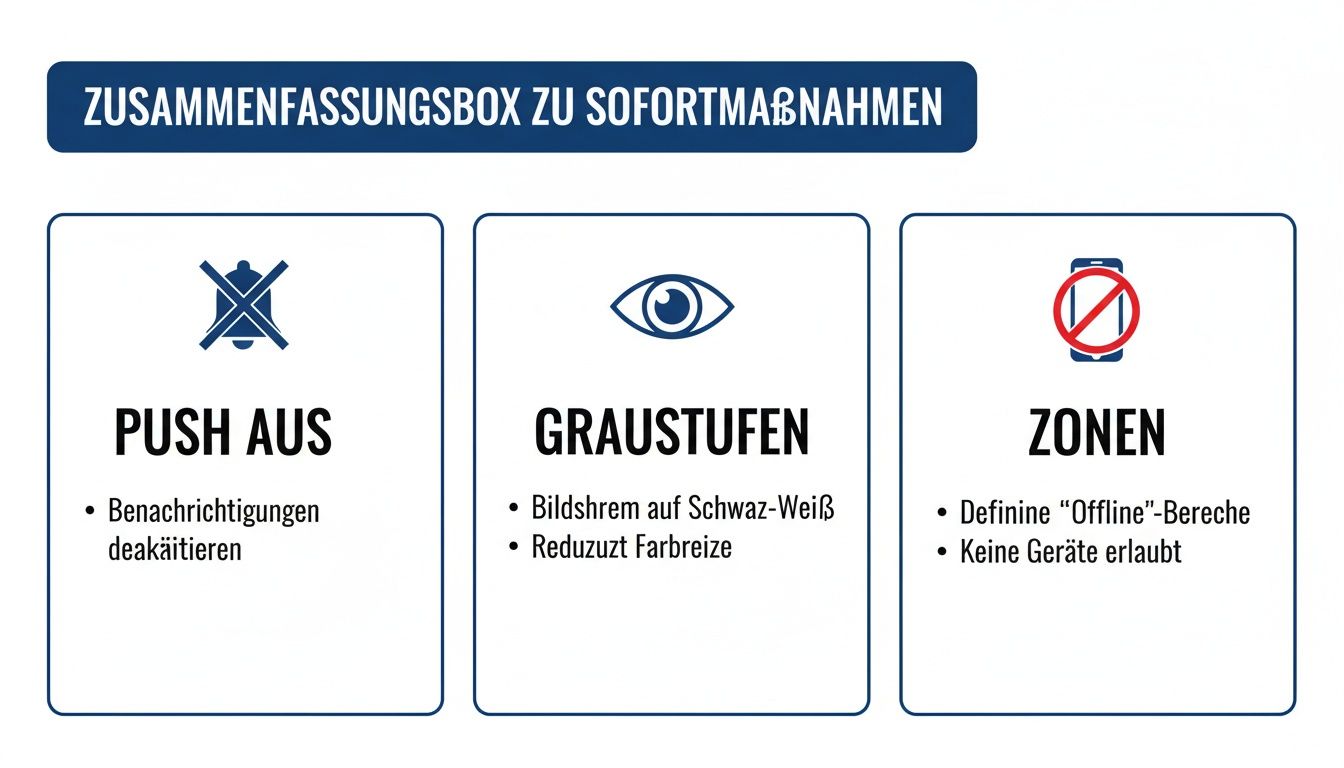
The combination alone of fewer notifications, an unappealing display, and clear phone-free zones immediately creates noticeable space in your mind and in your daily life.
Analog beats digital: small helpers for everyday life
Dependence on the smartphone often arises because it bundles countless everyday functions into a single device. By splitting these functions back up and consciously turning to analog alternatives, we strip the phone of its omnipotence.
Comparison of digital vs. analog everyday helpers This table shows how simple analog tools can replace digital functions in order to reduce screen time in a targeted way.
| Digital function (distraction potential) | Analog alternative (focus-promoting) |
|---|---|
| Smartphone alarm (leads straight to emails & news) | Classic alarm clock |
| Note-taking apps (distraction from other apps) | Notebook and pen |
| Calendar app (pop-ups and notifications) | Wall calendar or pocket calendar |
| Calculator app (you unlock the phone) | Simple calculator |
| Recipe app (full of ads and videos) | Cookbook or printed recipe |
Every time you reach for an analog tool, it is a conscious decision against digital distraction and in favor of more focus in the moment.
Actively breaking the cycle
The principle behind physical barriers like the Zenbox is psychologically simple, but extremely powerful. To unlock the blocked apps again, you have to get up and consciously hold your smartphone to the Zenbox – which you have ideally placed in another room, for example on the refrigerator in the kitchen.
This simple action has an enormous effect. The automatic impulse to “just quickly” open Instagram is interrupted by a conscious physical action. You have to leave your cozy spot on the sofa and become active. In most cases, this brief moment of pausing is enough to question the urge and to choose something else, something better, instead.
With methods like these, you gradually train your “attention muscle” and learn once again to make conscious decisions, rather than letting yourself be steered by the algorithms of the apps. It is about using technology again in a way that serves you – and not the other way around.
Using the right tools – digital and analog
Technology is often a curse and a blessing at the same time. It led us into phone addiction, but it can also help us find our way back out. Instead of demonizing the smartphone entirely, we can use smart tools to set conscious boundaries. The trick lies in the skillful combination of software and very tangible, physical helpers.
Pure app solutions that, for example, only record screen time are a good first step. But they have one decisive weakness: you can bypass them with a few taps. As soon as the inner urge to “just quickly” check becomes too strong, the digital block is quickly disabled again. This is exactly where physical barriers come in – they are often the truly decisive step.
Physical hurdles – how to outsmart your brain
A physical barrier creates a tangible, real distance between you and your smartphone. It forces you to break out of your digital rut and perform a conscious, physical action. This small detour interrupts the autopilot and gives you valuable seconds to question your decision: “Do I really want this right now?”
A brilliant example of this principle is the Zenbox. It is far more than just a sleek timer; it is a physical anchor that grounds your digital boundaries in real life. The way it works is remarkably simple, yet psychologically incredibly effective: in the accompanying app you choose which apps you want to block for a certain period. To start focus mode, you simply tap your phone briefly to the Zenbox. That's it.
The decisive moment is when you unconsciously reach for the phone. To lift the block, you have to get up and hold your phone to the box again. This small physical act breaks the automatic reach for the device and turns an impulse into a conscious decision.
What this really looks like in everyday life
Rather than dry theory, concrete examples best show how such tools make a real difference. Here are a few scenarios of how very different people use the combination of app and physical barrier to regain control:
- The student during exam season: the Zenbox is stuck to the refrigerator in the kitchen. For a two-hour study session, all social media and messenger apps are blocked. Any distraction would mean leaving the desk and walking to the kitchen – a threshold that almost always works.
- The professional working from home: to draw a clear line between work and free time, “after-work mode” is activated promptly at 6:00 p.m. All work apps like Slack, email, and Teams are blocked. The Zenbox sits in the study, which is declared a phone-free zone after work.
- The family at dinner: a “family time mode” is set up for everyone. Each family member “checks in” their phone at the Zenbox in the hallway. This ensures that the shared time at the table truly stays free of digital interruptions and real conversations take place.
Tools like these do not put you under pressure; instead, they give you an adaptable system to work with. Learn more about how, with the Zenbox Version 1, you can make conscious decisions again and turn technology into your ally.
When professional help is the right path

Self-discipline and digital helpers are valuable tools, no question. But there is a point at which they simply are no longer enough. Recognizing when you need outside support is not a sign of weakness – quite the opposite. It shows real strength and the courage to take yourself seriously.
Sometimes the behavioral patterns are simply so deeply ingrained that you can no longer see the forest for the trees. A professional outside perspective can then be exactly the impulse needed to finally break the vicious cycle.
If, despite all your efforts, you keep falling back into old habits, that is a clear signal. Constantly failing in the attempt to get your own phone use under control is incredibly wearing and only reinforces the feeling of having lost control. At the latest then, it is time to place the matter of treating phone addiction in professional hands.
Clear warning signs that go beyond a bad habit
Some signs should really make you sit up and take notice. They indicate that this is no longer just a quirk, but a serious dependency that needs therapeutic support.
Pay close attention to these alarm signals:
- Severe withdrawal symptoms: do you feel not just uncomfortable without your phone, but genuinely low in mood, extremely irritable, or even panicky?
- Social withdrawal: have you lost contact with important friends, or is there tension in the family because screen time always takes priority?
- Concealing and lying: do you make up excuses about your phone use, or use it secretly to avoid discussions?
- Major drop in performance: are your grades, your performance at work, or everyday household responsibilities suffering massively because of your screen time?
When your whole life revolves only around the smartphone and real experiences become an afterthought, the line into addiction has definitely been crossed. Professional help offers you a protected space to understand the causes and to discover new paths for yourself.
Among children and adolescents in particular, the situation has escalated dramatically. A study by the German Federal Centre for Health Education shows that the proportion of problematic users has risen by an alarming 126 percent since the coronavirus pandemic. More than a quarter of 10- to 17-year-olds use social media in a “risky or pathological” way, with 4.7 percent already considered addicted. Read more about the risks of excessive screen use at tessin-zentrum.de.
Where to find concrete support
The first call often takes the greatest effort, but there are many places that can help you discreetly and competently. Dare to take the step!
- Addiction counseling centers: almost every city has such centers, which often offer free initial consultations. There they can professionally assess your situation and suggest suitable therapy options.
- Psychotherapists: look specifically for therapists who specialize in behavioral or media addiction. Cognitive behavioral therapy in particular has proven to be very effective here.
- Specialized clinics: in severe cases, an inpatient stay in a psychosomatic or addiction clinic can also be the right step. An intensive program helps you break out of old patterns completely.
Reaching out for help means taking responsibility for your own well-being back into your own hands. It is the decisive step toward regaining control and once again leading a self-determined, fulfilling life.
Frequently asked questions about treating phone addiction
On the way to a healthier relationship with the smartphone, questions naturally come up. That is completely normal. Whether it is about your own motivation, how to get the people around you on board, or which aids are really worthwhile – here you will find answers to the most common concerns that reach us. Clear and straight to the point.
Can I get a phone addiction under control on my own?
Yes, in many cases that is absolutely doable. Especially when you take the first warning signs seriously and counteract them early. The strategies we have discussed here – from the small digital tricks to new, analog habits – are truly effective at helping you reclaim control.
In the end, your personal level of distress is what decides. As long as your job, friendships, and emotional balance are not yet seriously suffering, the chances of succeeding on your own are very good. But if you notice that you keep failing and feel powerless, then professional help is the right and, above all, a courageous next step.
How do I convince my family of phone-free times?
The key here lies not in bans, but in emphasizing the benefits. Don't talk about what everyone is no longer allowed to do; instead, paint a picture of what you, as a family, gain back: real conversations at dinner, fun game nights without constant beeping, or shared outings where your attention truly belongs to one another.
Make concrete suggestions and use tools that act as a neutral ground rule for everyone.
A shared “family mode,” in which everyone's phones land in a box for a set period, creates fairness and takes the wind out of the sails of any argument. That way no one feels disadvantaged – the rule applies to everyone, young and old alike.
I need my phone for work – what can I do?
This is one of the most common objections and a real challenge. The solution lies in a crystal-clear separation of work and free time. Set fixed working hours after which work apps are consistently muted or blocked.
It is precisely here that physical helpers are worth their weight in gold. Deliberately place your Zenbox far away from your after-work sofa, perhaps even at the other end of your home. The automatic impulse to “just quickly” check your work emails is interrupted by the walk over there. This small moment of pausing gives you the chance to consider whether it really has to happen right now – and most of the time the answer is no.
Is the Zenbox a subscription or a one-time purchase?
The Zenbox is a one-time purchase. There are no hidden costs, no subscription, nothing of the sort. You buy the physical NFC device and with it gain full access to the accompanying app, without anything ever being charged again.
Incidentally, the device is manufactured in Germany using 3D printing and works entirely without a battery or power connection. That makes it a sustainable and maintenance-free solution. And to make the decision easy for you, there is also a 30-day money-back guarantee. If you do not feel the effect you were hoping for, you can simply send the box back, no hassle.
Are you ready to reclaim control over your attention? The Zenbox is a simple yet astonishingly effective tool for setting conscious boundaries and breaking out of the cycle of constant distraction. Discover how technology can become your ally again.