

How to overcome phone addiction and reclaim your focus
Do you ever catch yourself scrolling mindlessly through your feeds, even though you actually meant to do something completely different? If so, you're not alone. Many of us know that feeling of losing control. But to overcome phone addiction, we first need to take a step back and understand what really keeps us so firmly tethered to the screen.
Why our smartphones hold us so tightly
For many people, reaching for the phone has become a reflex – at the bus stop, in the waiting room, even in the middle of a conversation. But why exactly? It's no accident. Behind it lie carefully designed psychological mechanisms that deliberately trigger our brains and keep pulling us back.
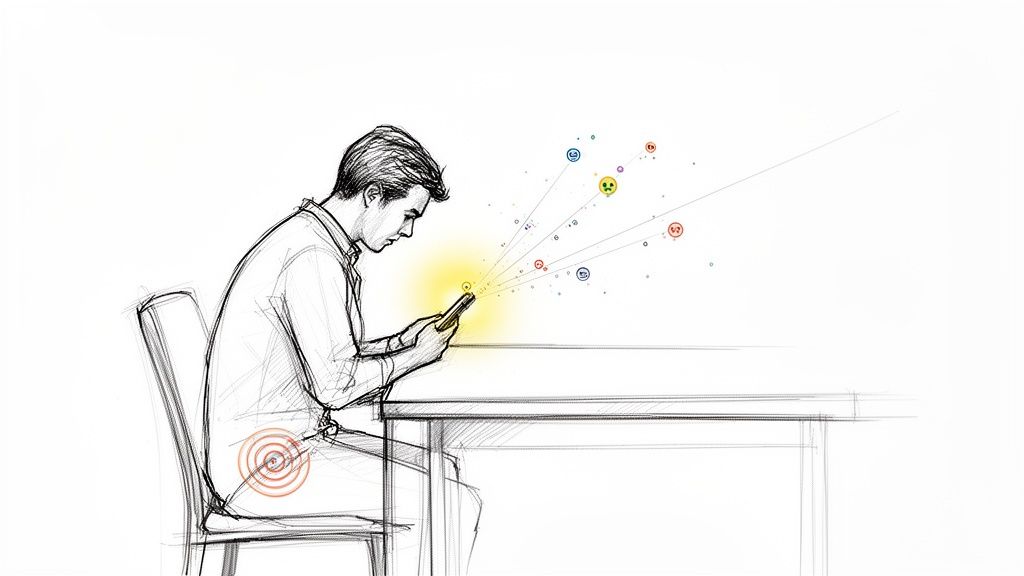
The main culprit is our reward system, driven by the messenger chemical dopamine. Every notification, every like, every new message gives us a tiny dopamine hit. It feels good, and our brain quickly learns the equation: check phone = reward.
This creates a cycle that soon develops into a deeply ingrained habit. The tricky part is the unpredictability of the reward. Sometimes an exciting message is waiting, sometimes just a marketing email. It's precisely this uncertainty – the same kind you find in slot machines – that makes constant checking so irresistible.
The psychological pitfalls in everyday life
Two further forces work in the background, making it even harder for us to simply put the phone down:
- FOMO (Fear of Missing Out): That constant fear of missing something important – a message, a new trend, or a breaking news alert. It's a powerful engine that drives us to refresh our feeds again and again.
- Phantom vibration syndrome: Ever felt your phone vibrate in your pocket when nothing actually happened? That's a clear sign of just how strongly our brain is conditioned to constantly expect a signal from the device.
These mechanisms turn the smartphone into the quick default solution for every hint of boredom. Instead of pausing for a moment and letting our thoughts wander, we immediately reach for the device.
The real goal is to start making conscious choices again. Instead of automatically reaching for your phone, ask yourself: „What do I really want to do in this moment?“
The scale of the problem in numbers
We shouldn't underestimate the situation, especially when we look at the younger generations. Recent studies on smartphone use paint a clear picture: the average screen time of teenagers in Germany stands at a remarkable 231 minutes per day. What really makes me take notice: 68 percent admit to being on their phone more often than they intended, and almost half even let themselves be distracted during important things like homework. You can find more on these figures in the summary of the JIM study on handyhase.de.
Becoming aware of these unconscious patterns is the first and most important step. Only when you understand why this urge is so strong can you truly develop effective counter-strategies and reclaim control.
Be honest with yourself: An honest review of your digital habits
The will to overcome phone addiction is everything. But without knowing exactly where you currently stand, any plan is just a shot in the dark. That's why the path to more digital freedom always begins with an unsparing, honest review of your habits.
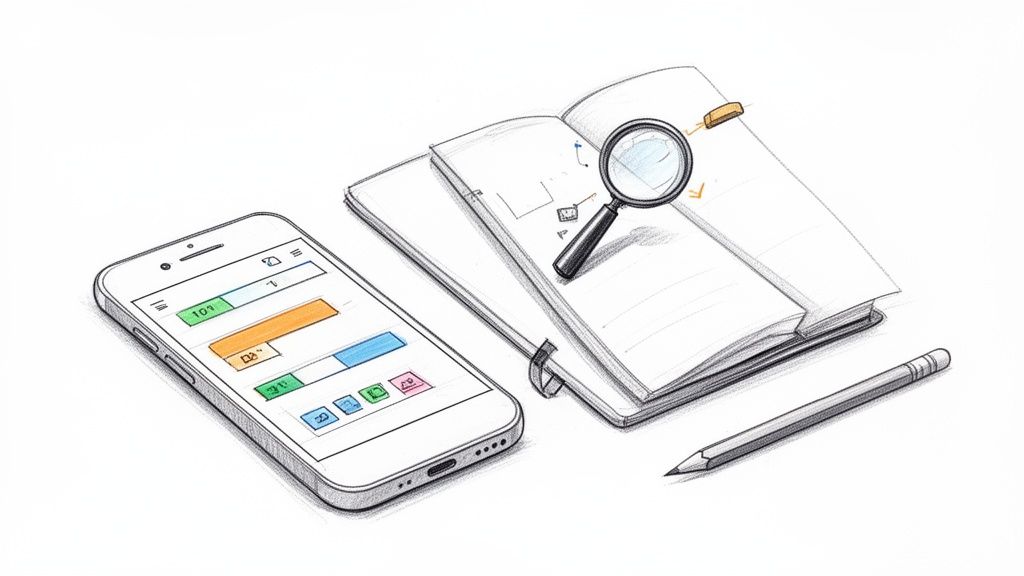
Fortunately, you don't need to keep a cumbersome diary for this. The most important tools are already in your pocket. Both Android with „Digital Wellbeing“ and iOS with „Screen Time“ give you the hard facts about your usage – without any sugar-coating.
Take a moment and have a close look at these features. Yes, the numbers can be a bit of a shock at first. But see them for what they are: your very own starting point for real change.
Find your personal time-wasters
Which apps sit right at the top of the list? Usually it's the usual suspects like Instagram, TikTok, YouTube or Facebook. Note down your personal top 3 time-wasters.
But the sheer amount of usage time is only half the story. It gets far more interesting when you recognise the patterns behind it:
- How often do you reach for your phone? The sheer frequency of unlocking it – often more than 100 times a day – reveals a lot about the impulse to „just quickly“ check something.
- When are your weak moments? Do you scroll right after waking up, during your lunch break, or late into the night in bed? These are exactly the time windows that matter.
- What are your triggers? Do you reach for your phone out of boredom while waiting for the bus? Or is it your favourite means of procrastination when a tricky task is sitting in front of you?
This analysis reveals your very own personal triggers. You'll be surprised how often reaching for the smartphone happens completely unconsciously. If you want to dig deeper into why these patterns are so persistent, have a read of our article on the typical signs of smartphone addiction.
What matters is this: these numbers are not an accusation, just data. They are your tool to reclaim control, not to beat yourself up.
Set yourself realistic and measurable goals
Armed with this new knowledge, you can finally set goals that actually work. Forget the radical „digital detox“ from one day to the next. That usually only leads to frustration and the dreaded yo-yo effect. Lasting change needs small, manageable steps.
Instead, start with concrete, manageable goals that fit easily into your everyday life. Here are a few examples from practice that have proven their worth:
- Cut the time for your top app by just 20 minutes a day. Sounds like little, but it adds up to over two hours a week!
- Establish a screen-free hour before bed. Ideally, charge your phone completely outside the bedroom.
- Define one phone-free meal a day, for example dinner with your family or partner. No phone at the table, full stop.
- Halve the number of phone checks in the morning. Instead of every ten minutes, only every twenty.
Pick one or two of these goals for the first week. No more than that. The trick is to give yourself quick wins. Every small victory is hugely motivating and makes it much easier to stick with it and gradually tackle further habits.
Use your smartphone as a tool against itself
Sounds paradoxical, doesn't it? But the device that constantly distracts us can actually become our greatest ally in the fight for our attention. Instead of demonising the smartphone, we can use its own technology to outsmart ourselves and build more conscious habits. It's about transforming your phone from a captivating entertainment machine into a pure tool.
The first step is to strip the device of its irresistible pull. Apps are deliberately designed to keep us hooked with bright colours and constant signals. We can remove this very psychological hook with just a few simple steps.
Make your phone deliberately boring
Perhaps the simplest technical change with the greatest effect is to radically reduce the visual stimuli. When your smartphone looks less exciting, you'll reach for it less often all by yourself.
- Switch to greyscale mode: Banish the colours from your display. In your phone's accessibility settings you'll almost always find an option to show everything in black and white. You'll be amazed how unappealing Instagram suddenly looks once the colourful images are gone.
- Disable (almost) all notifications: Every red badge, every beep is a deliberate call for your attention. Go through your app settings and mute everything that isn't absolutely time-critical. Calls from important contacts are fine, but the notification about a new discount in the online shop certainly isn't.
- Design your home screen minimally: Tidy up your home screen. Banish all time-consuming apps from there and place only useful tools like your calendar, notes or banking app. Social media apps belong in a folder on the second or third page – just the fact that you have to actively search for them interrupts the unconscious reach for the phone.
The trick is to create friction. Every extra tap, every small hurdle between you and the distraction gives your brain a valuable moment to question the automatic action.
Physical hurdles as the ultimate focus booster
Sometimes digital tricks alone aren't enough to break truly deep-seated habits. This is where physical tools come into play, drawing a clear, unmistakable boundary between you and the digital distraction. One such tool is the Zenbox.
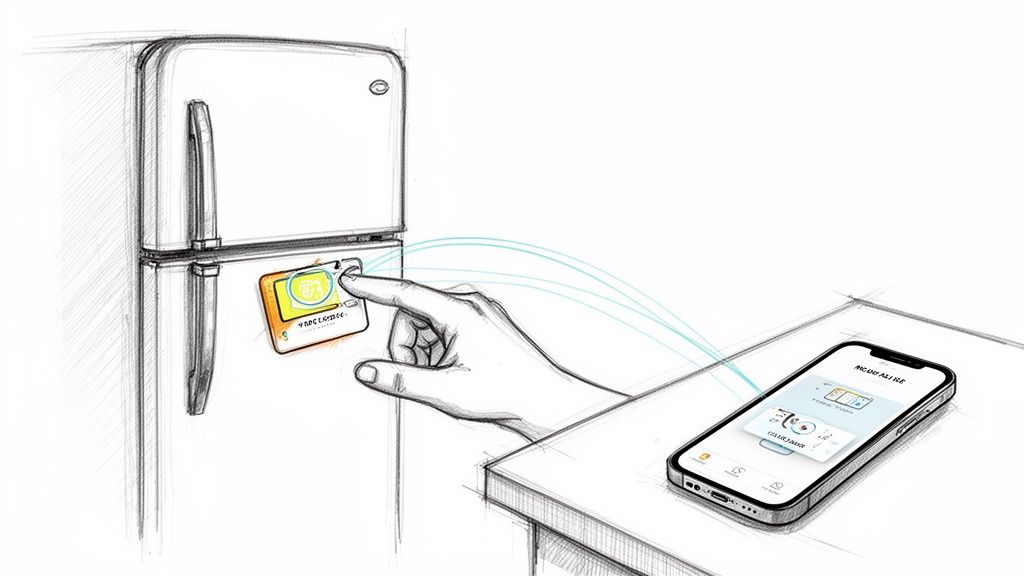
The Zenbox is a small, 3D-printed NFC device that works like an external „off button“ for your smartphone. The idea is simple, yet brilliant: in the app, you decide which apps you want to block for a certain period of time. To start this focus timer, you simply tap your phone against the Zenbox.
The real clever part, though, is the unlocking. To be able to use the apps again early, you have to physically hold your phone to the box again. Imagine attaching the box magnetically to the fridge. When you're in an important work session in your home office and want to „just quickly“ check social media again, it forces you to get up and consciously walk over to the fridge.
This physical action creates a valuable pause. It forces you to stop and ask: „Do I really want this right now?“ The figures show just how dominant smartphones are in our everyday lives, with Samsung (36 %) and Apple (34 %) leading the market. Especially in the home office, this dominance quickly becomes a productivity trap that causes stress and disrupts sleep. A tool like the Zenbox steps in right here, fostering digital mindfulness through a very real, physical barrier.
The combination of these technical and physical strategies makes the goal of overcoming phone addiction far more tangible. It's about reclaiming control and making conscious choices. Your general mental attitude also plays a big role here, above all mindfulness. In our follow-up article you'll learn how to use mindfulness in everyday life as a tool against stress.
Create a strong analogue counterweight
If you really want to do something about your phone addiction, it's not enough to just delete apps or mute notifications. The real problem is the vacuum that appears when you put the smartphone down. Without a plan, you'll immediately fill that emptiness with scrolling at the first sign of boredom.
The trick is to make your life away from the screen so exciting and fulfilling that the phone becomes an afterthought.

The key is to consciously fill the time you gain with analogue activities – things that give you energy rather than drain it. The best place to start is with concrete routines for the most critical moments of the day.
Establish phone-free rituals
The morning right after waking up and the evening before bed are the most dangerous time windows for mindless scrolling. If you can build conscious, analogue rituals into precisely these moments, you set the course for a focused day and a peaceful night.
A phone-free morning routine can truly work wonders. Instead of reaching for the smartphone first thing and flooding yourself with emails, messages and social media feeds, why not try something different:
- Meditate for five minutes: It doesn't have to be anything complicated. Simply focus on your breath. This helps gather your thoughts before the digital noise of the day begins.
- Read a few pages: Keep a real book on your nightstand. Diving into a story is a much gentler start to the day than the harsh, cold light of the display.
- A short stretch: Get your body moving, not just your thumb. It not only wakes you up but also improves your sense of your body for the whole day.
The end of the workday also benefits enormously from digital boundaries. Instead of collapsing straight onto the sofa after work and letting Instagram and TikTok wash over you, create a conscious transition. A short walk around the block helps clear your head. Or devote yourself to a hobby that keeps your hands busy – painting, playing an instrument or pottering about in the garden.
Create phone-free zones
One of the most effective strategies of all: set up places in your home where smartphones simply have no business being. Such physical boundaries automatically create mental breathing space and make switching off much, much easier.
The easiest way to break a bad habit is to change your environment. When the phone is out of sight and out of reach, the temptation drops dramatically.
Start with the most important room for your recovery: the bedroom. Consistently banish your smartphone from there. The most common excuse? „But I need it as an alarm clock!“ The solution is as simple as it is brilliant: buy yourself a classic alarm clock.
This one small step has a huge effect. You not only improve your sleep quality, because you avoid the blue light of the display before falling asleep. You also prevent the aimless scrolling in bed in the morning that so often leads to a rushed and stressful start to the day.
Such analogue countermeasures are a central building block for breaking digital dependency for good. Physical tools that require a conscious decision are a genuine help here. If you're looking for a modern solution that supports you in consistently enforcing phone-free times, the Zenbox as a physical barrier can be an extremely valuable support.
Staying on track for the long haul: Dealing with setbacks is the true key to success
Breaking free from the constant pull of the phone is not a project with a clear end date. It's much more of an ongoing journey, a marathon, not a sprint. There will be brilliant days when you reach your goals effortlessly, and then there are the other days when you suddenly slip back into old patterns. That's human and absolutely no reason to throw in the towel.
The real art lies not in never stumbling, but in getting back up. Every "relapse" is not a failure, but an incredibly valuable lesson. Take a moment and ask yourself honestly: what was the trigger? Stress at work? A feeling of boredom on a Sunday afternoon? The social pressure to reply to a group message immediately? These insights are pure gold, because they prepare you for the next, similar situation.
Standing up to social pressure
One of the trickiest aspects is often the people around us. Friends, family, colleagues – they're all used to us being available almost instantly. If you suddenly change your response times, that can quickly cause irritation. Here, open and confident communication is your most important tool.
Explain to the people you care about what you're doing and why. It's not about ignoring them, but about being more conscious with your own time and attention.
- Communicate boundaries clearly: Say openly when you're offline. A simple "Hey, I put my phone away from 9 pm in the evening, but I'll get back to you first thing in the morning" creates clarity and prevents misunderstandings.
- Offer alternatives: Instead of endless chat tirades, why not suggest a quick phone call again or, even better, a proper meet-up. That's not only more efficient, it also strengthens your relationship far more than hundreds of emojis.
- Be a good example: Often you'll rub off on others with your behaviour. When the people around you notice how much more present and relaxed you are without the constant distraction, it may well get them thinking too.
Setbacks are not defeats. They are data points. They show you exactly where you still need to fine-tune your strategy a little.
Consciously notice and celebrate your successes
So that you don't lose your motivation, it's crucial to actually see and appreciate your progress. And by that I don't just mean the bare numbers of the screen time app. There are so many other, far more meaningful indicators of your success.
Maybe take a few minutes once a week for a short journal. What has concretely improved? Have you finally finished a book again? Slept better? Had a deep conversation without glancing at your phone once? Those are the real wins. Celebrate these small milestones. Every single step, however small, is a victory over the old habit and brings you a big step closer to your goal.
Common questions and hurdles along the way – and how to master them
Anyone who starts questioning their smartphone use will sooner or later run into the same hurdles. That's no reason to give up – quite the opposite. It shows you're on the right track. Here are answers to the most common questions that, in my experience, keep coming up again and again.
„But I need my phone for work!“
A classic, especially since home office and constant availability have become the norm. This isn't about banishing the phone completely, but about getting back in charge. The key lies in a crystal-clear separation.
Define fixed working hours for yourself and use the tools your smartphone offers. With focus modes you can specify exactly which apps and contacts are allowed to reach you during work. Everything else gets muted. After work, the reverse rule applies: all work channels are consistently set to silent. A separate work profile or even a second, simple work phone can work real wonders for being able to switch off mentally after work too.
„How long does it take until I really feel a change?“
The good news first: the first positive effects usually don't keep you waiting long. Many people report a clearer head in the morning after just a few days, or that they find it much easier to wind down in the evening. That's a fantastic motivational boost!
But to truly change a habit trained over years – that reflexive reach for the phone – in a lasting way, it takes a bit more patience. Realistically, reckon on a period of 30 to 60 days. What matters here is: it's not about perfection. Every day you handle your phone more consciously is a win.
„How do I convince my family or my partner to join in?“
Going it alone is often doomed to fail here and quickly leads to frustration. The most important thing is to talk about it openly. Explain to your loved ones why this matters to you. Don't frame it as an accusation („You're always on your phone too!“), but as a wish – for example, for more undisturbed, genuine time together.
Instead of just talking, make concrete suggestions that are fun:
- The shared phone garage: At dinner or on game night, all devices go into a box or a drawer.
- Plan screen-free activities: How about a walk after work or an outing at the weekend where the phones deliberately stay in the bag?
- Agree on fixed offline times: Why not set a time that's sacred for everyone. For example: Sundays from 10 to 12 is absolute family time, without any digital distraction.
You'll be surprised how often your own example proves contagious. When the people around you notice how good this change is for you, they often become curious all on their own and join in.
Are you ready to draw a clear, physical boundary between yourself and the constant distraction? The Zenbox is your minimalist „off switch“ for more focus and less scrolling. Discover at https://www.thezenbox.de how easy it can be to bring digital mindfulness into your everyday life.