

Phone Addiction, What to Do About It: Practical Ways Out of the Digital Trap
If you want to do something about your phone addiction, you first need to understand what actually keeps you glued to the screen. It's about unmasking that inner autopilot that keeps making you reach for your smartphone without thinking. Once you see through these mechanisms, you can take back control – that's the first and most important step before we move on to concrete strategies.
Why You Just Can't Put Your Phone Down
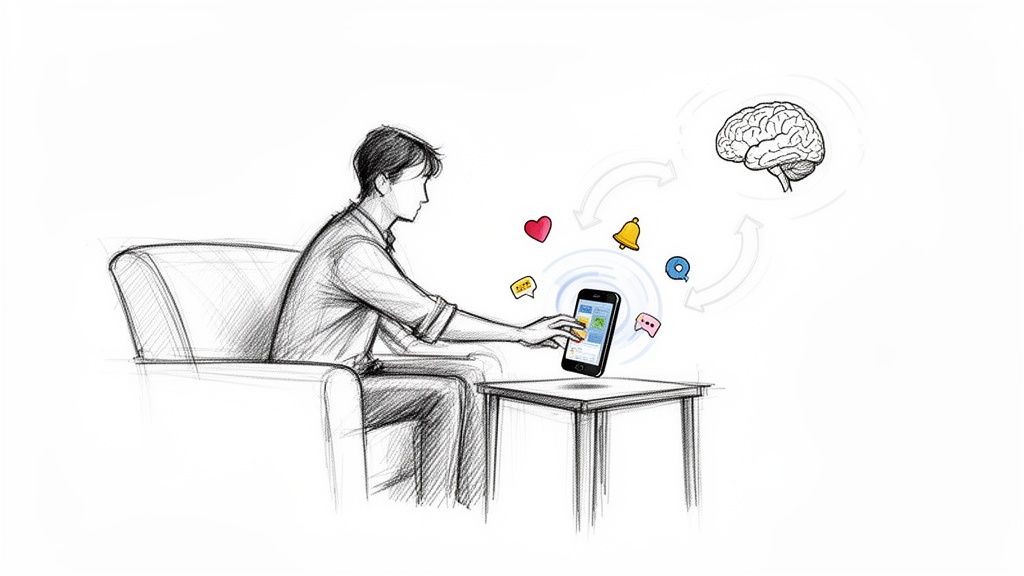
Do you ever catch yourself scrolling aimlessly through your feeds without really knowing why? You're not alone. This isn't a sign of weak willpower – it's a completely normal reaction to cleverly designed mechanisms meant to keep your brain hooked.
The causes of problematic phone use run deep in our psychology. Social media apps are built to tap into the reward system in our brain. Every notification, every like, and every new story triggers a tiny release of the happiness hormone dopamine.
These constant but unpredictable rewards work like a digital slot machine. Your brain learns in a flash: „Pick up the phone, and you'll get a little, instant gratification.“ And so a vicious cycle begins that's hard to break out of.
The Subtle Fear of Missing Out
Another powerful driver is what's known as the „Fear Of Missing Out,“ or FOMO for short. This fear of missing an important piece of information, a social event, or the latest trend puts us into a kind of constant high alert. The phone becomes a window into a world where something exciting is always happening – and naturally, we want to be right in the middle of it.
This fear forces us to refresh our feeds again and again, even when we've long known it isn't good for us. Being offline can quickly feel like social isolation.
Typical Symptoms to Watch Out For
At what point does constant use become a real problem? Take a moment to notice these warning signs, which can point to a developing or already established phone addiction:
- Loss of control: You spend much longer or use your phone far more often than you intended, and you simply can't stick to your limits.
- Withdrawal symptoms: You become restless, anxious, or irritable when your phone isn't nearby or the battery is dead.
- Neglect: Your hobbies, friendships, or even your work suffer because time on the phone keeps taking priority.
- Building tolerance: You need more and more screen time to get the same satisfying feeling you used to.
A very clear sign is when you use your phone to regulate your mood. Do you automatically reach for the device to numb boredom, stress, or sadness, instead of looking at the real causes of your feelings?
Becoming aware of these patterns is the first step toward change. It's not about judging yourself, but simply about understanding what's going on in your head. Many people wonder at this point whether their behavior already counts as an addiction. To get a better sense of it, you can learn more here about whether you're addicted to your smartphone.
Scenarios Everyone Knows
These psychological traps show up in everyday situations. You may well recognize one or two of these:
Procrastination while working from home: A tricky task is waiting. Instead of getting started, you reach for your phone „just for a second“ to check your emails. An hour later you surface from the depths of Instagram, and the task is still untouched.
Endless scrolling in bed: You go to bed with the firm intention of finally getting an early night. But the phone is within reach. „Quickly skimming the news“ turns into an hour-long journey through TikTok videos that sabotages your sleep.
Moments like these show how unconscious habits shape our daily lives. Realizing that you're not alone in this, and that there are biological reasons for the behavior, is the perfect starting point for taking back control and doing something about your phone addiction in a focused way.
Actively Make Your Smartphone Uninteresting
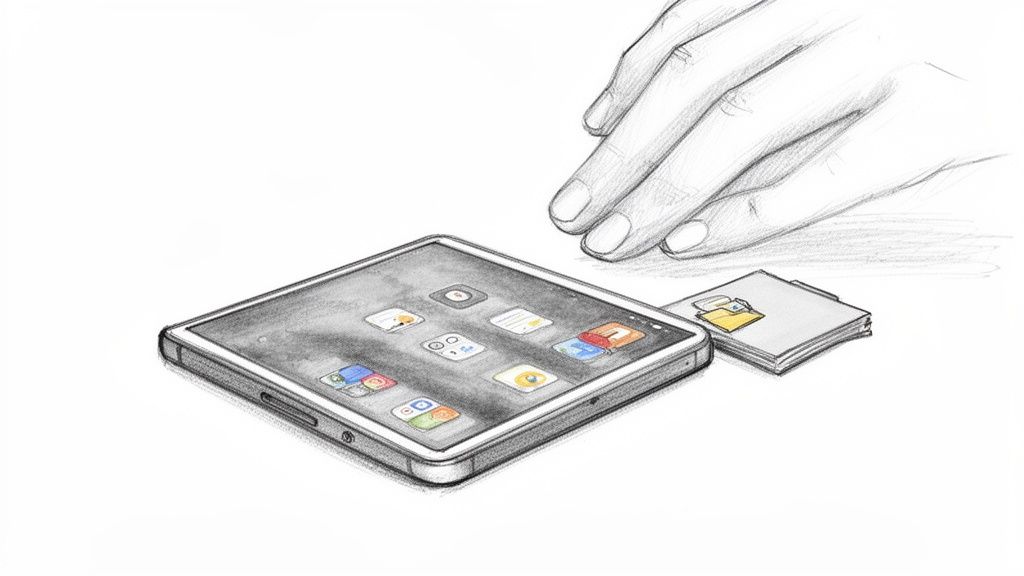
The quickest and perhaps most surprising way to break your phone's almost magical pull is to deliberately make it less appealing. This isn't about banishing it, but about intentionally switching off the constant digital cues that keep luring you to reach for it without thinking.
These first steps are surprisingly simple and don't require any complicated technology. In essence, you're disarming the psychological tricks that app developers use to hijack our attention. Think of it as a kind of digital decluttering that brings you noticeably more peace of mind right away.
Turn the Colors to Gray
What grabs us first on a display? That's right – the bright, colorful app icons. Red practically screams urgency (just think of the number of unread messages), while blue and green signal trust and relaxation. App designers use this color psychology deliberately to tempt us into tapping.
When you drain the color from your screen and switch it to grayscale, something astonishing happens: the visual temptation is suddenly gone. Your brain loses interest because the familiar reward cues are missing.
- iPhone: You'll find the toggle under „Settings“ → „Accessibility“ → „Display & Text Size“ → „Color Filters.“ Simply select „Grayscale“ there.
- Android: The path can vary slightly depending on the manufacturer, but the option is usually under „Settings“ → „Accessibility“ → „Visibility enhancements“ → „Color adjustment.“
This simple trick breaks the automatic habit of opening an app just because its colorful icon catches your eye. You'll notice that scrolling through Instagram or TikTok suddenly feels far less satisfying.
Reclaim Your Attention
Push notifications are the very embodiment of being controlled from the outside. Every flash, every sound, and every vibration pulls you out of whatever you're doing and forces you to react to a often trivial piece of information. These constant interruptions are a major driver of excessive phone use.
This is a real problem, especially among young people. A recent JIM study shows that teenagers in Germany use their smartphone for an average of 231 minutes a day – that's almost four hours. Among 18- to 19-year-olds, the figure even climbs to over 278 minutes. These numbers are alarming and point to a growing dependency that severely disrupts concentration and genuine social contact. You can read more about this in the findings of the JIM Study 2025 on phone use.
Set aside 15 minutes very deliberately and turn off notifications for every app that isn't absolutely time-critical. Be radical: do you really need a push alert for every like on Facebook or for a new discount offer? Probably not.
Allow only the truly essential apps – like your calendar, messages from close contacts, or calls – to send you notifications. That way you decide for yourself once again when to engage with your phone, instead of constantly being summoned by it.
Build Digital Hurdles on Your Home Screen
Your home screen is like the display case at a pastry shop. If the sweetest temptations are right at the front, reaching for them without thinking is practically guaranteed. The key is to create friction – in other words, to build in small obstacles that make you pause for a moment.
So banish all the addictive apps like social media, news feeds, or games from your home screen. This doesn't mean you have to delete them, only that you hide them strategically.
- Create a folder: Set up a folder and give it the most boring name possible, like „Extras“ or „Time Wasters.“
- Move the apps: Put all the problematic apps into this folder.
- Hide the folder: Slide this folder onto the very last page of your home screen.
The next time you reflexively want to reach for Instagram, it's no longer there. You have to actively swipe, find the folder, and open the app. This little detour breaks the automatic habit and gives you that crucial second to ask yourself: „Do I really want to do this right now?“
The following table sums up the first, easy-to-implement steps for making your smartphone less appealing and taking back control.
Quick Measures for Less Digital Distraction
| Measure | Goal | Implementation (Example) |
|---|---|---|
| Enable grayscale | Reduce the visual appeal of the apps. | In Accessibility settings, set the color filter to „Grayscale.“ |
| Disable push notifications | Put an end to outside control and constant interruptions. | Turn off all notifications except for calls, calendar, and direct messages from close contacts. |
| Tidy up the home screen | Prevent the automatic reach for „problem apps.“ | Move social media and news apps into a folder on the last home screen page. |
These quick measures are the absolute foundation if you want to get your phone use under control. They create valuable mental distance and clear the way for lasting changes in your everyday life.
Create Mindful Offline Islands in Your Daily Life
Now that we've made your smartphone less interesting, here comes the next, crucial step: you now need to anchor this new mental distance in your real-world surroundings too. If you truly want to get your phone addiction under control, there's no way around deliberately creating phone-free spaces and times for yourself. Let's call them your personal offline islands.
This isn't about a radical ban, but about making phases without constant digital noise a fixed and valuable part of your life. You set the rules again, not your smartphone.
Establish Phone-Free Zones
The best place to start is where your phone does the most damage. For most people, that's two places: the bedroom and the dining table. „Freeing“ these two zones often has the fastest and most noticeable effect on your well-being.
The bedroom as an oasis of calm Your bedroom should be a retreat, a place of rest – not an extension of your digital life. The blue light of the display disrupts the production of the sleep hormone melatonin, which makes it harder to fall asleep and noticeably worsens the quality of your sleep.
- Banish the phone: Consistently charge it overnight in another room.
- Get yourself an analog alarm clock: A simple alarm clock for a few euros takes the wind out of the classic excuse, „But I need it to wake up!“
- Find new evening rituals: Read a real book, listen to an audio play, or write your thoughts in a journal, instead of scrolling through feeds until the very last second.
This small change can work wonders. You'll not only fall asleep more easily, but also wake up more rested, because your brain can finally truly switch off at night.
The dining table for real conversations Shared meals are one of the few opportunities left in everyday life for undisturbed conversation. If everyone is staring at their phone, this valuable connection is simply lost.
Introduce one crystal-clear rule: phones have no place at the dining table. And that goes for everyone – for you, your partner, and the children too. At first it may feel a little strange, but you'll quickly notice how the quality of your conversations and your mindfulness while eating improve.
Define Fixed Phone-Free Times
Just as important as phone-free zones are fixed times when the smartphone is off-limits. This breaks the unconscious automatic habits. Particularly effective here are the first hour after waking up and the last hour before going to sleep.
Your analog start to the day If you reach for your phone right after waking up, you hand over control of your mood and focus for the whole day to emails, messages, and social media. Instead, start the day mindfully and on your own terms.
- Simply leave the smartphone untouched for the first hour after waking up.
- Use this gained time for a cup of coffee in peace, a few stretches, a short meditation, or planning your day – the classic way, on paper.
This calm start grounds you and protects your mental energy from the digital onslaught in the morning. Learn more about how you can use mindfulness in everyday life as a tool against stress and hectic to make these moments even more valuable.
Your digital dusk It's just as important to let the day wind down mindfully. Endless scrolling in bed keeps your brain running at full speed and prevents you from settling down.
- Put your phone aside at least one hour before going to sleep.
- Use this time to really unwind: a warm bath, relaxing music, or a conversation with your partner.
Trying to take such breaks, however, is often harder than expected. A representative Bitkom survey shows that only 36 percent of Germans deliberately plan a digital break. While 41 percent have already done a digital fast at some point, the success rate is low: only 6 percent lasted a week, while 15 percent stopped early. These numbers make clear how hard it is to manage phone use through willpower alone, and they underline the need for external aids. Discover further insights on the digital break in Germany to better understand the scale of the challenge.
These offline islands are your shield against the constant digital flood. They give you room to breathe, to think, and to truly experience things – abilities that are absolutely crucial in the fight against phone addiction.
Build Physical Barriers Against Unconscious Scrolling
Let's be honest: willpower alone is a pretty poor plan. We firmly resolve to put the phone away, and five minutes later we're scrolling again without knowing how we even got there. That's because reaching for the smartphone is a deeply ingrained habit run by our autopilot.
Relying on discipline alone is like swimming against the current. It's far smarter to change your environment so that the right behavior becomes easier and the unwanted one becomes harder.
This is exactly where physical barriers come in. Instead of mentally bracing yourself against the urge, you build small but noticeable hurdles into your day. These hurdles create a kind of „friction“ – they pull you out of your autopilot and give you that one decisive moment to pause and decide consciously.
The Principle of Mindful Friction
Imagine you want to snack less. If the chocolate is right there on your desk, you reach for it without thinking. But if it's stored on the top shelf in the basement, you have to get up, go down the stairs, search for it … This small extra effort – this friction – often makes all the difference.
The same principle works perfectly for phone use. It's about making access to the addictive apps so difficult that the automatic reach comes up empty. A mere app blocker on the phone is often too weak, because the hurdle can be overcome with a few taps. A physical barrier, on the other hand, requires a real action in the real world.
The trick is to separate the impulse from the action. If there's a conscious, physical action between the urge to open Instagram and the actual ability to do so, you take back control.
An Analog Off-Switch for Your Digital Distractions
A great example of such a physical barrier is the Zenbox. Think of it like an analog light switch for your distracting apps. It's a small, unobtrusive device that you place in a strategic spot in your home – on the fridge, in the hallway, on the bookshelf.
And here's how it creates the necessary friction – simple yet effective:
- Choose your apps: In the accompanying app, you select once which programs steal the most of your time (Instagram, TikTok, news portals, and so on).
- Start focus time: When you want to concentrate, you simply hold your phone briefly to the Zenbox. One tap is enough, a preset timer starts, and your selected apps are locked.
- Mindfully get up to end it: And now comes the clever part. To unlock the apps again, a single click won't do. You have to consciously get up, go to your Zenbox, and tap your phone to it again.
It's precisely this small, mindful action that breaks the vicious cycle. The quick reach for the phone during work to „just quickly“ check the feeds? It comes up empty. The app is locked, and the very thought of having to get up specially makes you pause: „Is this really so important right now?“
Here you can see how such „offline islands“ can be built into the day in a very practical way to create mindful breaks from the screen.
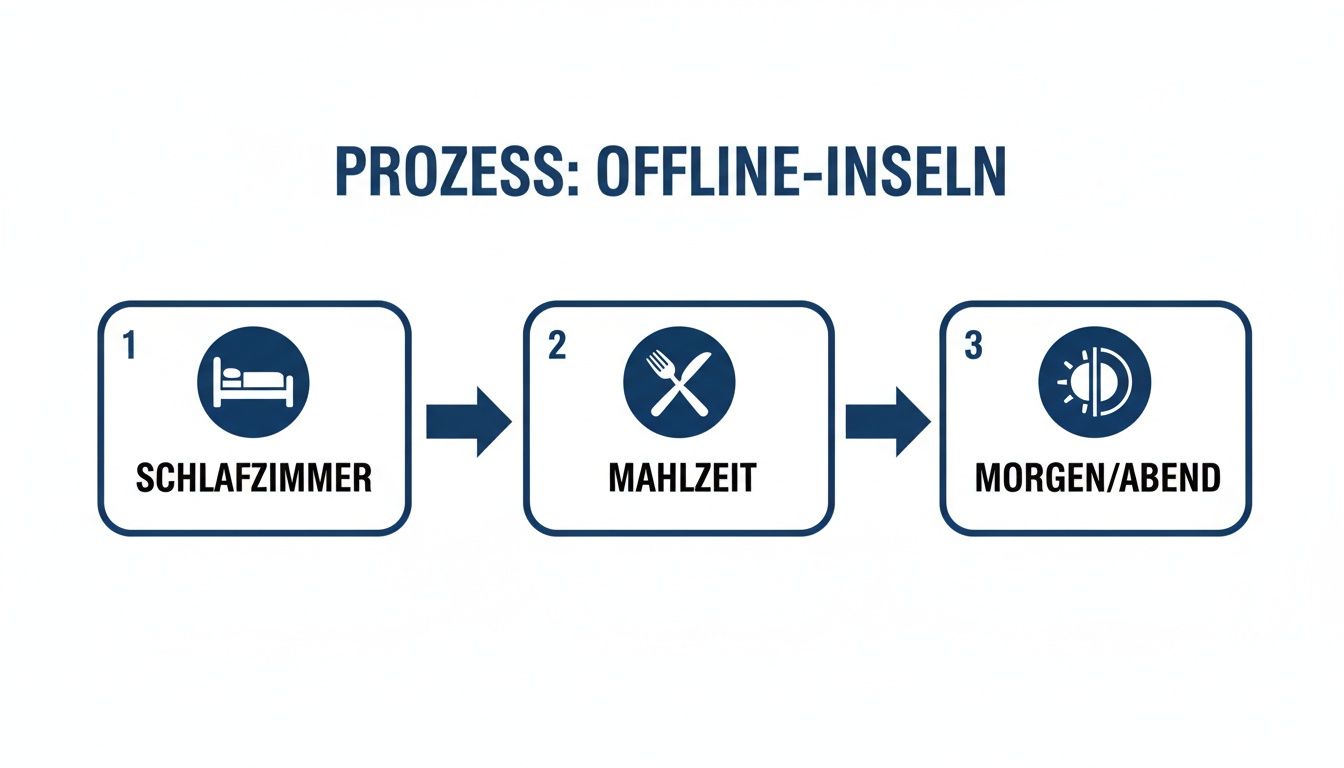
It's about keeping the most important phases of the day – like the time before sleep, mealtimes, or the first and last hours of the day – deliberately free of digital distraction.
How to Use Physical Hurdles in Everyday Life
What does this look like in practice? Here are two typical scenarios where such a barrier makes the decisive difference:
- Focused while working from home: You need to finish an important presentation. You've deliberately placed your Zenbox in the hallway, so it's not within reach. At the start of your work, you lock all social media and news apps for 90 minutes. Every unconscious attempt to distract yourself bounces off the digital lock and the physical distance to the box.
- Real family time in the evening: After dinner it's game night. You agree: from 7 to 8 p.m. all distracting apps are off-limits. One member of the family starts the session at the Zenbox on the fridge. The temptation to check emails or messages on the side is off the table.
The concern about the consequences of excessive phone use is, by the way, deeply rooted in society. A BiB study shows that the majority of Germans even support a minimum smartphone age of 12 years and a minimum age of 14 years for social media. This need for clear rules shows that it's not only teenagers, but we adults too, who are looking for effective methods of self-control.
In the end, it's about making a conscious decision instead of being steered by automated impulses. Tools like the Zenbox as a physical barrier are an enormous help here, because they give you exactly these crucial moments of clarity.
Stay on Track by Making Your Progress Visible
Changing a deeply rooted habit is not a sprint, but a marathon. And to keep from running out of breath along this long stretch, one thing is absolutely crucial: you have to be able to see your successes, no matter how small they may seem at first. Making progress visible is the fuel that keeps you going even on bad days.
The good news is: you don't need to keep complicated spreadsheets for this. Your smartphone itself gives you the tools you need to document your way out of the digital loop. It's simply a matter of using this data consciously for yourself, instead of just acknowledging it with a shrug.
Use Your Smartphone's Data for Yourself
Both iOS and Android now have pretty powerful features on board that let you analyze your screen time down to the detail. These reports are a real goldmine if you're willing to be honest with yourself.
They show you not only the total usage time, but also break down which apps are your biggest time wasters. And – very importantly – how often you pick up your phone each day. These „pickups“ are a fantastic indicator of the unconscious reach for the device.
- On iOS: Take a look under „Settings“ → „Screen Time.“ There you'll find a detailed weekly overview.
- On Android: The feature is usually called „Digital Wellbeing“ and is likewise tucked away in the settings.
But don't just look at these numbers – work with them. At the end of each week, note your average for daily usage and the number of pickups. That's your starting line.
Set Yourself Realistic and Measurable Goals
With this baseline in hand, you can now set clear, achievable goals. The classic mistake is wanting to go from 100 to 0. That almost always ends in frustration. Small, motivating milestones are far smarter.
A good weekly goal could be, for example: „I'll reduce my average screen time by 20%.“ If your baseline was four hours (240 minutes), that would be 48 minutes less per day. It's challenging, but doable. Another goal could be: „I'll lower my phone pickups from 150 to 120 per day.“
Celebrate the small wins too! Did you manage to spend a whole evening without pointless scrolling? Wonderful! Did you consciously leave your phone in another room during dinner? Perfect! These moments are the building blocks of lasting change – acknowledge them.
Dealing with Inevitable Setbacks
There will be days when things just don't go smoothly. You're stressed, tired, or bored, and before you know it, another hour has gone up in smoke on TikTok. That's completely normal and no reason to throw in the towel.
A setback doesn't mean you've failed. Instead, see it as a valuable lesson. Ask yourself: what exactly triggered this relapse? Was it a particular situation, a feeling, or a place? Once you know the trigger, you'll be better prepared next time. Be gentle with yourself and simply start fresh the next day.
Aids like the Zenbox make such progress literally tangible. The accompanying app not only visualizes how often you've started your focus sessions, but also adds up the hours of focused time you've reclaimed as a result. Seeing that you've already earned yourself 20 hours of undisturbed work or family time is an extremely powerful motivator.
Such visual rewards strengthen your sense of self-efficacy – in other words, the firm belief that you really can steer your own behavior. And it's precisely this belief that makes the difference in the end, when it comes to sticking with it for the long term and getting your phone use under control.
Your Most Burning Questions About Phone Addiction – Here Are the Answers
When you start examining your own phone use, very similar questions and doubts quickly come up. Don't worry, that's completely normal. I've gathered the most common points here and give you tried-and-tested answers to help you clear the last hurdles out of the way.
How Do I Know if It's Really an Addiction?
The core issue to watch out for is the loss of control. Do you keep resolving to put the phone away, but simply can't manage it? Do you constantly scroll longer than you actually wanted to? That's the clearest warning signal.
Alongside this, there are other classic signs you should take seriously:
- Withdrawal symptoms: You become restless, anxious, or even irritable when the smartphone isn't within reach or the battery is running low.
- Neglect: Your hobbies, friendships, or even your work suffer because the phone simply eats up too much time and attention.
- Emotional regulation: Your first reflex when you're bored, stressed, or lonely is to reach for the smartphone to distract yourself somehow.
A particularly strong indication is when you start hiding your actual usage time from your partner, your family, or friends.
How Long Does It Really Take to Change Your Phone Use?
That's naturally different for everyone. The good news is: you often feel the first positive effects, like better sleep or improved concentration, after just one to two weeks, if you stick with it consistently. These small, quick wins are worth their weight in gold for motivation.
But to truly overwrite old, deeply rooted habits and establish new, healthy routines, you should be realistic. Plan for at least 30 to 90 days. It's not about being perfect overnight, but about staying patient with yourself and making steady progress.
Aren't App Blockers Alone Enough?
App blockers are a great tool for becoming aware of your own usage. But they have one decisive weakness: you can usually get around them with a few taps. If the urge to scroll is strong enough, this digital hurdle is quickly skipped. Your autopilot soon knows exactly how to switch off the lock.
That's precisely why physical barriers are often far more effective. The conscious act of having to get up and go to a device like the Zenbox breaks the automatic chain of action far more lastingly. The best strategy is therefore usually a combination of digital settings, clear rules for yourself, and a physical helper.
What Do I Do if I Need the Phone for Work?
A classic trap, especially when working from home. The key to success here lies in a crystal-clear separation between work and personal use.
Familiarize yourself with the focus modes on your smartphone. Set up a „Work mode“ that, for example, only lets through notifications from email, Slack, or Teams, while social media is completely muted.
This is where tools like the Zenbox can provide targeted support. You can set it so that only your personal time-wasting apps (Instagram, news portals, YouTube) are locked, while your work applications remain accessible at all times. Also define fixed working hours and communicate them clearly to your team – that creates accountability.
Are you ready to take back control and place a real, physical barrier between yourself and the constant distraction? The Zenbox is a simple yet extremely effective tool for making undisturbed focus time the new normal. Discover at https://www.thezenbox.de how to boost your productivity and reclaim valuable offline time for yourself.