

Phone Addiction: What to Do? Proven Strategies for Your Digital Balance
If you find yourself asking, “What can I do about phone addiction?”, then the first and most important step is to take an honest look at your own behaviour. Forget the self-blame – an objective assessment is the true starting point for any change. It's the only way to take back control.
Honestly Assessing Your Own Smartphone Use
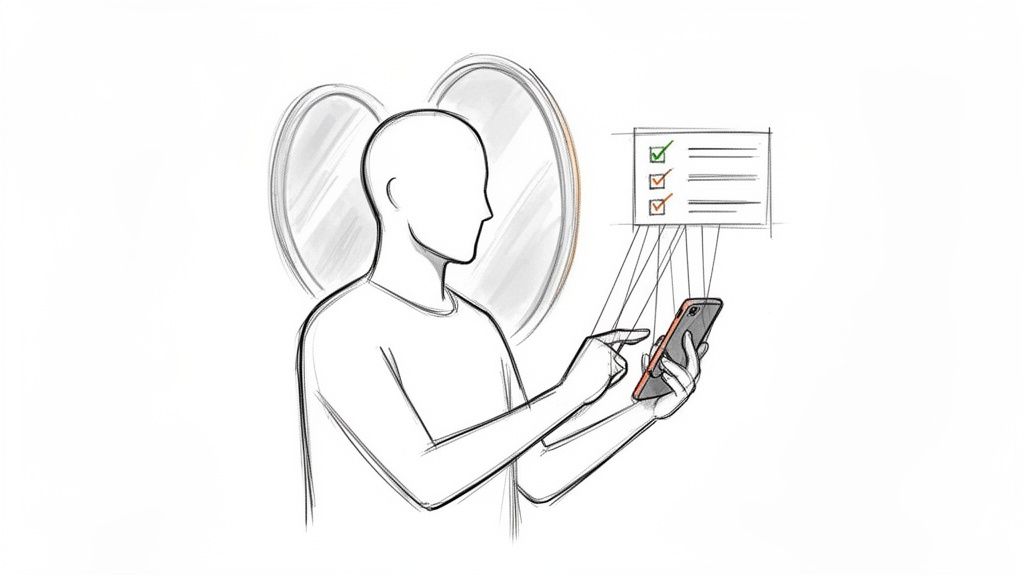
Before we get to concrete measures, we first need to understand exactly what we're dealing with. This first step is often the hardest, because it calls for radical honesty. This isn't about demonising the smartphone. Rather, it's about recognising the moments when it doesn't enrich your life but controls it.
Many of us reach for the device completely unconsciously – while waiting in line, during a short break, or even in the middle of a conversation. That's no accident. Apps are deliberately designed to hijack the reward system in our brains. Every like, every notification and every new video triggers a little dopamine hit that lures us into coming back again and again. This cycle is what makes it so incredibly hard to counteract with willpower alone.
Typical Signs of Problematic Use
Do you recognise yourself here? Be honest with yourself, because that's the first step towards improvement. Consider which of these behaviours apply to you:
- The phantom reach: You reach for your phone even though it hasn't rung or vibrated. A pure reflex.
- Inner restlessness: You become nervous or irritable when the battery is running low or you have no signal.
- The time trap: You only wanted to “quickly check” something and realise an hour later that you're still scrolling aimlessly.
- Neglect: Important tasks, hobbies or real social connections suffer because the phone takes priority.
These patterns are alarmingly widespread. A recent study shows that daily online use in Germany has risen to an average of 231 minutes. Almost 70 percent of those surveyed admit to spending more time on their phone than they originally intended.
To understand your own behaviour better, use the following checklist. It helps you recognise patterns without judging yourself.
| Checklist for Reflecting on Your Phone Use |
|---|
| Answer these questions honestly for yourself to recognise patterns in your usage behaviour. |
| Behaviour or Feeling |
| I reach for my phone when I feel bored, stressed or lonely. |
| I check my phone first thing in the morning and last thing at night. |
| I interrupt conversations or activities to respond to a notification. |
| I find it hard to concentrate on a task for any length of time without checking my phone. |
| I feel incomplete or afraid of missing out (FOMO) when my phone isn't within reach. |
This small exercise is often a real eye-opener. It shows you not only what you do, but also gives you first clues as to why you do it.
The decisive moment of change isn't when you put your phone down, but when you recognise why you pick it up so often. Is it boredom? Stress? The fear of missing out?
This insight is your most powerful tool. It's the foundation for all the further practical steps we'll show you. If you'd like to dive deeper into the signs of problematic use, find out here whether you're addicted to your smartphone. It's about making conscious choices rather than being steered by automated impulses.
The Invisible Costs of Constant Availability
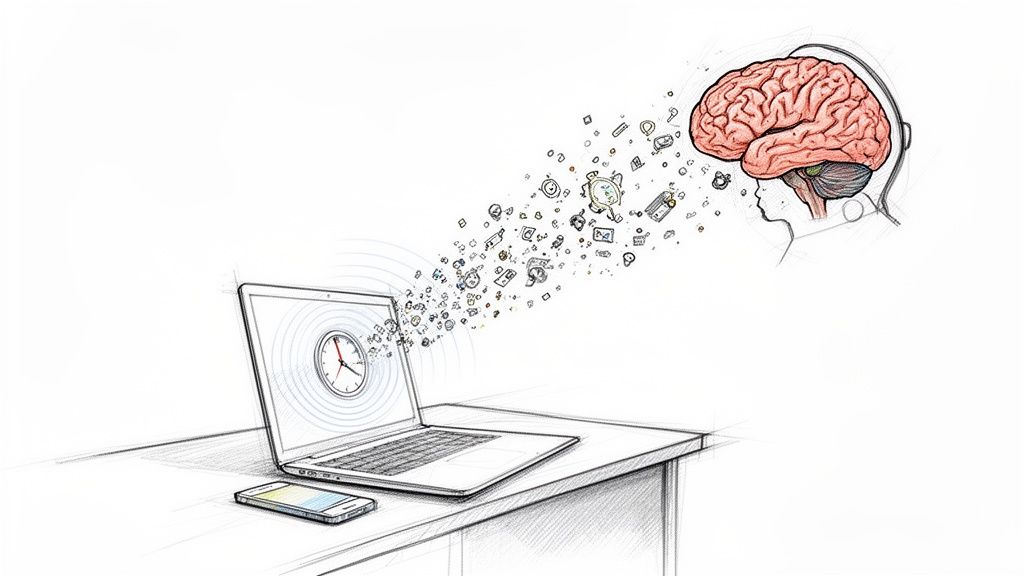
The question “Phone addiction: what to do?” goes much deeper than just the few minutes we lose to scrolling. We pay the real costs elsewhere – in our concentration, our productivity and, ultimately, our mental health. They're invisible and slowly creep into everyday life.
Did you know that your smartphone draws on some of your cognitive resources even when it's merely within sight? Even switched off, with the display facing down.
This effect is well documented scientifically. Your brain has to constantly devote a small portion of its energy to suppressing the impulse to reach for the phone. This constant, subliminal effort eats up precisely the mental capacity you'd need for important, demanding tasks.
The mere presence of your smartphone reduces your available cognitive performance. Think of it as a useless background app permanently blocking part of your working memory.
The High Price of Constant Interruption
Every brief glance at a notification has far more serious consequences than most of us realise. Even if you ignore the message and immediately turn back to your work, part of your attention stays stuck on the interrupted task. In psychology, this is called “attention residue”.
Your brain simply can't return to the original task at 100% right away. A scrap of thought lingers on the missed message or the quick glance at the timeline. This has concrete effects:
- Poorer quality of work: Your thoughts are fragmented. This leads to more superficial work and more mistakes creeping in.
- Longer working time: After each individual interruption, it can take up to 20 minutes to fully re-enter the state of deep concentration, the “flow”.
- More stress: Constantly jumping back and forth between tasks leads to mental exhaustion and a noticeably higher stress level.
Studies by Prof. Dr. Sven Lindberg from the University of Paderborn confirm this strikingly. The mere presence of a smartphone caused test subjects to work more slowly and with less focus. Worldwide analyses with over two million participants also showed that around 27% develop problematic use. You can read more about the scientific background of phone use here.
When Blue Light Steals Your Sleep
But the negative effects don't stop when you close the laptop. Smartphone use in the evening directly affects your sleep quality. The blue light emitted by the displays slows the production of the sleep hormone melatonin.
This falsely signals to your body that it's still daytime, making it considerably harder to fall asleep. At the same time, the endless stream of information, videos and messages keeps your brain running at full speed instead of letting it wind down.
The result? Restless nights, less restorative deep sleep and the feeling of waking up exhausted the next morning. Understanding these invisible costs is the first and most important step in finding the motivation for conscious change.
Transform Your Smartphone from a Troublemaker into a Tool
If you're asking yourself, “What can I do about phone addiction?”, then you're already holding a crucial part of the solution in your hands. It's not about demonising the device, but about consciously reshaping it. We take the power away from the app developers by defusing the psychological triggers and turning the phone from a dopamine dispenser into a genuine tool.
The whole thing works without radical bans. Instead, we make small but targeted adjustments in the settings. Each individual action builds a tiny hurdle that breaks these automatic, unconscious usage patterns.
Drastically Curbing Notifications
The first and perhaps most liberating step: switch off almost all push notifications. Every single one of these alerts is a calculated interruption that pulls you out of whatever you're doing. By stopping this flood, you take back control. You decide once again when to give your phone your attention.
Take a moment and go through your app list. Switch off notifications for everything that isn't absolutely time-critical.
- Social media (Instagram, TikTok, Facebook & co.): Completely off. Guaranteed. Nothing happening there needs your immediate response.
- News apps: Instead of being rushed along by breaking news, set fixed times to catch up.
- Email programs: Work emails may be an exception, but private messages can easily wait.
Keep only notifications for calls, texts from important contacts and perhaps calendar reminders. You'll be amazed at how much calm suddenly settles into your daily life.
Consciously Clearing Your Home Screen
Your home screen is essentially the digital front door to your concentration. If it's plastered with colourful, tempting app icons, the chance that you'll lose yourself in one of them is extremely high. A minimalist approach can work real wonders here.
Banish all distracting apps from the first screen. Tuck them into folders on the second or third screen. This one extra swipe and tap alone makes access more deliberate. On the home screen itself, only useful tools should remain: calendar, notes, weather, maps.
A tidy home screen is like a tidy desk. It signals to your brain: “This is about focused work, not aimless entertainment.”
Reducing Visual Stimuli to a Minimum
An extremely effective trick that many underestimate: greyscale mode. The vividly colourful app icons are psychologically designed to trigger our reward system and prompt us to tap. Take away the colour and they lose much of their magical pull.
The Instagram feed in black and white? YouTube thumbnails without glowing colours? Suddenly everything feels far less captivating. Reaching for the phone becomes more rational and less impulse-driven. Simply look in your smartphone's accessibility settings for “colour filters” or “greyscale” and give it a try.
In addition, you can use the built-in focus modes (on iOS) or the Digital Wellbeing features (on Android). Set up a “work mode” that completely blocks social media during the day, or an “evening mode” that only allows the audiobook app after 9 pm. This way you build a digital environment that supports your goals instead of constantly sabotaging them.
Creating Physical Boundaries for Digital Mindfulness
Changing the settings on your phone is a good start. But let's be honest: willpower alone often simply isn't enough to resist the almost magnetic pull towards the smartphone. Truly lasting change only comes when we build in conscious, physical hurdles. These hurdles create a healthy “friction” that interrupts our autopilot and forces us to make a conscious decision.
This is exactly where a clever tool like the Zenbox comes in. At its core, it's a simple but astonishingly effective method for drawing a clear line between you and digital distractions. So instead of relying on your mental discipline alone, you use a physical object that makes your intention tangible.
The process of turning your smartphone from a source of distraction back into a useful tool can be summed up in three basic steps.
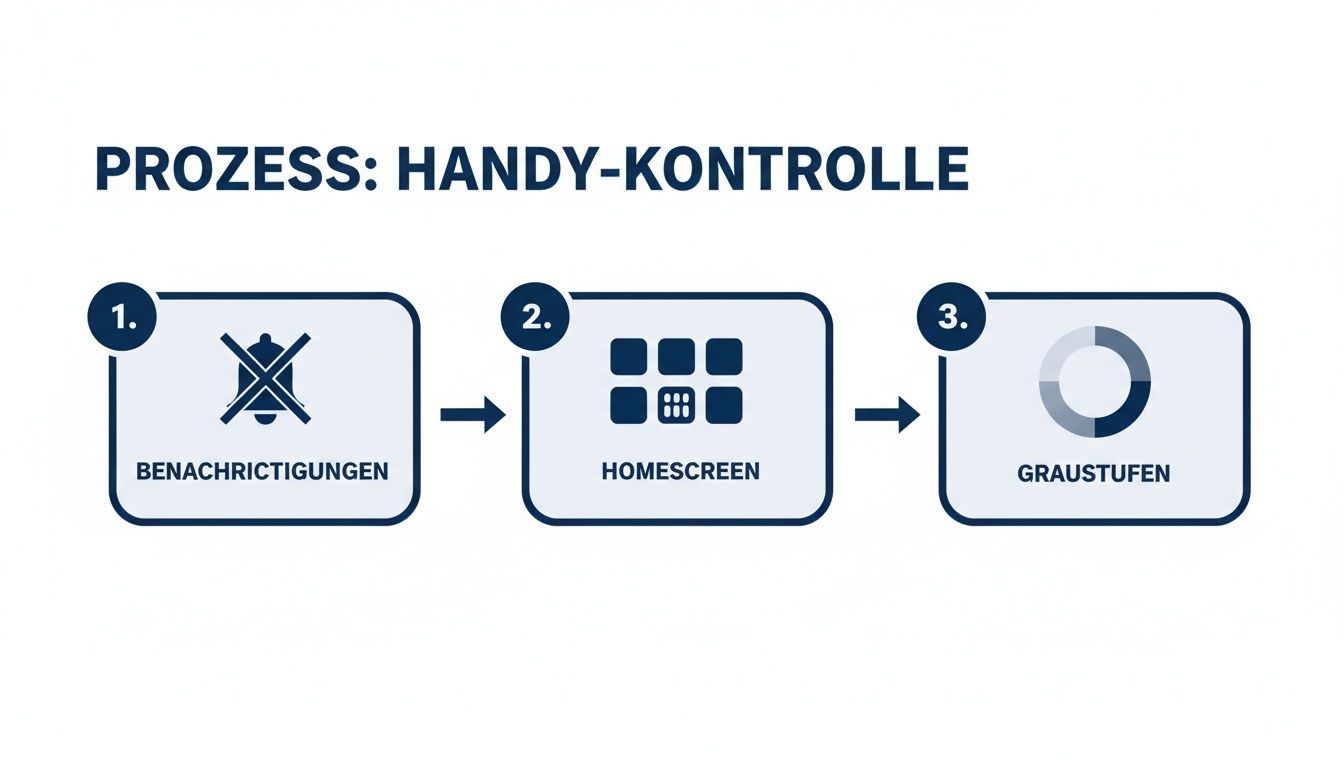
Each of these points – from muted notifications to less colourful stimuli – helps to break the automatic habits trained over years.
The Psychological Trick Behind the “Friction”
The way it works is wonderfully simple: in the accompanying app, you select the apps you want to block. Then you briefly tap your smartphone against the Zenbox – a small NFC-enabled device – and a focus timer starts. From that moment on, the chosen distractions are locked.
But the real magic lies in the unlocking. To release the apps again, you have to physically bring your phone to the Zenbox and tap it once more. This small but conscious action breaks the impulsive cycle.
By requiring a physical action, you transform an unconscious impulse (“I'll just quickly grab my phone”) into a conscious decision (“Do I really want to get up now to unlock this app?”).
This approach is worth its weight in gold, especially when working from home. A personal smartphone often lies just an arm's length away on the desk and is a constant temptation. And the problem is real: according to a DAK study, over 25 percent of 10- to 17-year-olds in Germany show addiction-like behaviour patterns. That's more than 1.3 million children and adolescents.
Real-World Scenarios for More Focus in Everyday Life
Just imagine how such a physical barrier makes the difference in practice:
- The developer in a deep-work phase: He places his Zenbox on a shelf on the other side of the room. Every time the thought arises to “just quickly” check social media, he'd have to get up. In most cases, reason wins and he sticks with his task.
- The family at dinner: The Zenbox is simply attached to the fridge. Everyone briefly holds their phones to the box as they sit down. This effortlessly creates a phone-free zone that encourages real conversation – without anyone constantly glancing at their display.
- The student during a study session: She activates study mode for two hours. The temptation to scroll through TikTok is effectively nipped in the bud by the need to make a special trip to the bookshelf.
A device against phone addiction like this replaces the need for constant willpower with a simple, established habit. It creates a clear separation between focused time and conscious leisure. This way, you regain control over your attention and sustainably foster more digital mindfulness.
Reclaiming Everyday Life: How to Fill the Digital Void with Life
Tech tricks and app blockers are a good start, no question. But the truly lasting path out of phone addiction leads away from the screen – back into the analogue world. Above all, it's about not experiencing the newly gained time as a void, but consciously filling it with things that are more fulfilling than the next dopamine hit from a notification.
The crux is not simply to stop the old, bad habits. You have to actively replace them with new, positive routines. What exactly do you do in the moments when you'd previously have scrolled aimlessly through Instagram or TikTok? The answer to that is crucial for your long-term success.
Small Habits, Big Impact: How to Get Started
Begin with small but effective changes to break the vicious cycle. A genuine classic that's still worth its weight in gold: banish your phone from the bedroom. Seriously. Buy yourself a simple, analogue alarm clock. That way, the first thing you reach for in the morning is no longer the smartphone, and you avoid the danger of drowning in a flood of emails and social media before you've even got up.
The same goes for meals. Make the dining table a phone-free zone. This simple rule creates space again for real conversations and conscious moments – whether with the family, your partner or simply with yourself.
The point of a meal is to taste and enjoy it, not to photograph it for Instagram. Mindful eating is one of the simplest mindfulness exercises there is, and the phone only gets in the way.
Such small, analogue hurdles in everyday life are incredibly important. They create a minimal resistance and turn the automatic reach for the device back into a conscious decision. To lay the groundwork for more calm, our guide to mindfulness in everyday life as a tool against stress offers valuable inspiration.
Fill the Gap: What to Do with Your New Freedom?
So if you're asking yourself, “Phone addiction: what to do?”, then the best answer is: live! The time you no longer spend in front of the screen is a gift. Use it. Dig out old hobbies or finally try something new that challenges your hands and your mind.
Here are a few concrete ideas that work right away:
- Get out into nature: A walk in the woods, a loop through the park – nothing grounds and calms the nervous system quite like it. Consciously leave the phone at home or at least switch it to flight mode.
- Get creative: Grab pen and paper and start drawing. Learn a few chords on the guitar. Cook an elaborate dish. Creative activities can put you into a flow state that's far more satisfying than any passive consumption on the phone.
- Nurture real connections: Call a friend instead of just sending a message. Arrange to meet for a coffee. Real, human interaction can't be replaced by anything.
These analogue alternatives provide a much deeper and more lasting satisfaction. They help you find a healthy balance again and make the smartphone what it should be: a useful tool, but not the centre of your life.
Staying the Course Long-Term and Mastering Setbacks
The path to a healthier relationship with your smartphone isn't a sprint, but more of a marathon. You don't shed deep-seated habits overnight. There will be days when everything runs like clockwork, and then moments when you suddenly find yourself back in the old groove. That's completely normal and part of the process – so no reason to throw in the towel.
What's decisive for long-term success is how you deal with these setbacks. Instead of letting them discourage you, you should see them for what they really are: valuable opportunities to learn.
Understanding Slip-Ups as Signposts
When you notice that you've once again scrolled aimlessly through social media feeds for an hour, pause for a moment. Instead of blaming yourself, become a curious observer: what exactly triggered it just now?
- Emotional triggers: Did you perhaps feel stressed, lonely or simply bored? Often the phone is just a quick plaster for uncomfortable feelings.
- Situational triggers: Were you in a particular situation, for example waiting for the train or alone on the sofa in the evening?
- Environmental triggers: Was the phone perhaps simply lying within reach on the desk when you actually wanted to work with focus?
Anyone who knows their own personal triggers can counteract them far more deliberately in future. If you know that boredom is your biggest enemy, keep a list of offline alternatives ready. If it's stress, find healthier outlets – perhaps a short walk around the block?
Celebrating Progress – Even the Small Wins
Nothing motivates as much as the feeling of making progress. So don't use your phone's screen-time feature as a monitoring instrument that gives you a guilty conscience, but as your personal progress tracker.
See the weekly statistics of your screen time not as a school report, but as a training log. A reduction of just 15 minutes a day is already a huge success that you should acknowledge.
Consciously celebrate the small victories. Every evening the phone was banished from the bedroom is a success. Every meal without a smartphone on the table is a win. Be patient with yourself. If you take the question “Phone addiction: what to do?” seriously, it's not about perfection. It's about steady progress on the path to more digital freedom.
Frequently Asked Questions About Phone Addiction
Here I answer a few of the most common questions I'm asked again and again. They're meant to give you quick orientation when you're wondering: “What can I do about my phone addiction?”
How long does it take to overcome phone addiction?
Unfortunately, there's no blanket answer, because it depends heavily on your personal habits. From my experience, though, I can say: allow at least 3 to 4 weeks for new, healthier routines to really take hold.
The first two weeks in particular are often the hardest. During this time, most people struggle with a kind of withdrawal symptom – restlessness, the constant feeling of missing something important (FOMO), or the almost automatic reach for the phone. But hold on, because it gets noticeably easier afterwards. Patience really is everything here.
Is it enough to simply delete a few apps?
Deleting apps is a great first step and definitely a good beginning. But on its own, it rarely solves the actual problem. The addiction usually has deeper roots that lie in entirely different areas of life – whether stress, boredom or the human need for social recognition.
The decisive shift only happens when you don't just delete the app, but also ask yourself why you used it so excessively. Find that trigger and consciously replace it with a positive alternative in real life.
What do I do if I need my phone for work?
A common dilemma. The key here lies in a crystal-clear separation between work and private life. Fortunately, your smartphone today has tools on board to help you with this. Use focus modes or set up separate user profiles to completely block out private distractions during working hours.
- Work focus: During this time you block everything that has nothing to do with your work – that means social media, private messengers and games.
- After-work mode: As soon as you're finished, you switch over and deactivate all work emails and work apps.
This way, the smartphone becomes once again what it's meant to be: a useful tool that doesn't dominate your life. The most important thing is to consistently stick to these self-imposed boundaries.
To draw these boundaries effortlessly in everyday life, the Zenbox can help you as a kind of physical anchor for your digital time-outs. With just one simple action, you create conscious, distraction-free zones. Discover at thezenbox.de how simple digital balance can be.