

Boost Your Concentration for More Focus in Everyday Life
Anyone who wants to boost their concentration must learn to consciously steer their own attention and shield themselves from distractions both external and internal. This is best achieved through a combination of mental training, an optimised work environment, and a healthy lifestyle. The first and most important step, however, is simply to understand where your focus is being lost in the first place.
Why Concentration Comes So Hard in the Digital Age
Does this sound familiar? The feeling that your brain is being pulled in a thousand different directions at once? You are definitely not alone. The ability to focus deeply and undisturbed on a single task has become almost a superpower in the 21st century. But why is that, really?

The obvious culprits are quickly identified: endless social media feeds, the constant ping of notifications, and the unspoken expectation of always being reachable. But these are merely the symptoms of a much deeper problem. Our brain is naturally programmed to react to new stimuli – a clever survival mechanism from ancient times that warned us of danger. Today, this very mechanism is hijacked by algorithms that reward us with little dopamine hits for every click.
The Myth of Multitasking
Another persistent concentration killer is the belief that we can do several things at once. The truth is: our brain cannot truly multitask at all. Instead, it switches extremely quickly back and forth between different tasks. This constant switching, also known as “task switching”, is incredibly exhausting for our brain and devours enormous amounts of mental energy.
Picture a student sitting over their term paper. Every few minutes a quick glance at the phone, a quick reply to an email, a quick look something up online on the side. Each of these tiny switches pulls them completely out of their thought process. By the time they are fully back into the original task afterwards, several valuable minutes often pass.
The consequence of this constant back and forth is not only that we get less done. Far worse is the deep mental exhaustion that sets in by the end of the day. You feel as though you have been busy all day without having truly accomplished anything substantial.
The Shrinking Attention Span
This new digital reality has measurable consequences. Studies show that our collective attention span is dropping drastically. A study by the Max Planck Institute for Human Development found that the average duration of concentration on a single task at the computer fell from 2.5 minutes in 2004 to an alarming 47 seconds in 2019.
This constant struggle for our attention quickly leads into a vicious circle:
- Quick rewards: Our brain gets used to the short bursts of dopamine from likes and messages.
- Falling frustration tolerance: Deep, focused work suddenly feels boring and tiresome by comparison.
- Actively seeking distraction: We begin to unconsciously look for the next distraction to escape this exhausting feeling.
The following table summarises the most common disruptive factors, shows their concrete consequences for your performance, and gives a first glimpse of solution approaches that are explored in more depth in the article.
| The Biggest Concentration Killers and Their Effects | | :--- | :--- | :--- | | Disruptive factor | Concrete effect in everyday life | Strategic solution approach | | Digital notifications | Constant interruptions of the workflow, a feeling of being externally controlled. | Deliberately disable notifications, schedule fixed times for emails/messages. | | Multitasking | Higher error rate, mental exhaustion, superficial handling of tasks. | Focused work on a single task (single-tasking), time-blocking. | | Inner restlessness/racing thoughts | Difficulty immersing yourself in a task, procrastination. | Mindfulness and breathing exercises, writing thoughts down to clear your head. | | Physical environment | Noise, clutter, or visual stimuli distract you unconsciously. | Tidy up your workspace, reduce noise (e.g. with headphones), eliminate visual sources of distraction. |
This constant struggle for our focus is a clear sign of our times. If you would like to delve even deeper into the mechanisms of digital distraction, you will find valuable tips against smartphone addiction in our article.
The most important message, however, is this: concentration is not an innate gift, but a skill that can be trained – like a muscle.
The Biological Foundation for Undisturbed Focus
Before we dive into the world of focus techniques and time-management methods, we need to talk about the foundation. Because, let’s be honest: the best productivity app does absolutely nothing if the body is running on empty. You cannot build a stable house on shaky ground – and just as little can you squeeze mental strength out of an exhausted body.
The three cornerstones on which your concentration rests are purely biological: sleep, nutrition, and movement.
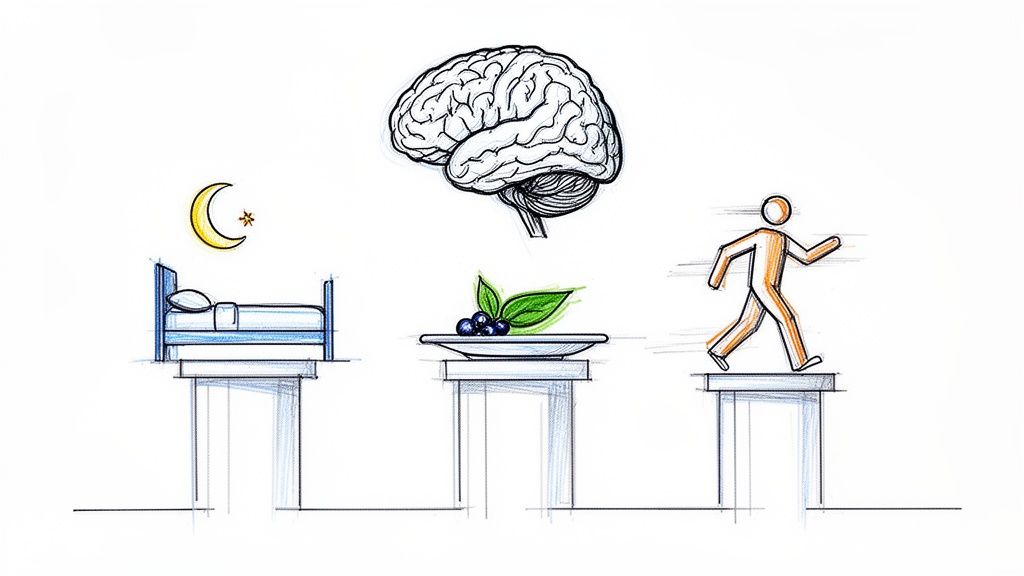
We tend to underestimate these basics when we are searching for the next “miracle weapon” for more focus. Yet even the smallest deficits in one of these areas can undo any technique, however good. So regard these three pillars not as a tiresome obligation, but as your most important tools for building concentration sustainably.
Sleep: The Nightly Maintenance Programme for Your Brain
Sleep is so much more than just a break. At night your brain starts a critical maintenance programme: it sorts the impressions of the day, anchors what has been learned in memory, and literally flushes out toxic waste products that accumulate between the brain cells during the day.
Even a single night of poor or insufficient sleep can throttle the performance of the prefrontal cortex – the boss in your head for concentration, decisions, and impulse control – by up to 15 percent. We all know the result: a feeling like fog in the head, a shorter fuse, and an almost magnetic attraction to every distraction, however small.
Your ability to concentrate during the day is forged the night before. Good sleep is not a luxury, but the absolute foundation for mental focus.
Small adjustments can often work wonders here:
- Cool and dark: A cool bedroom around 18 °C and complete darkness signal to the body that it is time to regenerate.
- Screen detox: The blue light from phones and laptops inhibits the production of the sleep hormone melatonin. Put the devices aside at least an hour before sleeping.
- Rhythm is everything: Try to go to bed and get up at roughly the same time, even at the weekend. A stable rhythm is worth its weight in gold for your internal clock.
Nutrition: The Right Fuel for the Mind
What you eat lands directly in the control centre – your brain. Blood sugar levels in particular are the decisive factor here. A quick energy kick from a chocolate bar or a soft drink inevitably leads to a deep crash. Suddenly you are sitting in the dreaded afternoon slump, and focused work is no longer even thinkable.
Instead, rely on a diet that supplies your brain with energy in a long-lasting and stable way. It is easier than it sounds:
- Slow carbohydrates: Wholegrain bread, oats, or lentils release their energy slowly and thus prevent stark fluctuations in performance.
- Good fats: Omega-3 fatty acids are essential for healthy brain cells. They are found, for example, in oily fish (salmon, mackerel), walnuts, and flaxseed.
- Water, water, water: Dehydration is one of the most common – and most easily remedied – causes of concentration problems. Two to three litres of water or unsweetened tea spread across the day is a good guideline.
Movement: The Reset Button for Mental Blockages
Movement acts like a restart for the brain. You do not need to run a marathon for it. Even a brisk walk of 15 to 20 minutes gets the blood flowing in your head and provides a fresh load of oxygen and nutrients. This not only sharpens focus in the short term, but in the long term even promotes the formation of new nerve cells.
Make movement your trump card in the working day. When you get stuck, stand up. Take a walk around the block, do a few stretches at the open window. You will be surprised how often the solution to a tricky problem appears precisely when you grant your brain a short, active break.
Reshaping the Working Day for Deep Work
One of the biggest concentration killers is a day without clear structure. Many of us let ourselves be carried through the day by popping-up emails and spontaneous requests. The result? You are constantly in reactive mode and, by the end of the day, have the feeling of not having accomplished anything truly important. To boost your concentration, you need to take your calendar back into your own hands and transform it from a mere task list into a genuine focus tool.
It is about consciously creating a structure in which deep, undisturbed work is not just a rare exception, but the rule. Two methods have proven extremely effective in practice: the Pomodoro Technique and time-blocking.
The Pomodoro Technique: The Perfect Entry into Focus
The Pomodoro Technique is brilliantly simple. You work in short, highly focused sprints – classically 25 minutes – and then take a short break of five minutes. After four such rounds, there is a longer break of 15 to 30 minutes.
This rhythm is worth its weight in gold, because it prevents mental fatigue and keeps motivation high. The real trick, however, lies in tailoring the method to suit yourself. Play with the intervals to find out what works best for you:
- For getting started: The classic 25/5 rhythm is ideal for easing in.
- When you are in the flow: Try longer intervals, for example 50 minutes of work followed by 10 minutes of break.
- On low-energy days: Shorter sprints of 15–20 minutes lower the hurdle considerably and help you get into action all the same.
The most important thing here is to truly understand the breaks as breaks. Stand up, stretch, look out of the window. There is just one thing you should not do: reach for your smartphone.
Time-Blocking: From Reactive Chaos to Proactive Focus
While the Pomodoro Technique sets the beat for your work, time-blocking creates the necessary space for it. Behind it lies a simple principle: you block out fixed time windows in your calendar for each task. Instead of a vague to-do list, you thus have a very concrete plan for the day.
Just think of a typical, reactive working day: you start by checking emails, get interrupted by an “urgent” request, then attempt an important task, get distracted again, and jump back and forth between meetings and small stuff.
With time-blocking it looks quite different. You very deliberately reserve time windows for yourself:
- 09:00 - 11:00: Deep-work block for the most important project of the day. During this time the phone is out of reach and all notifications are off.
- 11:00 - 11:30: Answer emails and messages all at once.
- 11:30 - 12:00: Preparation for the meeting in the afternoon.
By assigning your time a clear task in advance, you decide what you will work on before the distractions of the day even get a chance. This takes away an incredible amount of mental pressure and makes concentration the standard, not a daily battle.
A little pro tip: combine time-blocking with theme days to reduce the constant jumping between different types of tasks (context switching). One day for creative work, one for administrative tasks, and another for meetings. This clear structure creates calm in the mind and allows your brain to remain in a particular mode for much longer – a massive boost for efficiency and focus.
Mental Tools to Sharpen Your Concentration
Picture your attention like a muscle. If it is not trained, it slackens – especially in a world that tugs at it without pause. The good news is: you can strengthen this mental muscle in a very targeted way. This does not require complicated methods, but simple yet immensely effective exercises.
This is not hocus-pocus. These techniques are based on solid neurobiological principles and train precisely the brain areas we need for self-regulation and impulse control. In other words, exactly the abilities that help us resist distractions. The best part? You can do them anytime and anywhere, often in just a few minutes right at your desk.
Reaching for external aids is widespread in our society. Almost 70 percent of people in Germany use substances such as caffeine or even medication to concentrate better. A revealing study from spektrum.de shows that almost 30 percent of this group reach for such means 40 times or more a year, which underlines the urgent need for healthy alternatives.
The Focus Exercise for the Desk
One of the simplest and at the same time most effective methods for warming up the “attention muscle” is object focusing. It is a wonderful way to stop the endless carousel of thoughts and arrive back in the moment.
Here is how it works:
- Choose an object: Take any item in your immediate surroundings. It could be your coffee cup, a pen, or the plant on the windowsill.
- Gather your attention: Observe this object for one to two minutes with all your senses. Notice every detail: the colour, the shape, the surface texture, how the light falls on it.
- Observe your thoughts: It is completely normal for your thoughts to wander. That is not a failure! The actual training effect lies in noticing this wandering kindly and without self-criticism, and gently steering your attention back to the object.
Every time you consciously bring your attention back, it is like a repetition in strength training – only for your focus.
The 4-7-8 Breathing Technique for Calming Down
When inner restlessness, stress, or rising hecticness sabotage your concentration, a conscious breathing exercise is an incredibly powerful antidote. The 4-7-8 technique is especially effective because it calms the nervous system in the shortest time and clears the head again.
Sit upright but relaxed for this. First breathe out audibly through the mouth to empty the lungs. Then close your mouth and breathe in calmly through the nose while counting inwardly to four. Hold your breath and count to seven. Then breathe out slowly and in a controlled way through the mouth while counting to eight. Simply repeat this cycle three to four times.
These simple techniques are your first step towards regaining control over your attention. They create little islands of calm in the storm of everyday life and build the mental foundation for genuine, deep concentration.
Such exercises are, by the way, a central part of mindfulness practice. If you would like to dive deeper and learn how to use mindfulness in everyday life as a tool against stress and hecticness, you will find further practical guidance with us. If you apply these mental tools consistently, you will bring noticeably more clarity and focus into your life.
Getting Digital Distractions Under Control with Clever Tools
Mental techniques and a well-structured day are the foundation, but let’s be honest: we are often fighting an opponent that always seems one step ahead – our own digital environment. The constant buzzing of the smartphone, the colourful app icons screaming for our attention – all of it is designed to undermine our willpower.
A decisive lever for truly boosting your ability to concentrate is therefore to shape the environment so that we do not have to constantly fight in the first place.
Pure software solutions or the simple aeroplane mode quickly reach their limits here. They lack one decisive component: the conscious, physical action. This is precisely where tools come in that create a tangible barrier between you and the digital distraction.
More Than Just Blocking Apps
Picture a student in the middle of exam season. Every hour counts. Even so, her hand wanders almost automatically to the phone again and again – just a quick check of what’s going on. A few seconds become minutes, and the painstakingly built-up focus is gone.
An app block can be bypassed with a few clicks. What she really needs is a conscious hurdle. That is exactly the idea behind a physical tool like the Zenbox. Instead of merely blocking something virtually, she has to actively hold her smartphone to the box to start a previously defined focus session. This simple but conscious gesture has a far stronger psychological effect.
The act of holding the phone to the Zenbox is a clear commitment to oneself. It is the signal: “My undisturbed study time begins now.” This conscious decision creates a mental distance from the digital world that pure software blockers cannot achieve.
To end the focus session, she has to repeat the same physical act. If the box then happens to be in another room, this small distance creates a decisive moment of reflection. That is often enough to nip the impulse to interrupt your concentration in the bud.
A Physical Barrier for Sustainable Focus
This principle of the conscious hurdle is of course not only useful for students. It is a universal tool for regaining control. The problem of shrinking concentration starts frighteningly early. A DAK study shows that around 60 percent of fifth and sixth graders in Germany say they are easily distracted. At the same time, over 80 percent already own their own smartphone by the age of ten. Studies show that physical barriers such as the Zenbox can boost effective study time by up to 40 percent – a valuable aid in a world overflowing with stimuli.
The following infographic shows the mental three-step process that such tools support: first take a deep breath to come to rest, then consciously notice the rising distraction, and finally actively steer your attention back to the actual task.
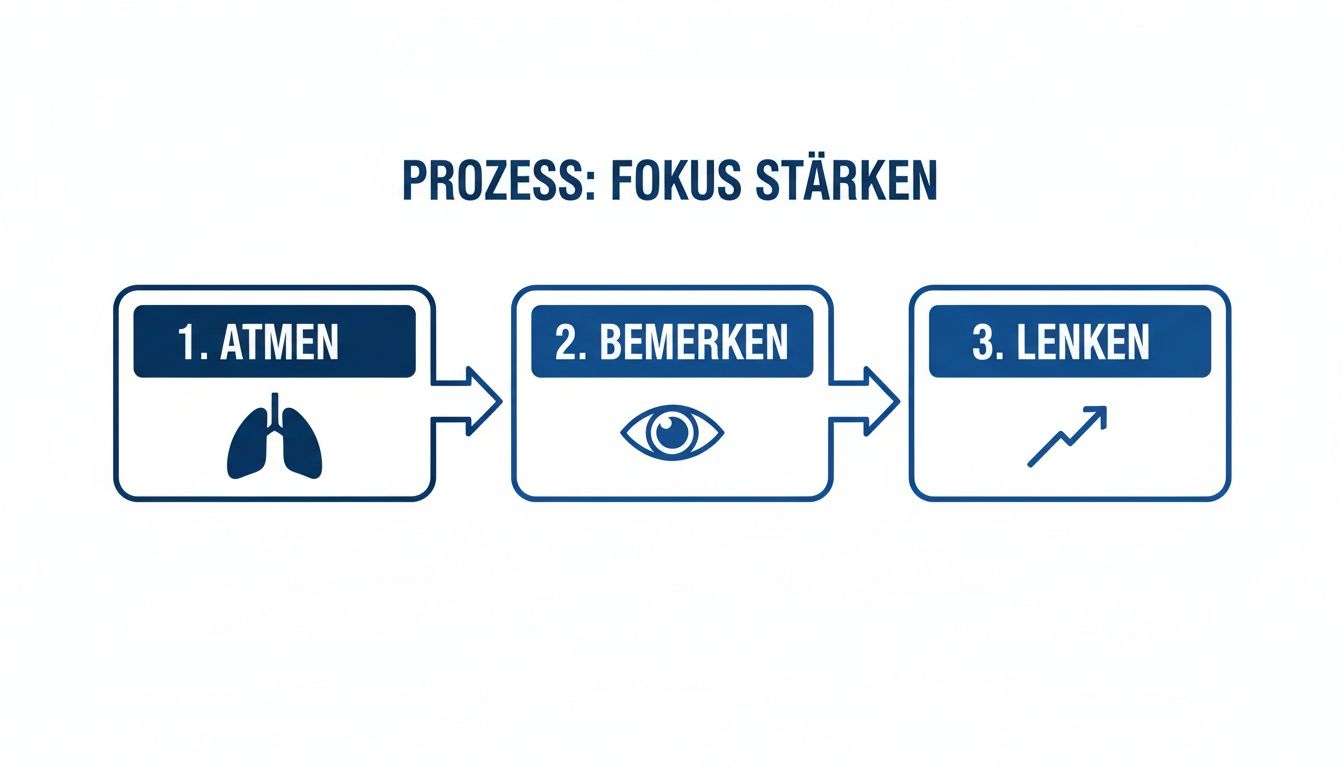
You can see clearly here that focus is not a state that you simply have or do not have. It is an active, repeatable process. Physical tools ease this cycle by giving us support at exactly the decisive moment of “steering”. If you want to dive deeper into how such a device against smartphone addiction works in detail, you will find more on this in our blog.
Frequently Asked Questions About Concentration
Here I have gathered the answers to the most burning questions about concentration that come up again and again. Regard them as little shortcuts to avoid typical pitfalls and get into action faster.
How quickly will I really notice a difference in my concentration?
After just the first week of consistent practice you will probably feel the first small successes. Perhaps you will notice that you no longer let every email throw you off track. That is a good sign – your brain is beginning to get used to the new rules of the game and you are regaining a piece of control.
For truly stable, far-reaching improvements that hold even when things get hectic again, you should realistically reckon with about four to eight weeks. During this time new habits take root and neural connections solidify.
But remember: sticking with it is everything. Better to work in a truly focused way for 15 minutes every day than to set aside a whole morning once a week and then give up in frustration. Start small – that is the key.
What is the most common mistake people make when they want to improve their focus?
By far the biggest mistake is to rely solely on your own willpower and to want to change everything at once. The classic resolution “From tomorrow I’ll concentrate better!” is unfortunately doomed to fail from the outset. It is too vague, ignores the power of our environment, and usually ends in frustration.
It is far cleverer to reshape the environment so that concentration becomes the easiest option.
Instead of forcing yourself not to look at your phone, create a conscious hurdle instead. Lock it away for an hour, for example, with a tool like the Zenbox. This way you shift the battle from pure willpower to a simple, one-off action.
Choose a single, small habit that you believe has the greatest leverage. That could be locking the phone away or a fixed focus block in the morning. One thing at a time.
Do these techniques also work if my working day is completely irregular?
Yes, absolutely! A chaotic everyday life does not mean you have to do without structure – you just have to think about it differently, more flexibly. If a rigid daily plan does not work for you, then work with “focus islands” instead.
Simply set the one or two most important tasks each morning that need your undivided attention that day. And then deliberately create small, distraction-free time windows just for these tasks.
This is exactly where flexible aids are worth their weight in gold:
- You use them precisely when the focus phase begins.
- Whether in the morning at the office or late in the evening working from home – the timing is flexible.
- You can spontaneously adapt the duration of your focus session to your schedule.
This way you stay in control of what truly matters, even in the greatest chaos.
Is there a simple trick for instantly more concentration?
There is, and it is astonishingly simple: the “5-minute rule”. When you keep putting off a task and just cannot get going, resolve to work on it for only five minutes.
Usually the greatest resistance is the moment before you start. The sheer size of a task can paralyse us. Five minutes, by contrast, feel manageable, almost trivial.
The psychological effect, however, is enormous. As soon as the first five minutes are up, the greatest hurdle has been overcome. The task suddenly no longer seems so threatening, and it becomes much easier to simply stick with it. If you combine this with deliberately placing your smartphone out of reach, the effect is unbeatable.
Do you finally want to regain control over your digital environment and integrate genuine focus islands into your everyday life? The Zenbox is the physical tool that helps you consciously switch off distractions and boost your concentration sustainably. Discover now how a single touch can make the difference: https://www.thezenbox.de