

Stop Smartphone Addiction and Rediscover Your Digital Balance
When people talk about smartphone addiction, they don't mean a lack of willpower. More often, it's a deeply rooted, unconscious habit – one that is deliberately encouraged by the design of our digital devices. Behind it lies the compulsive urge to reach for the phone, even when there's no logical reason to do so. Often it's simply the fear of missing out on something important.
What smartphone addiction really means
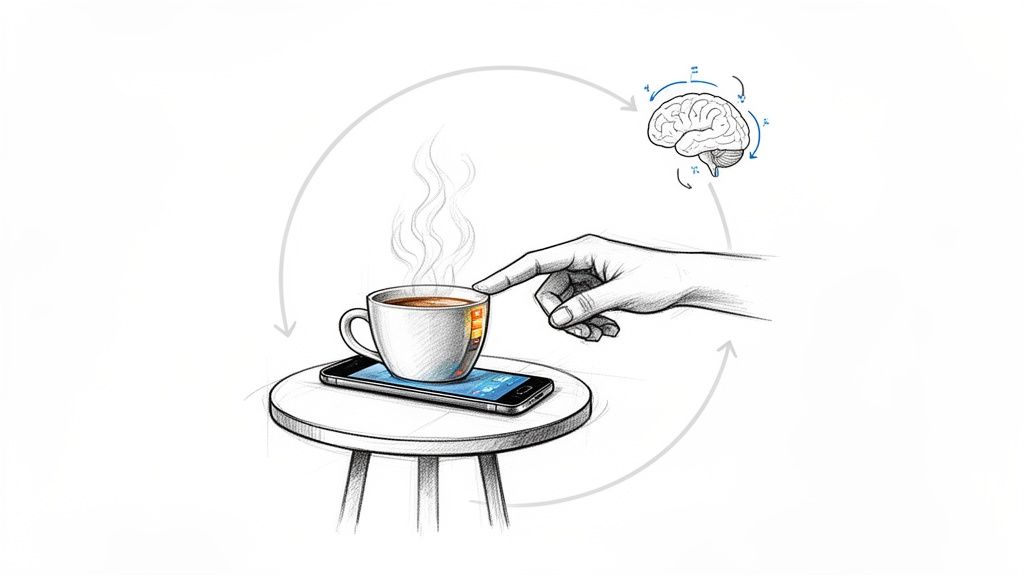
Picture your smartphone for a moment like a cup of coffee. Enjoying your morning coffee is a lovely ritual. But needing a dose of caffeine every 30 minutes just to get through the day? That's a clear sign of dependence. It's much the same with the smartphone: the line between intensive use and genuine addiction is fine and often invisible.
Recognising exactly where that line lies is the first and most important step. It's not about demonising technology, but about creating real awareness of your own habits. Many of us reach for our phones completely automatically, without giving it a second's thought.
The power of habit and dopamine
Behind this automatic reach for the phone lies an incredibly powerful mechanism in our brain: the dopamine loop. Dopamine is the neurotransmitter that controls our reward system. Put simply: it motivates us to repeat things that feel good.
Every notification, every like, and every new message on your smartphone triggers a tiny release of dopamine. App developers know this principle all too well and use it deliberately to make their applications as captivating as possible. The endless scrolling through a social media feed is no accident. It works like a digital slot machine that keeps us hooked with unpredictable rewards.
Smartphone addiction, then, is not a character flaw. It is far more a biochemical response to an environment designed to hijack our attention and turn it into money.
A societal phenomenon
The fact that we lose ourselves so easily in the digital world is by no means an isolated case. The spread of smartphones has reached a scale that has fundamentally changed our daily lives. In Germany, around 69 million people aged 16 and over already use a smartphone – which corresponds to a penetration rate of 82 per cent. You can find more details on smartphone use in Germany at Statista. These figures make one thing clear: the device has become a fixed part of our lives.
Where do you stand personally?
Honest self-reflection can work wonders for getting a better sense of your own situation. It's not about assigning blame, but about taking a neutral inventory. The following questions can serve as a mirror for your digital habits:
- Reaching for it in every free minute: Do you use every little break – in the lift, at the supermarket checkout, at a red light – to glance at your phone?
- The fear of an empty battery: Do you become anxious, stressed, or even feel a slight panic when your smartphone's battery is running low?
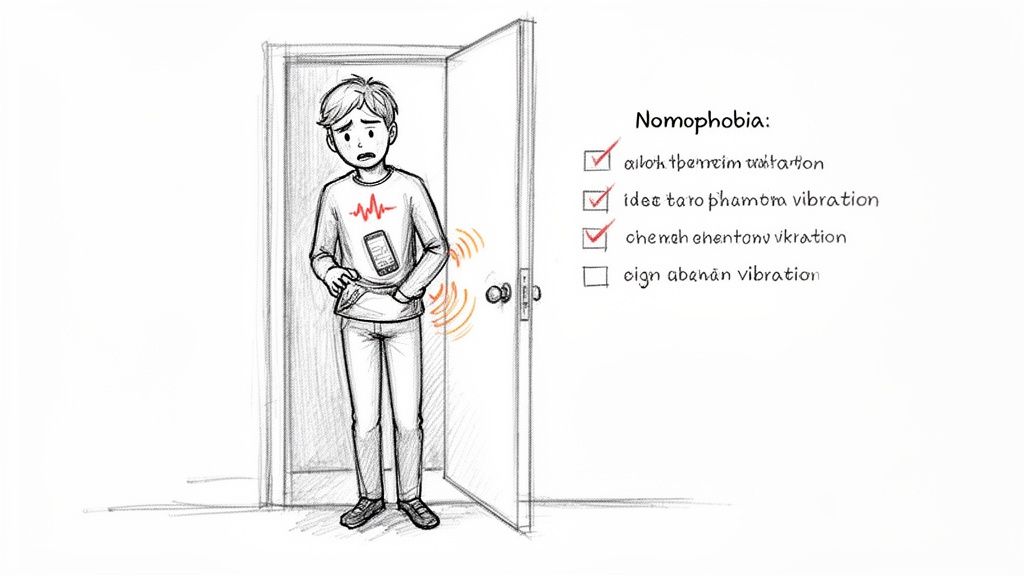
- Phantom vibrations: Do you sometimes feel a vibration in your pocket, only to discover that no message has arrived at all?
These questions are of course not diagnostic tools. But honest answers to them can be an early sign that your smartphone use is taking on problematic features. And that's exactly what this article is about: helping you regain control and build a healthier relationship with technology.
The most important warning signs of phone addiction
A smartphone addiction rarely appears overnight. It tends to creep quietly into everyday life, disguised as many small habits that solidify over time. This is less about sheer screen time and far more about the subtle changes in behaviour that mark the fine line between intensive use and a genuine loss of control.
Recognising these alarm signals is the crucial first step towards regaining control – before a bad habit turns into a serious problem. If you notice some of the following signs in yourself, that's no reason to panic. See it as an invitation to reflect honestly on your behaviour and consciously steer in a new direction.
Physical and psychological signs
The traces of problematic phone use show up both physically and mentally. The spectrum ranges from barely noticeable sensations to strong emotional reactions that weigh on everyday life.
A classic example is what are known as phantom vibrations. Do you know the feeling? You reach for the phone because you could have sworn it vibrated – yet there's nothing on the display. Your brain is already so strongly trained on the next digital reward that it begins to invent signals where there are none.
Another phenomenon that is becoming increasingly common is nomophobia (short for „No-Mobile-Phone-Phobia“). Behind it lies the fear, or even panic, that comes over people when they leave the house without a smartphone, when the battery is running low, or when they simply have no reception. It's the nagging feeling of being cut off from the world and somehow helpless.
The constant state of anticipation keeps the body in permanent tension. It remains, as it were, in a state of high alert, which over the long term can lead to chronic stress, sleep disturbances, and considerable difficulty concentrating.
Behavioural changes in everyday life
Alongside the physical signals, there are very clear behavioural patterns that point to an emerging smartphone addiction. The tricky part is that they often creep in so unnoticed that we ourselves barely register them anymore – though those around us notice all the more clearly.
One of the most telling signs is the loss of control over how long you use it. You firmly intend to just quickly check your emails, and find yourself still scrolling on Instagram an hour later. This dwindling influence over your own actions is a core feature of addictive behaviour.
This often goes hand in hand with the growing neglect of other, genuinely important areas of life.
- Social connections suffer: Conversations with friends or family are constantly interrupted by a quick glance at the phone. This behaviour, known as „phubbing“, signals disinterest to the person opposite you and can lastingly damage relationships.
- Hobbies and interests wither: Things you used to enjoy fade into the background because that time is spent on the screen instead.
- Responsibilities get postponed: Important tasks at work, in your studies, or around the home are left undone because the digital distraction is simply more tempting.
Checklist for self-assessing your smartphone use
The following checklist is meant to help you reflect on your own behaviour. Be completely honest with yourself.
This table helps you reflect on your own behaviour using typical signs of problematic use. Tick off which points apply to you.
| Symptom or warning sign | Description of the behaviour | Applies to me (Yes/No) |
|---|---|---|
| Tolerance build-up | You need more and more time on the phone to feel the same sense of satisfaction or distraction as before. | ☐ Yes / ☐ No |
| Withdrawal symptoms | When the phone isn't within reach, you quickly feel restless, irritable, anxious, or simply bored. | ☐ Yes / ☐ No |
| Use in risky situations | You use your smartphone while driving, cycling, or crossing a road on foot. | ☐ Yes / ☐ No |
| Concealing the extent | You play down how much you actually use it in front of others, or use the phone in secret. | ☐ Yes / ☐ No |
| Escaping from problems | You reach for the smartphone to escape negative feelings such as stress, sadness, or loneliness. | ☐ Yes / ☐ No |
This list is of course only for orientation. But if you found yourself inwardly nodding at several points, that's a strong indication that your relationship with the smartphone has taken an unhealthy turn. The good news, though, is this: recognising it is already the first and most important step towards change.
The invisible costs to your health and your social life
Excessive smartphone use is far more than just a bad habit. It leaves tangible marks on our wellbeing and, like a constant, quiet background noise, gnaws away at our mental and physical energy. The consequences often creep in unnoticed, yet their impact on our quality of life can be severe.
Imagine your body has an internal clock governed by light. During the day, sunlight keeps you awake; in the evening, darkness signals to your body to produce the sleep hormone melatonin. The intense blue light of your smartphone display, however, plays a nasty trick here: it fools your brain into thinking it's still broad daylight.
This effect massively disrupts melatonin production and prevents you from settling down. The result? Trouble falling asleep, restless nights, and a feeling of chronic exhaustion the next day, even after seemingly enough sleep.
Mental strain from constant availability
Smartphone addiction affects not only our sleep but also our mind. The compulsion to be constantly reachable and online creates a permanent state of tension. Every notification that flashes up is a potential interruption that fragments our focus and pulls us out of concentration.
This constant digital stress is an ideal breeding ground for psychological strain. Studies show clear links between excessive phone use and an increased risk of:
- Anxiety: The constant worry about missing something important (keyword: FOMO – Fear of Missing Out) can lead to inner restlessness and nervousness.
- Depressive moods: Constantly comparing yourself with the idealised lives of others on social media can undermine your self-worth and intensify feelings of inadequacy and loneliness.
- Difficulty concentrating: Our brain grows accustomed to the quick, short stimuli of the smartphone and increasingly forgets how to focus on a single task over longer periods.
The constant switching between the real world and digital distraction is as exhausting for our brain as a marathon without a break. At some point the energy reserves are depleted, which shows up as irritability, mental emptiness, and a lack of productivity.
The figures speak a clear language: the average daily smartphone use in Germany already stands at around 4.4 hours. According to US studies, one can already speak of an addiction when the device is activated more than 60 times a day. This can bring with it a broad spectrum of psychological consequences, from a lack of concentration through withdrawal symptoms to sleep deprivation and depression. You can find more on the consequences of phone addiction in this article from Health Rise.
Social isolation in the age of connectivity
It's quite the paradox: the device that's meant to connect us with the whole world often leads to a deep estrangement from the people right next to us. There's even a name for this phenomenon: „phubbing“ (a combination of the English words „phone“ and „snubbing“, i.e. to slight someone).
Phubbing means ignoring the person in front of you during a conversation in order to look at your phone instead. It's a subtle but extremely hurtful form of disregard. The message behind it is clear: „Whatever is happening on this screen is more important right now than you.“
Think of a dinner with friends. Instead of looking each other in the eye and really listening, the smartphones lie on the table and keep interrupting the flow of conversation. Yet genuine, deep connections only arise through undivided attention and presence. Every time we turn towards the screen, we weaken the bond with the person sitting opposite us.
This loss of authentic social interaction can have serious consequences. It fosters a sense of loneliness and isolation, even when you're surrounded by people. The digital world simply doesn't replace the quality of genuine human closeness – in the worst case, it can even crowd it out. The invisible costs of smartphone addiction are therefore not only personal in nature; they undermine the foundation of our social relationships and, with it, one of the most important pillars of a happy life.
Why we find it so hard to resist digital temptation
Have you ever wondered why it's often so maddeningly hard to simply put the smartphone down? That usually has little to do with weak willpower. The truth is: we're responding to an environment that was deliberately created to hold on to us – and this response is deeply anchored in our biology.
Picture your smartphone like a little slot machine you carry around in your pocket at all times. Every notification, every like, every new message – all of it is a tiny, unpredictable reward. Each time, this mechanism releases a small shot of dopamine in your brain. This feel-good hormone controls our reward system and ensures that we want to repeat a behaviour again and again.
Through this constant stream of small rewards, an incredibly strong habit forms. The brain learns in a flash: „checking the phone feels good for a moment.“ It's precisely this loop that's the reason reaching for the device so often happens completely automatically and unconsciously.
The fear of missing out as a constant driver
Another powerful engine behind our phone use is what's known as the „Fear of Missing Out“, or FOMO for short. It's that nagging worry of missing an important social interaction, an exciting piece of news, or a great experience if you're not permanently online.
Social media platforms are true masters at fuelling this feeling. They flood us with an endless stream of perfectly staged moments from other people's lives, thereby creating the subtle pressure of somehow having to keep up.
The fear of no longer being up to date or of being socially left behind drives us to check our feeds again and again. The smartphone thus becomes a tool with which we try to soothe this social anxiety – and, paradoxically, we only intensify it in the process.
This mechanism is so effective because it taps into our most fundamental human needs: the desire for belonging and recognition. And because social updates are constantly available, it becomes almost impossible to resist this urge.
Design that deliberately hooks you
One thing must be clearly understood: our susceptibility to these digital temptations is no accident. App developers and tech corporations invest vast sums to make their products as captivating as possible. To do so, they deliberately draw on insights from behavioural psychology.
Two of the best-known tricks are:
- Variable reward system: As with a gambling machine, you never know exactly when the next reward will come – the next like, the next message. This uncertainty is far more gripping than a regular, predictable reward and motivates us to simply keep going.
- Infinite scrolling: The endless scrolling through feeds has no natural end. There's no point at which our brain gets the signal to stop. This technique simply switches off conscious pauses and keeps us trapped in the app as long as possible.
These and many other design decisions are aimed solely at capturing our time and attention. But simply realising that our behaviour is often a deliberately triggered response to these sophisticated triggers is the first step towards improvement. Anyone who understands the mechanisms behind their own urge can begin to consciously steer against them and reclaim control piece by piece.
Effective strategies for reclaiming your attention
Recognising that the smartphone has too much control over your everyday life is the first and most important step. Now it's about rolling up your sleeves and taking that control back. Fortunately, there's a whole arsenal of tried-and-tested strategies to help you handle your device more consciously and get a grip on smartphone addiction.
The key to success is usually a mix of different approaches: simple behavioural changes for everyday life, technical adjustments to the device itself, and the use of physical tools that truly anchor new, healthy habits.
Start with simple behavioural changes
The most effective way to break the cycle doesn't begin with complicated software, but with clear rules you set for yourself. At its core, it's about drawing conscious boundaries where there were none before.
Two methods are especially effective and remarkably easy to put into practice:
- Create phone-free zones: Designate places in your home where the smartphone is off-limits. The bedroom should be at the very top of that list. The blue light of displays has been shown to disrupt the production of the sleep hormone melatonin and can thus massively impair sleep quality. Make the bedroom a true place of rest again.
- Define phone-free times: Set fixed windows of time during which the phone is deliberately put aside. This could be the first hour after waking up, to start the day focused, or shared meals, to give your full attention to family or friends.
These small changes act like training for your brain. You learn once again that it's perfectly fine not to be permanently reachable – and that real life often has so much more to offer than the endless digital stream.
Use technology to your advantage
Your smartphone itself offers plenty of levers to reduce its own pull. Instead of letting it control you, you can configure its functions so that they serve you – and not the app developers vying for your attention.
The basic idea is simple: make your smartphone as boring as possible. The fewer stimuli it sends out, the less often you'll feel the unconscious urge to reach for it.
Here are three technical tricks that take effect immediately:
- Disable (almost all) push notifications: Every message that lights up is a deliberate interruption that pulls you out of concentration. Go into your settings and switch off notifications for all apps that aren't absolutely time-critical. Calls and perhaps messages from close contacts can stay on, but social media, news apps, or games don't need permission to disturb you at any moment.
- Enable greyscale mode: Colours are an extremely powerful psychological trigger. Colourful app icons and glowing symbols are deliberately designed to capture your attention. Try switching your display to greyscale mode (usually found in the accessibility settings). You'll be amazed at how unattractive your screen suddenly becomes.
- Reorganise your home screen: Banish all the time-wasting apps from the first screen. Put them in folders on the second or third page. That extra tap or swipe alone creates a small hurdle that lets the automatic reach come up empty.
These digital adjustments are a powerful lever in the fight against smartphone addiction, because they tackle the problem at its source and disarm the psychological tricks of the apps.
Create physical barriers for real change
As helpful as behavioural rules and technical settings are, they have one big weakness: you can get around them with a swipe or a click. For a truly lasting change, you often need a tangible, physical boundary – a kind of „positive friction“ that interrupts the automatic reach for the phone.
This is exactly where tools like a phone box come into play. The idea is simple but extremely effective: you deliberately create physical distance between yourself and the device.
The following graphic shows how dopamine, FOMO, and endless scrolling, as psychological triggers, act directly on our brain and keep making us reach for the smartphone.
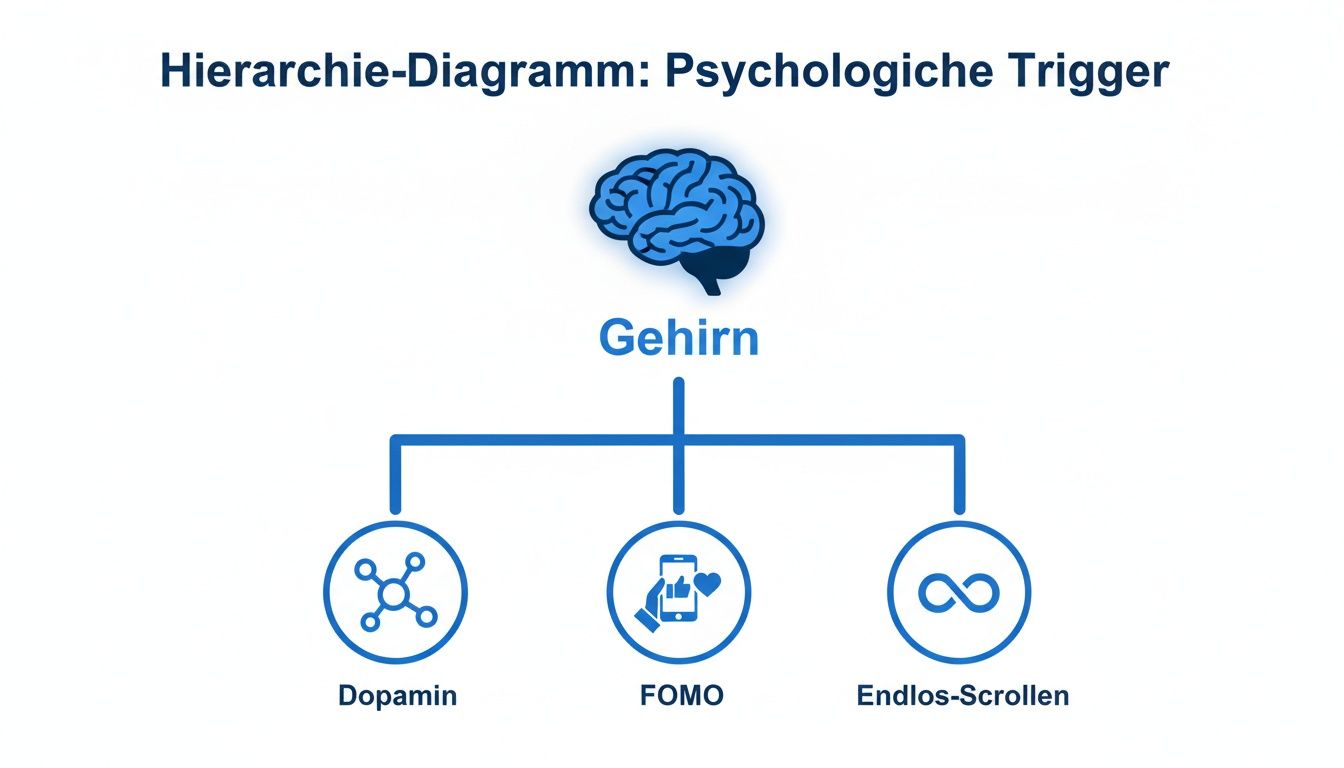
This visualisation makes clear how digital mechanisms hijack our reward system and create a habit loop that's hard to break out of.
A physical tool like the Zenbox steps in at exactly this point. Instead of relying solely on your own willpower, which can quickly run out on a stressful day, you create an unmissable, real hurdle. The conscious act of locking the smartphone away – whether for a focused work session or a distraction-free dinner – decouples the impulse from the action.
Imagine you want to work on an important project with full concentration. You place your phone in the box, set a timer, and put the box out of reach. Now, every time the automatic thought „I'll just have a quick look at my phone“ arises, it's stopped by physical reality. The device isn't there. This interruption gives you the crucial second to consciously decide: „No, I'm staying with my task.“ In this way, over the long term you can not only boost your ability to concentrate, but also develop lastingly healthier digital habits.
Comparison of different methods for reducing smartphone use
To better classify the different approaches, a direct comparison is worthwhile. The following table contrasts purely software-based solutions with physical approaches and highlights their respective strengths and weaknesses.
| Method | How it works | Advantages | Disadvantages |
|---|---|---|---|
| Software solutions | Apps or system settings (greyscale, app limits, notification filters) reduce the device's pull. | Free, built directly into the device, easy to set up. | Easily circumvented, require constant willpower, don't tackle the physical reach for the phone. |
| Physical barriers (e.g. Zenbox) | Create physical separation between user and smartphone, often combined with a timer. | Interrupts the habit loop effectively, requires no permanent willpower, creates clear phone-free times/zones. | Requires an initial investment, not suited to emergencies (without a bridging mechanism). |
Ultimately, no method on its own is the perfect solution. Software adjustments are an excellent first step towards making the smartphone „more boring“. Physical barriers like a phone box, however, provide the commitment needed to break out of old patterns and establish new, healthier routines. The combination of both approaches is often the most effective path to a more conscious relationship with technology.
The growing movement for more digital mindfulness
If you feel that your smartphone takes up too much space in your life, you're definitely not alone in that. A genuine societal movement has developed, driven by the desire for a healthier, more conscious relationship with technology. More and more people are realising that constant availability and digital overstimulation come at a price – and they're ready to change something about it.
This shift is far more than just a fleeting trend. It's a strong sign that we want to take our quality of life back into our own hands. Instead of merely reacting passively to the endless notifications, people are actively seeking ways to regain control and to integrate digital mindfulness into their everyday life in very practical terms.
A generation rethinks
What's especially interesting is that it's precisely the younger generations, who have practically grown up with the internet, who are driving this change. They critically question the norm of constant connectivity and make concepts like „digital detox“ a firm part of their lifestyle. For them, it's not about demonising technology, but about using it more consciously and deliberately for themselves.
This shift in mentality can also be captured in figures. For 2026, a full 51 per cent of Germans have resolved to actively avoid or reduce stress. Among Generation Z in particular, a strong rethink can be observed: more than a third of 18- to 28-year-olds plan to consciously spend less time on their phone or on social media in 2026. That's a figure significantly higher than among older generations, as a survey shows. You can read more about this in this article about Gen Z's New Year's resolutions on smartup-news.de.
Digital mindfulness is not a step backwards or a form of technophobia. It is far more an expression of mental strength and the conscious decision to place your own wellbeing above constant distraction.
You're part of a positive development
This societal trend should give you encouragement. The fight against smartphone addiction is no lonely undertaking, but a shared effort taken up by millions of people. Every single step you take to reduce your screen time contributes to this positive movement.
The following principles are at the heart of this new culture of mindfulness:
- Conscious use instead of automatic consumption: It's about using the smartphone deliberately as a tool, rather than letting it use you. Quite simply.
- Quality over quantity: A truly undisturbed moment with friends or family is infinitely more valuable than hundreds of fleeting online interactions.
- Focus as a superpower: In a world full of distractions, the ability to concentrate deeply becomes an invaluable advantage – at work just as much as for personal growth.
By joining this movement, you invest directly in your mental health and your relationships. You learn how to use mindfulness in everyday life as a tool against stress and hectic pace in order to lead a more balanced and fulfilling life.
Your questions about smartphone addiction – answered clearly and concisely
Here I've gathered the answers to the most common questions on the topic of smartphone addiction. That way you get a clear overview quickly.
When does one speak of phone addiction from a medical point of view?
Even though „smartphone addiction“ is not yet an official, standalone diagnosis in the medical catalogues, experts draw parallels to known behavioural addictions. The decisive factors here are quite concrete signs: the loss of control over how long you use it, noticeable withdrawal symptoms such as nervousness or irritability when the device isn't within reach, and continued use even though you clearly feel the negative consequences at work, in your studies, or in relationships.
If you feel that your phone use is getting out of control, it's always a good step to seek professional support.
Which apps steal the most of our time?
Clearly at the top are social media apps like TikTok, Instagram, and Facebook, closely followed by video platforms like YouTube. That's no accident. Their design, with the endless feeds and constant notifications, is deliberately built to hold our attention for as long as possible.
Take an honest look at your smartphone's screen-time statistics. The result is often a real eye-opener and the perfect prompt to change something.
Can a physical box for the phone really make a difference?
Yes, absolutely. The difference from digital solutions is decisive: while you can get around app blocks or time limits with a few clicks, a physical box creates a real, tangible barrier. The conscious act of actually locking the phone away breaks the unconscious reach for the device that we've trained ourselves into.
You could call it „positive friction“. This small hurdle forces us to pause and make a conscious decision, rather than simply giving in to the impulse. This makes it much easier to break old automatic patterns and establish new, healthier habits. If you're specifically looking for a device against phone addiction, such a tool is an extremely valuable help.
It's a simple but incredibly effective method for stepping off the digital hamster wheel and regaining control. In this way you create real, undisturbed windows of time for what truly matters to you.
Would you like to regain control over your digital balance and build real focus time into your everyday life? The Zenbox is a simple, physical tool that helps you minimise distractions and create conscious breaks. Discover now how the Zenbox can improve your concentration and wellbeing: https://www.thezenbox.de