

How to Concentrate Better Without Constant Distraction
Concentrating better today is more than just a nice-to-have skill – it's a conscious decision. It's about actively taking control, minimizing distractions, and creating an environment that makes genuine, deep work possible in the first place. That means not only getting a grip on the constant pings from your smartphone, but also optimizing the fundamentals like sleep and nutrition.
Why Deep Focus Matters in the Digital Chaos
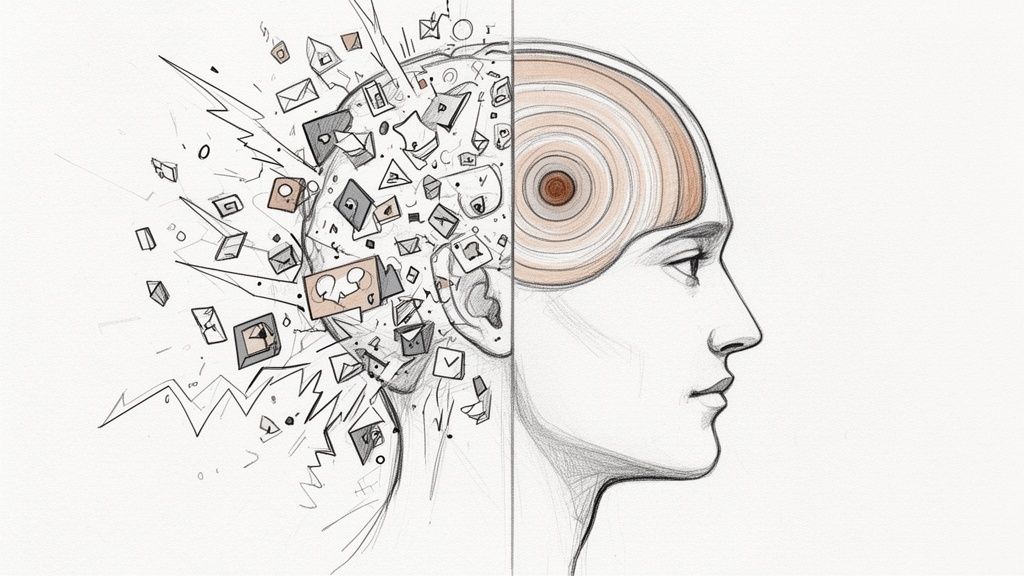 In our hyper-connected world, the ability to focus fully and completely on one thing has become a real superpower. We're bombarded from all sides: notifications pop up, emails flood the inbox, and the smartphone is always just a reach away. These constant interruptions fragment our workflow.
So when you notice your concentration slipping, that's rarely a personal failing. It's far more the logical consequence of an environment that constantly competes for our attention. This ongoing battle not only makes us less productive, it also generates a great deal of stress.
Anyone who works from home, studies, or spends a lot of time at a desk knows the feeling all too well. Quickly checking social media, firing off a fast reply while actually trying to polish an important presentation – these little disruptions add up. Every time we're pulled out of a task, our brain needs precious time and energy to find its way back.
The Psychology Behind Distraction
Our brain is naturally wired to react to new stimuli – an ancient survival mechanism. Digital technologies exploit exactly that. Every notification, every "like" promises a small dopamine reward and makes the urge to check immediately almost irresistible.
This creates a vicious circle of constant distraction that weakens our cognitive performance and drives stress levels up.
This table sums up the biggest disruptors to our concentration and shows their immediate effects.
| The Most Common Concentration Killers in Everyday Life | | :--- | :--- | :--- | | Concentration Killer | Typical Effect | Long-Term Consequence | | Smartphone notifications | Constant interruption of the workflow. | Lower productivity, increased stress levels. | | Multitasking | Error-proneness rises, no task gets done properly. | A feeling of overwhelm, risk of burnout. | | Noise & visual clutter | The brain becomes overstimulated and tires more quickly. | Chronic difficulty concentrating, mental exhaustion. |
Knowing these disruptors is the first step toward counteracting them deliberately.
In fact, according to the TK Stress Report, 66 percent of people in Germany feel frequently or sometimes stressed – a figure that has risen significantly in recent years. Stress and concentration problems go hand in hand. When our brain is in "fight-or-flight mode," little capacity is left for complex, creative thinking. You can find more on this in the findings of the stress report on tk.de.
It's not about working harder, but smarter. That means consciously setting yourself apart from the digital overstimulation and deliberately creating phases of undisturbed thinking.
Willpower alone often isn't enough to overcome these deeply rooted habits. What we need instead are clear strategies, conscious breaks, and the right tools to regain control over our attention. If you'd like to learn more about the mechanisms of digital dependency, take a look at our post on the challenges of smartphone addiction. Those who understand the psychological traps can develop effective counter-strategies.
Build Your Personal Foundation for Better Focus
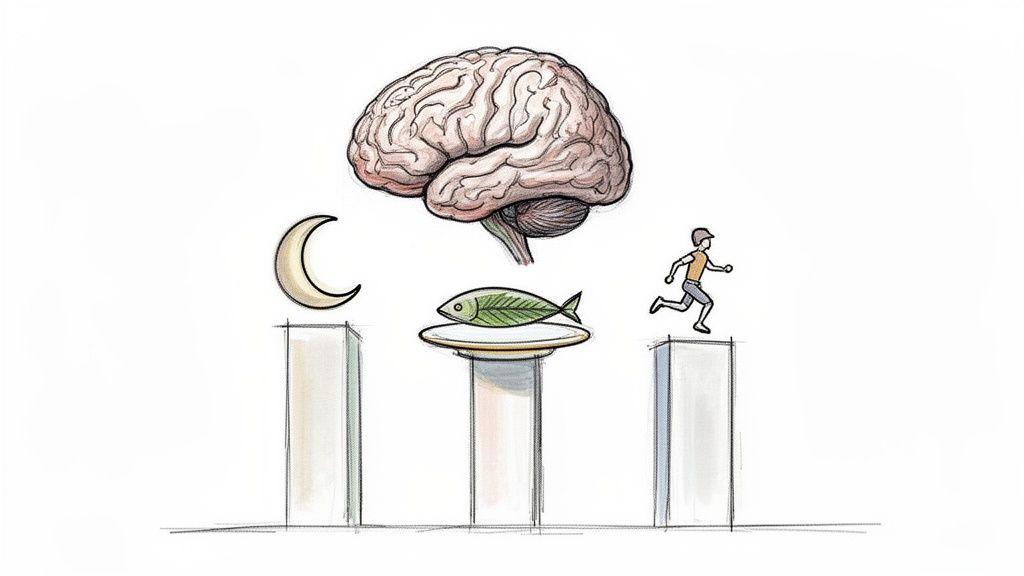
Before we dive into clever work techniques or digital tools, we need to take a step back and start with the absolute basics. Genuine, deep concentration isn't purely a matter of willpower. It depends heavily on your physical and mental condition.
Picture your focus like a house. Without a stable foundation, it wobbles at the slightest tremor. This foundation rests on three essential pillars: sleep, nutrition, and movement. People often dismiss these as generic advice, yet their effect on our ability to concentrate is direct and measurable. Neglect just one of these areas and you unconsciously sabotage your ability to concentrate before the workday has even begun.
The Restorative Power of Sleep
Good sleep is non-negotiable. It is arguably the single most important factor for our cognitive performance. At night, your brain processes information, consolidates memories, and literally flushes out waste products that accumulate during the day. Lack of sleep immediately leads to reduced attention, slower reactions, and poorer decisions. Everyone knows the feeling of thinking as if through cotton wool after a short night.
A consistent evening routine can work wonders. It signals to the body that it's time to wind down.
- One hour before sleep: Put the screens away. The blue light from smartphones and laptops significantly disrupts the production of the sleep hormone melatonin.
- 30 minutes before sleep: Read a real book (perhaps not a gripping thriller), listen to calm music, or try a short meditation.
- The bedroom: Consistently banish your smartphone from this room. It should be an oasis of calm, not an extension of your office.
Even these small adjustments can make a huge difference to your rest – and therefore to your concentration the next day.
Fuel for Your Brain: The Right Nutrition
What you eat goes straight to your control center – the brain. A diet full of sugar and heavily processed foods leads to nasty blood sugar swings. The result? Energy dips and concentration gaps in the afternoon. By contrast, real "brain food" supplies your mind with a steady stream of energy.
Concentration doesn't begin at the desk, but at the breakfast table. A simple yet incredibly effective start to the day: a large glass of water right after waking up. It rehydrates body and brain after the night and wakes up the grey cells.
Deliberately work foods into your daily routine that support your cognitive abilities:
- Omega-3 fatty acids: Found in fatty fish like salmon, but also in walnuts and flaxseeds. They are essential for the health of brain cells.
- Complex carbohydrates: Oats, whole-grain bread, or quinoa provide long-lasting energy, entirely without the dreaded sugar crash.
- Antioxidants: Berries, dark leafy greens like spinach, and nuts protect the brain from oxidative stress.
Movement as a Cognitive Booster
Physical activity isn't just good for the body, it's also a powerful tool for sharpening the mind. Even short bouts of movement boost blood flow to the brain, which improves the supply of oxygen and nutrients. The result is a noticeable increase in attention and often in creativity too.
You don't need to run a marathon for this. It's about integrating small impulses of movement into your day. Make it a rule to take a five-minute break after 60 minutes of focused work. Stand up, stretch, do a few squats, or take a quick walk around the block. This little reset helps enormously to break through mental fatigue and recalibrate your focus.
Design Your Work Environment as a Focus Oasis
Your workspace is far more than just a place to tick off to-do lists. It can be your strongest ally in the battle for concentration – or your greatest enemy. A cleverly designed environment signals unmistakably to your brain: "Now it's time for focused work." By contrast, a chaotic desk combined with a screen full of notifications practically screams for distraction.
The good news? It's in your hands. With a few targeted adjustments, you can transform your physical and digital world into a place where concentration can flourish. It's about erecting deliberate hurdles for disruptions while at the same time strengthening everything that supports your focus.
Bring Order to Your Physical World
A tidy desk makes for a clear head. This old piece of wisdom is no mere platitude. Every superfluous object in your field of vision is a potential hook on which wandering thoughts can latch. Your goal should be to keep only the absolutely necessary within reach.
But it's about more than just tidying up. Create an environment that actively promotes concentration:
- Ergonomics isn't a luxury: An uncomfortable chair or a poorly adjusted monitor are constant energy drains. Physical discomfort continuously saps your mental strength. A good chair and a screen at eye level are investments that pay off immediately.
- Good light, better focus: Ensure plenty of daylight or a bright, glare-free desk lamp. Dim light tires the eyes and makes it incredibly hard to stay awake and alert.
- Create yourself an island of calm: If you're not lucky enough to work in a quiet room, noise-cancelling headphones are worth their weight in gold. They create a personal bubble of silence, even in the midst of the greatest hustle and bustle.
Once these physical foundations are in place, it's time to get a grip on the digital world.
Tame Your Digital Environment
Digital distractions are often the most stubborn, because they lure us with the promise of instant reward. A clean desktop without superfluous icons and a browser with few, relevant tabs are the first important step. Reduce this visual background noise wherever you can.
But you have the greatest leverage in managing your notifications. Switch off all unimportant pop-ups, sounds, and red badges – on the computer as well as on the smartphone. Every single notification rips apart your flow, and getting back in costs precious mental energy each time.
A typical scenario: someone plans a 90-minute "deep work" session. In preparation, everything unrelated to the task is cleared off the desk. The smartphone goes into airplane mode, all unnecessary browser tabs are closed, and a focus app blocks distracting websites. This creates an almost hermetically sealed environment that makes maximum concentration possible in the first place.
This conscious shaping of the work environment also has a measurable influence on overall life satisfaction, by the way. The SKL Happiness Atlas 2025 shows that satisfaction in Germany is stagnating – frustration over a lack of productivity and constant distractions play a role here that shouldn't be underestimated.
When you shape your environment deliberately, you establish a powerful routine. Over time, your brain learns to link your optimized workspace directly with deep concentration. This makes it ever easier to switch into focus mode. These practices are a central building block for more mindfulness in the workplace.
Rely on Proven Techniques for Structured Work Phases
Good preparation, as we know, is half the battle. Instead of plunging into work headlong and hoping that concentration will somehow show up, you can steer it deliberately. Think of focus like a muscle that can be trained. It's about giving your brain a clear signal: "Now it's time to work. Everything else is unimportant."
When you structure your work into clear units, you relieve your brain enormously. The constant decision about what to do next falls away. Instead, you create a healthy rhythm of exertion and relaxation that keeps you capable all day long and gives you the good feeling of having truly accomplished something. Two methods have proven especially effective in practice: the Pomodoro Technique and timeboxing.
The Pomodoro Technique and Timeboxing in Practice
The Pomodoro Technique is brilliantly simple, and that's exactly why it's so effective. The principle: you work 25 minutes at a stretch, highly focused, on a single task. After that you take a five-minute break. After four such rounds, you treat yourself to a longer break of 15 to 30 minutes. This rhythm builds a gentle, positive pressure that puts an end to perpetual procrastination and makes getting started immensely easier.
Timeboxing is essentially the next level. Here you block fixed time slots in your calendar for specific tasks. A 90-minute block in the morning could, for example, be reserved for writing a report – and exclusively for that. This method forces you to plan realistically and prevents tasks from stretching on like chewing gum.
The real point of these techniques isn't just time management. They condition your brain to switch into a state of deep concentration on command and – just as important – to consciously let go again.
An essential part of the success lies in creating a kind of "focus oasis." That starts with the physical preparation of your workspace and continues seamlessly into your digital environment. Only when both areas are free of disruption can deep concentration truly emerge.
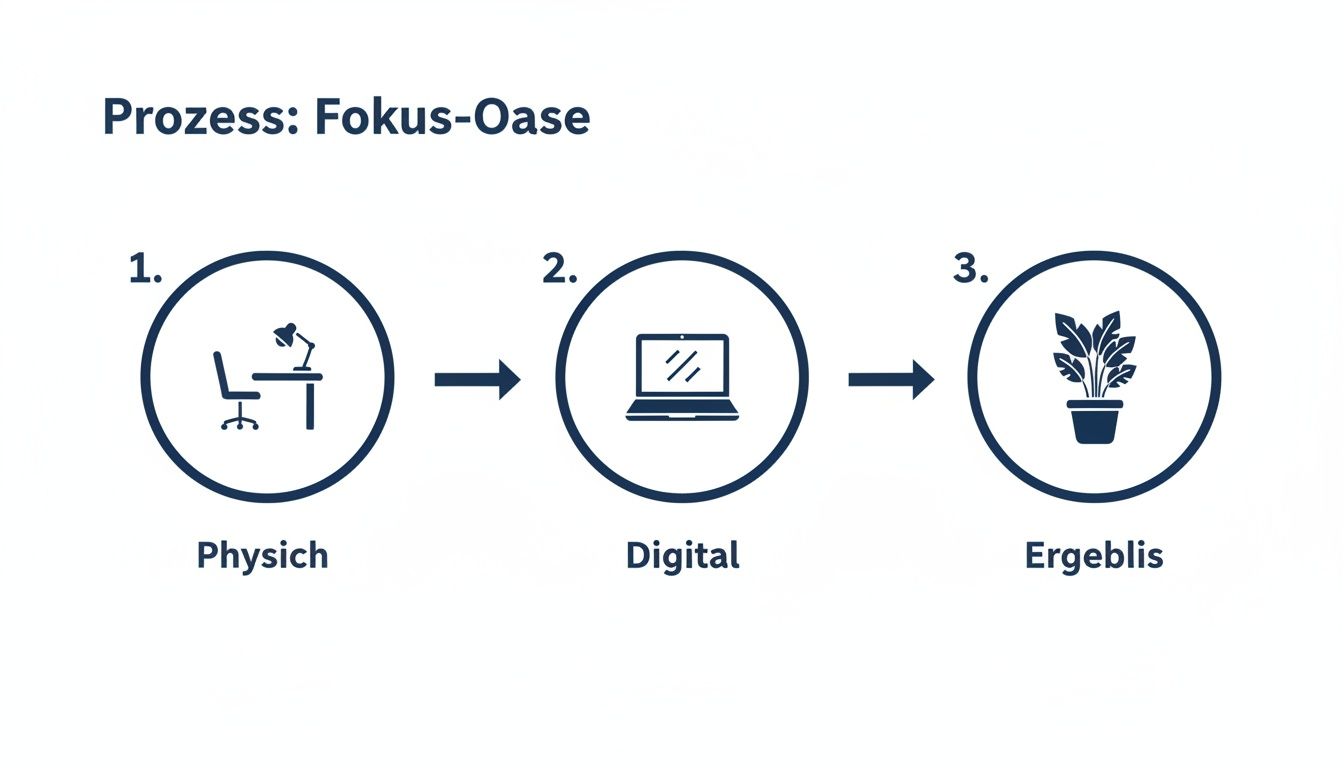
As the graphic shows, sustainable focus is no accident. It's the result of a deliberate process that begins with a tidy desk and ends with a distraction-free digital workspace.
Strengthen the Mental Muscle with Mindfulness
Besides a good structure for your working hours, you can also train your ability to concentrate quite directly. Short, snappy mindfulness exercises are worth their weight in gold here for clearing the head and sharpening focus again.
- Focus meditation for the time-pressed: Sit upright for two minutes, eyes closed. Direct your entire attention to your breath. Feel the air flowing in and out. When thoughts arise (and they will), simply notice them and gently set them aside by refocusing on your breath.
- The quick body scan: Move through your body in your mind, without judging anything. Start at the toes and slowly travel upward to the shoulders and head. This exercise grounds you immensely and brings you out of the carousel of thoughts straight back into the here and now.
These small exercises are like a reset button for your brain and can be done perfectly at your desk. They're the ideal complement to structured techniques like Pomodoro, because they help you regain control over your attention and strengthen that ability in the long run.
Avoid the Smartphone Trap and Change Digital Habits
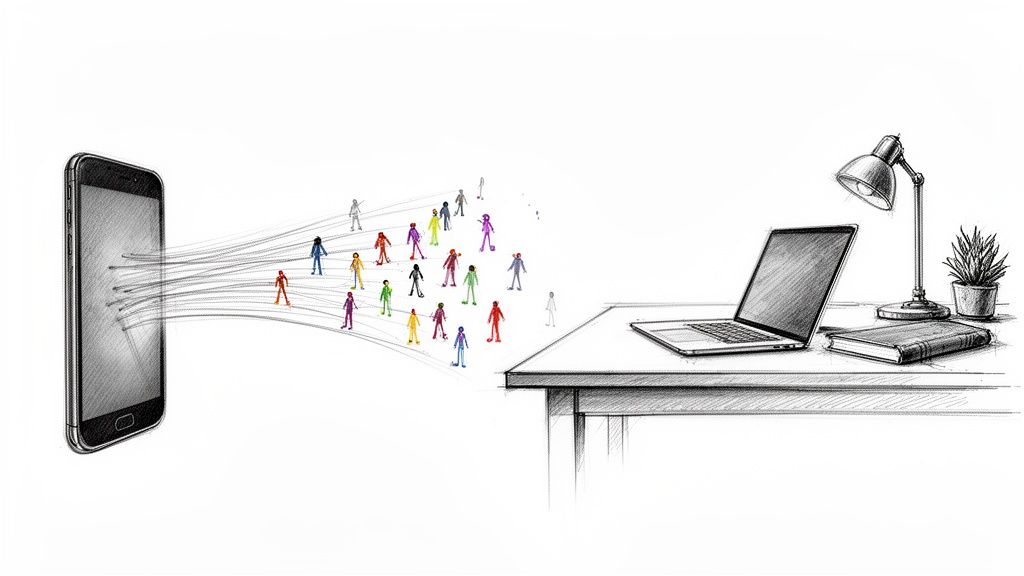
Let's be honest: the smartphone is probably the biggest concentration killer of our time. Simply placing it face-down on the table usually doesn't help much. There's psychology behind it – modern apps are designed to hijack the reward system in our brain. Every single notification promises a small, instant gratification, which makes reaching for the device almost a reflex.
To truly reclaim control, it takes more than the well-meant advice to mute the phone. It's about building deliberate hurdles and reversing the balance of power between you and your smartphone once and for all.
Simply Make Your Smartphone Less Attractive
The first step is to dial down the constant visual and auditory temptation. Apps deliberately use bright colors and playful icons to capture our attention. But there's something quite simple you can do about it.
- The grayscale trick: Try switching your display to grayscale. You'll be surprised how uninteresting Instagram, TikTok, and the rest suddenly seem once the loud colors are gone.
- The app diet: Be consistent. Delete every app you haven't used in the last two weeks or that brings you no real value. Fewer apps simply mean fewer distractions.
- Set digital guardrails: Use the built-in features of your operating system (like "Screen Time" on Apple or "Digital Wellbeing" on Android) to set clear time limits for social media or news portals. Once the time is up, that's it for today.
Even these small changes take much of the smartphone's passive pull away and force you to use it more consciously.
Create Deliberate Offline Zones and Times
It's not enough just to "defuse" the device itself. Just as important is breaking the habits that have formed around it. Here, clear rules and above all physical barriers help to interrupt the unconscious reach for the phone.
Picture a family of four who declares the living room a phone-free zone. Every evening from 7 p.m., all the smartphones go into a small box. The result? Suddenly there's more talking, playing, and time spent together again, instead of everyone staring silently into their own digital universe.
A student preparing for exams can block social media apps just as deliberately. Tools like the Zenbox are especially clever here. As a physical NFC device, it works like an analog "off switch" for distracting apps. You deliberately place the box out of reach, start a focus timer with the tap of a finger, and to unlock the apps you actually have to get up and touch the box – a simple yet astonishingly effective hurdle.
This strategy gains importance when you consider that, according to the trend study "Youth in Germany," 49 percent of 14- to 29-year-olds feel stressed. The constant digital pressure contributes substantially to making concentration a real challenge, especially for young people. Anyone who wants to learn more will find deeper insights in the comprehensive study from staatklar.org.
By drawing physical and digital boundaries, you build up new, healthier routines step by step. This process takes a little patience, but the concentration you regain is well worth the reward. If you want to dive deeper into the topic, read our article with valuable tips on how to overcome phone addiction.
Sustain and Keep Developing Your Focus Over the Long Term
Better concentration is not a sprint, but a marathon. You now have a whole range of tools and strategies at hand to put an end to distractions. But the real art lies in not just trying it all once, but actually integrating it into your everyday life and turning it into a firm habit.
Picture it like building a muscle: it takes regularity. You don't have to be perfect overnight. Quite the opposite: there will always be days when your thoughts simply won't settle down. That's entirely human. What matters is only how you handle it. Don't view such moments as failure, but as an opportunity to learn something. What was different today? Less sleep? A particularly tricky task on your plate?
Keep a Focus Journal for Self-Reflection
A surprisingly simple yet extremely effective means for this is a focus journal. Don't worry, you don't have to write novels. A few bullet points per day are entirely enough to record what went well and what didn't.
A typical entry might look something like this:
- Morning: Got two Pomodoro rounds done for Project X. Focus was top-notch because the phone was in the Zenbox.
- Afternoon: After lunch, the big yawn set in. But a short walk in the fresh air got me back on track.
- Today's insight: Physical distance from the smartphone is the absolute game-changer for me.
Over time, these little notes will help you recognize clear patterns. You'll discover which circumstances fuel your concentration and which nip it in the bud. On that basis, you can fine-tune your strategies ever further and consciously celebrate each small success – which is a huge motivational factor!
Concentration is a constant process of balancing. What works great today may be less effective again tomorrow. Stay curious and flexible. See your ability to focus as something living that develops together with you.
Stay Motivated and Turn the Right Dials
Your tasks and challenges aren't the same every day, after all. A method that carried you through a stressful project phase may not be the best choice when you head into a creative brainstorming session. This is exactly where it pays off to master a whole repertoire of techniques from which you can select the right one depending on the situation.
Don't be afraid to experiment. Maybe you'll find that 45-minute work blocks suit you far better than the classic 25 minutes of the Pomodoro Technique. Or you'll discover that a five-minute meditation before an important meeting works real wonders. Listen to the signals of your body and your mind and adjust your approach.
In the end, it's about developing a mindful and proactive attitude. Instead of letting yourself be steered by every notification and every impulse, you take the wheel yourself. Every work block completed with focus and every distraction consciously avoided is a small workout for your "focus muscle." That way you'll not only become more productive, but also noticeably calmer and more content in dealing with daily demands.
Questions from Practice: Concentration in Everyday Life
On the path to better focus, the same questions keep coming up. Here I've gathered the most common stumbling blocks from my experience and give you tried-and-tested answers that genuinely help.
What to Do When You Run Out of Steam Mid-Day?
We all know that moment: you stare at the screen, read the same sentence for the fifth time, and nothing works anymore. This acute concentration gap is a clear signal from the brain that it needs a break. The biggest mistake now would be to force yourself to keep going by sheer will – that only leads to frustration and errors.
What helps instead is a conscious "pattern interrupt." Stand up, walk to the window, and take a few deep breaths. Get yourself a glass of water or briefly stretch your neck. This tiny physical interruption pulls you out of the mental dead end and supplies your brain with fresh oxygen. Often this mini-reset is all it takes to then carry on working clearly and focused again.
How Often Do I Really Need a Break?
The perfect break frequency is highly individual, but there are a few good rules of thumb. The Pomodoro Technique, where you take a five-minute break after 25 minutes of work, works astonishingly well for many. It prevents you from becoming mentally tired in the first place. If you prefer to work for longer stretches, you should treat yourself to a real time-out after 90 minutes at the latest.
What's decisive, though, isn't just the whether, but above all the how of the break. Quickly switching from the work screen to the smartphone is not recovery. Real breaks happen offline.
Can Concentration Be Trained Like a Muscle?
Yes, absolutely! Don't see concentration as an innate talent, but as a skill that can be developed. Every time you resist the urge to open an email immediately, or refocus on your actual task after a disruption, that's a small workout for your "focus muscle."
Short mindfulness exercises are especially effective here. Take just two to five minutes a day to concentrate solely and exclusively on your breath. It sounds simple, but it demonstrably strengthens exactly those brain regions we need to steer our attention. Over time you'll notice that it becomes considerably easier to stick with one thing and simply let distractions drift past.
Isn't It Enough to Just Turn the Phone Over?
For most of us, the answer is unfortunately no. The mere visible or tangible proximity of the smartphone uses up part of our cognitive performance. This phenomenon is known as "brain drain." Even when the display faces down, our subconscious knows: the whole world of distraction is just a reach away.
What's truly effective is only a real spatial separation. Deliberately place your smartphone in another room or use aids that create a physical barrier. Such hurdles are far more powerful than pure willpower, because they interrupt the automated reach for the device. Only then do you create the mental space that genuine, deep concentration requires.
Had enough of digital distractions and want to finally make focused work phases a firm habit? The Zenbox can help you, as a physical anchor, to take conscious time-outs from the digital world and regain your concentration.