

More Focus at Work Through Mindfulness in the Workplace
Mindfulness in the workplace is far more than just a trend – it is a core skill for not merely surviving in today's working world, but for staying mentally healthy and focused. It is about switching off the autopilot and shifting into a state of conscious awareness. This not only strengthens your resilience, it also noticeably improves the quality of your work.
Why Mindfulness Is Crucial in Modern Working Life
The modern working world can really wear you down. Constant availability, a flood of emails, and the unspoken expectation that you must always respond immediately – all of this puts our brain into a permanent state of alarm. This continuous stress doesn't just make us tired; it also blocks our cognitive abilities, such as creativity and solution-oriented thinking.
This is exactly where mindfulness comes in. It is not an esoteric concept, but a scientifically grounded form of mental training. It develops our ability to consciously direct our attention to the present moment, without immediately judging things. Instead of getting lost in worries about the future or frustration about the past, you learn to deal with what is happening right now in a clear and calm way.
Breaking the Cycle of Stress and Reactivity
Without mindfulness, we quickly fall into a trap that many will recognise:
- The trigger: An unexpected, urgent email lands in the inbox.
- The automatic reaction: The heart starts to race, concentration on the actual task disappears, and stress hormones flood the body.
- The result: You work frantically, make mistakes, and feel drained at the end of the day without having truly accomplished anything.
Mindfulness helps to break this vicious cycle. It creates a tiny but decisive gap between a stimulus and our reaction to it. And it is precisely in this gap that the freedom lies to consciously decide how to respond to a situation, instead of being controlled by it.
Mindfulness is the conscious act of leaving the autopilot behind. It is the ability to pause and observe what is happening within and around us, in order to then make a considered decision rather than acting impulsively.
The following graphic captures the dynamics of stress – from the digital triggers, through the tangible consequences, to mindfulness as an effective approach to a solution.
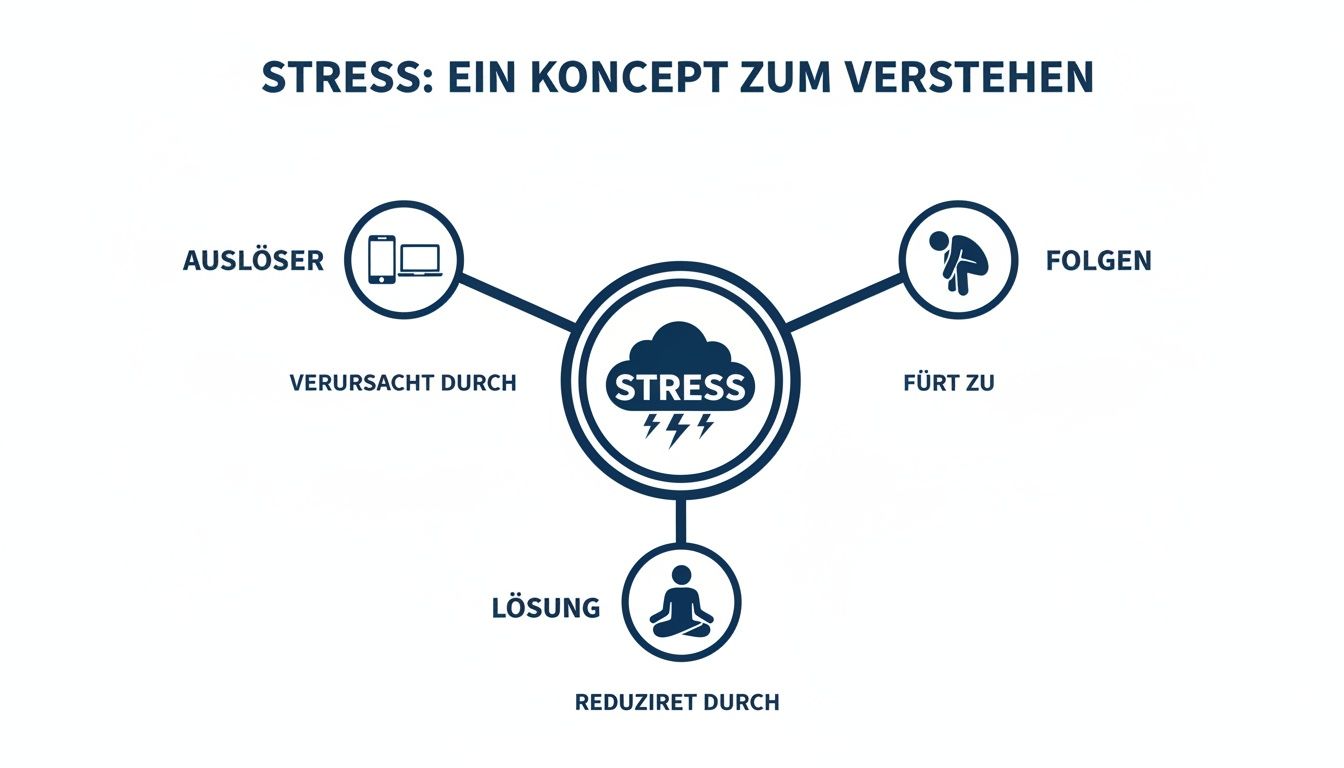
As the illustration shows, mindfulness is the direct counterpart to the stressors that characterise our digital working world.
The following table shows how targeted mindfulness practices can counteract the most common challenges of modern working life.
Typical Stress Factors and Mindful Approaches to Solutions
| Challenge in everyday work | Effects without mindfulness | Mindful approach to a solution |
|---|---|---|
| Constant interruptions (emails, notifications) | Loss of concentration, fragmented working, a feeling of being overwhelmed | Introduce conscious "single-tasking" phases, deliberately disable notifications, do short breathing exercises between tasks |
| High pressure from expectations and deadlines | Tension, fear of making mistakes, procrastination, sleep problems | Set priorities with a clear head, break tasks down into small, manageable steps, focus on the next step |
| Unclear communication or conflicts within the team | Emotional reactions, brooding, a tense working atmosphere | Listen actively without judging straight away. Notice your own feelings before reacting. Take a pause to formulate a considered response |
| Information overload and "meeting marathons" | Mental exhaustion ("Zoom fatigue"), difficulty making decisions | Plan short breaks between meetings (e.g. 5 minutes) to consciously switch off. Notice your body and stretch. |
These examples make it clear that mindfulness is no cure-all, but it is an extremely effective tool for meeting everyday stressors actively and on your own terms.
The Measurable Consequences of Chronic Stress
The effects of this unconscious working mode are not imagined; they can be backed up with hard figures. According to the DAK Psychreport from 2021, mental illness and burnout were responsible for 276 sick days per 100 insured persons – a doubling compared to 20 years ago.
These alarming figures underline that mental health is not a luxury, but an economic and personal necessity. You can learn more about the connections between stress and leadership at yer.de.
Mindfulness in the workplace is therefore a proactive strategy for counteracting this development, protecting your own well-being, and remaining capable of performing well over the long term.
Practical Mindfulness Exercises for In Between
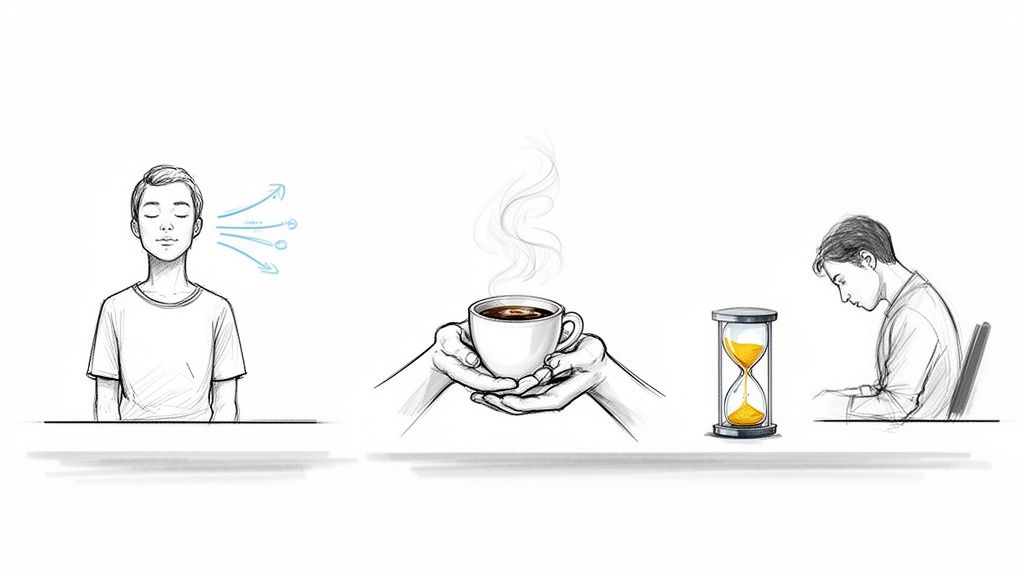
Forget the idea that you need a yoga mat and an hour of time for mindfulness in the workplace. The truly effective exercises are often the shortest ones – small mental breaks that can be woven into even the busiest day almost unnoticed. It is about consciously creating moments of calm in order to step out of the reactive autopilot and take back the wheel.
The trick is not to regard these exercises as another item on the to-do list, but as valuable tools. Imagine you are about to give an important presentation. Instead of being swept along by the rising nervousness, you take a brief moment for yourself.
The Three-Minute Breathing Exercise: Your Mental Reset Button
This technique is an incredibly powerful anchor for quickly calming the nervous system again. The best part? You can do it anywhere – at your desk, just before a meeting, or even on the way to the printer.
Here's how it works:
- The first minute: Arriving in the body. Close your eyes or simply lower your gaze. Direct your entire attention inwards. What do you feel right now? The contact of your feet with the floor, the chair that supports you, the slight tension in your shoulders? Notice everything, completely without judging it.
- The second minute: Focus on the breath. Now concentrate solely on your breath. Feel how the air flows in and out through your nose. Observe the gentle rise and fall of your chest. When thoughts arise – and they will – let them drift past like clouds in the sky and gently return to your breath.
- The third minute: Expanding awareness. Slowly let your focus encompass the whole body again. Feel the energy flowing through you. Notice the sounds around you, but without clinging to them. Then slowly open your eyes and return to the moment with renewed clarity.
This simple exercise works like a restart for your brain. It breaks the stress cycle and gives you the chance to respond to the next challenge with a clear head.
Mindfulness in the Small Things: The Power of Everyday Routines
Besides such targeted exercises, you can also incorporate mindfulness into everyday actions quite easily. This is exactly what turns the practice into a genuine habit, rather than limiting it to a few special moments.
- The mindful coffee: Instead of emptying the cup on the side while skimming through emails, take two minutes. Feel the warmth of the cup in your hands. Smell the rich aroma. Taste the first sip consciously and without distraction.
- Mindful walking: On the way to the coffee kitchen or to your next appointment – pay attention to the sensations of walking. Feel how your feet touch the floor and roll off again. Notice your posture, the movement in your arms.
Such informal exercises sharpen your senses and bring you back from the carousel of thoughts into the here and now. If you would like to delve deeper into the topic, our article on mindfulness in everyday life as a tool against stress offers even more valuable inspiration. In this way, mindfulness becomes a skill you can call upon at any time – whenever you need it.
Creating Focus Through Mindful Work Routines
Genuine, lasting focus and mindfulness in the workplace do not come from a few sporadic exercises. They are the result of routines that we consciously weave into our everyday working life. It is about shaping core processes – such as meetings or focused work phases – mindfully, rather than simply "getting them done".
One of the most effective yet often overlooked techniques concerns the start of a meeting. Instead of jumping straight into the agenda, a conscious intention can turn the entire course of events for the better.
Beginning Meetings with a Clear Intention
Before the first word about the agenda is spoken, simply take 30 seconds as a team. Everyone asks themselves inwardly: "What is my most important contribution to this meeting? What is the best possible outcome we can achieve together?"
This short pause has a surprisingly profound effect. The focus shifts from a mere to-do list towards a shared goal. Instead of passively taking in information, the participants are far more engaged and solution-oriented from the very start.
A meeting without intention is like a ship without a rudder. A conscious intention at the beginning gives everyone a shared direction and turns an obligatory event into productive collaboration.
This simple practice also helps, by the way, to reduce the dreaded multitasking. Those who focus on their contribution are less tempted to check emails on the side.
Designing the Environment for Undisturbed Deep Work
Besides communication, it is above all the phases of undisturbed concentration that are decisive for truly high-quality work. Such "deep work" phases, however, require a carefully created environment. Simply muting notifications is usually not enough – the habit of constantly reaching for the smartphone is simply too deeply ingrained.
Here, physical anchor points help to send the brain clear signals. One such anchor could be deliberately placing the smartphone in another room or stowing it in a dedicated box such as the Zenbox. This physical act signals: "My focus time begins now."
To truly protect these undisturbed work phases, clear agreements within the team are essential:
- Establish fixed focus times: Block out recurring daily time slots in your calendar that are visible to everyone as "do not disturb" times. For example, from 9:00 to 10:30.
- Define communication channels: Determine which channel is used for which level of urgency. A phone call for genuine emergencies, the team chat for quick questions, and email for anything that can wait.
- Encourage asynchronous communication: Create a culture in which an immediate response is not expected to every message. This takes away the pressure of having to be constantly available.
Through routines like these, you draw a clear line between phases of collaboration and phases of concentration. You protect your most valuable and productive hours, which not only improves the quality of your work but also enormously strengthens the feeling of control and self-determination.
Would you like to dive deeper into how you can minimise distractions? In our comprehensive guide, we show you how to improve your ability to concentrate and thereby sustainably enhance your work performance.
How to Finally Put an End to Digital Distractions
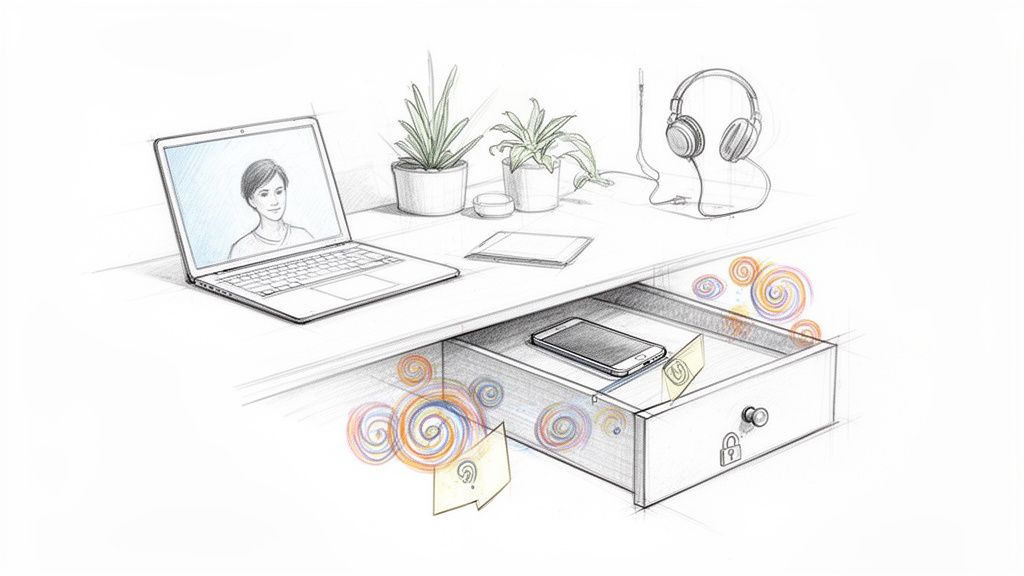
Hand on heart: smartphones and the constant flood of notifications are the greatest concentration killers of our time. Every interruption, however tiny – a brief vibration, an illuminated display – tears us out of the flow. This costs not only time, but above all valuable mental energy. You won't win this battle against the digital sirens with willpower alone. What we need is a clever strategy.
The trick is to build quite deliberate hurdles for yourself. Instead of having the smartphone within reach on the desk, where it practically screams for attention, we banish it out of sight and out of reach. The mere reluctance of having to get up specially to fetch it from the drawer often works wonders against the impulsive grab.
Redesign Your Architecture of Attention
A mindful approach to our digital helpers means regaining control. We have to move from being a passive reactor to an active designer of our working environment. And that begins with the organisation of the digital workplace.
- Notifications? Cut them radically! Simply switch off everything that is not absolutely vital. Every flash of an email or a chat message is an open invitation to distraction.
- Create topic islands: Use different browser profiles or virtual desktops to strictly separate private and professional tabs. When you are polishing an important presentation, social media feeds have absolutely no place there.
- Fixed times for communication: Set yourself fixed time blocks in which you answer emails and messages – for example, in the morning after the first coffee, at midday, and once before the end of the working day. It is best to communicate this within the team as well, in order to manage expectations.
In sum, these small interventions act like a strong line of defence for your focus. You take back command of your attention, instead of losing it bit by bit to countless digital troublemakers.
Our brain is not a multitasking machine, even if we like to tell ourselves it is. It is made for deep, focused work. Every digital distraction forces it into a context switch – and this demonstrably lowers our cognitive performance and exhausts us more quickly.
Physical Helpers for Digital Focus
Sometimes software settings simply are not enough. That is when physical tools come into play, ones that erect a real, tangible barrier between you and the digital distraction.
The Zenbox is a perfect example of this. You could describe it as a kind of "analogue flight mode" for your smartphone. You consciously place your phone on the box, start a focus timer, and thereby create a genuine physical separation.
The principle is brilliantly simple: the smartphone gets its fixed place, which initiates the conscious act of focusing. This action alone strengthens your intention to stay on task and makes the thoughtless reach for the phone considerably harder. If you want to delve deeper into this topic, you will find valuable strategies in our article for effectively combating phone addiction.
Making Your Own Progress Visible and Staying on Track
Building new habits is often a tough business. The trick to not throwing in the towel after a short while? Make your progress visible. With mindfulness in the workplace in particular, this is worth its weight in gold, because the positive effects often creep in quietly and are barely tangible at first.
So don't rely solely on the vague feeling of being "somehow calmer". Concrete, measurable points of reference help you to see your development in black and white. This not only gives you the well-deserved confirmation, but also shows crystal clearly which methods truly work for you. In this way, you go from being a mere user to a conscious architect of your mental fitness.
Simple Methods That Really Work
You don't need complex analysis tools to see what's happening. A few simple yet enormously effective habits are entirely sufficient and can be effortlessly built into everyday life.
-
The focus journal: Take five minutes at the end of the working day. That's all it takes. Answer these three simple questions in writing:
- How often today did I consciously take a short mindfulness break?
- Was there a situation in which an exercise helped me to keep a cool head instead of reacting impulsively?
- What was my biggest concentration killer today, and how did I deal with it?
-
Counting distraction-free work blocks: A simple timer is enough. Keep track of how many undisturbed work phases of, say, 25 minutes (entirely in the style of the Pomodoro technique) you manage in a day. When this number grows, that is the tangible proof that your concentration is becoming stronger.
These simple methods provide you with incredibly valuable insights into your very own patterns. You will quickly notice when you are most productive and which troublemakers most frequently tear you out of the flow.
Seeing progress is the strongest motivator. A simple notebook or counting focus blocks turns the abstract goal of "becoming more mindful" into a tangible, motivating journey.
Do you notice, for example, that after the lunch break you reflexively reach for the smartphone and then sink into the news feed? That is a fantastic insight! Now you can deliberately counteract it. Perhaps a short walking meditation or a five-minute breathing exercise right after eating is exactly what's needed to break this pattern.
Such aha moments are pure gold. They give you the opportunity to realign and refine your mindfulness practice again and again. In this way, mindfulness does not become yet another item on your to-do list, but a genuine support that helps you to master modern working life with greater composure and confidence. Think of it as your very own fitness programme for the mind.
Typical Hurdles and How to Master Them: Your Questions About Mindfulness at Work
Have you decided to integrate mindfulness into your everyday working life? Wonderful, that's the most important step. But as so often, the devil is in the detail. In practice, the same questions and uncertainties often come up. Here you will find very pragmatic answers to them, so that your start goes smoothly.
"But I don't have any time for this!" – How do I start when my calendar is full?
This is the most common objection – and the biggest misconception. Forget the idea that you have to meditate for an hour a day straight away. That is unrealistic and only leads to frustration.
The trick lies in the small things. Start with so-called "mental coffee breaks" of just one minute. That's all. A single conscious breathing exercise before a tricky phone call, or the mindful walk to the printer, can make a surprising difference.
It is about regularity and the conscious decision, not about duration. Make it a habit to consciously pause for just 60 seconds several times a day. That fits into even the fullest schedule.
"What will my colleagues think?" – Dealing with scepticism within the team
You don't have to shout your new routine from the rooftops. Many of the most effective exercises are completely invisible to onlookers. No one in the office notices whether you are taking three deep breaths at your desk or mulling over a complex email.
Concentrate on yourself and the tangible effects. If your practice demonstrably makes you calmer, more focused, and more solution-oriented, the results speak for themselves. That is the best proof there is.
A little tip: instead of talking about "meditation", simply call it a "short concentration exercise" or a method for "clearing your head". Your composure during the next stressful project phase will leave more of an impression than any long explanation.
"I'm not stressed at all." – Does everyone really benefit from it?
Absolutely. Mindfulness is far more than just an emergency kit for stress. See it as a mental fitness programme that does not only repair, but above all prevents and strengthens your fundamental resilience.
- Creative minds use it to break through mental blocks and find new perspectives.
- Leaders make better decisions through clearer perception and less impulsiveness.
- Entire teams improve their communication and collaboration, because they truly listen to one another again.
Ultimately, mindfulness sharpens the mind and improves self-awareness. This increases performance and well-being – entirely regardless of your current stress level.
"My open-plan office is far too loud!" – How is this supposed to work?
It is precisely there that mindfulness unfolds its greatest benefit! A loud, bustling environment is the perfect training ground for your "attention muscle". Instead of seeing the background noise as a disturbance, you can use it deliberately for your exercises.
Try this technique: for two minutes, concentrate quite consciously on a single, constant sound in your surroundings – the soft hum of the server or the whoosh of the air conditioning. Simply notice it, without judging it. In this way, the supposed disruptive factor becomes your personal meditation anchor.
And for those moments when you really need quiet: good noise-cancelling headphones are worth their weight in gold for creating a little oasis of stillness for a short, guided breathing exercise.
Would you like to reduce digital distractions in a targeted way and create conscious focus times? The Zenbox is an ingenious tool for physically taking your smartphone out of the equation and protecting your concentration. Take a look at https://www.thezenbox.de to see how you can support your mindfulness practice with this simple yet incredibly effective tool.