

Device Against Phone Addiction That Actually Works
Do you know the feeling? You actually want to concentrate on your work, your studies, or a lovely moment with your family, but your smartphone is constantly competing for your attention. Almost all of us know this creeping problem of constant distraction, and willpower alone is often barely enough to resist the pull of notifications. A physical device against phone addiction is far more than just a technical gimmick. It creates a conscious hurdle that breaks the automatic reach for your phone.
The quiet problem of constant distraction
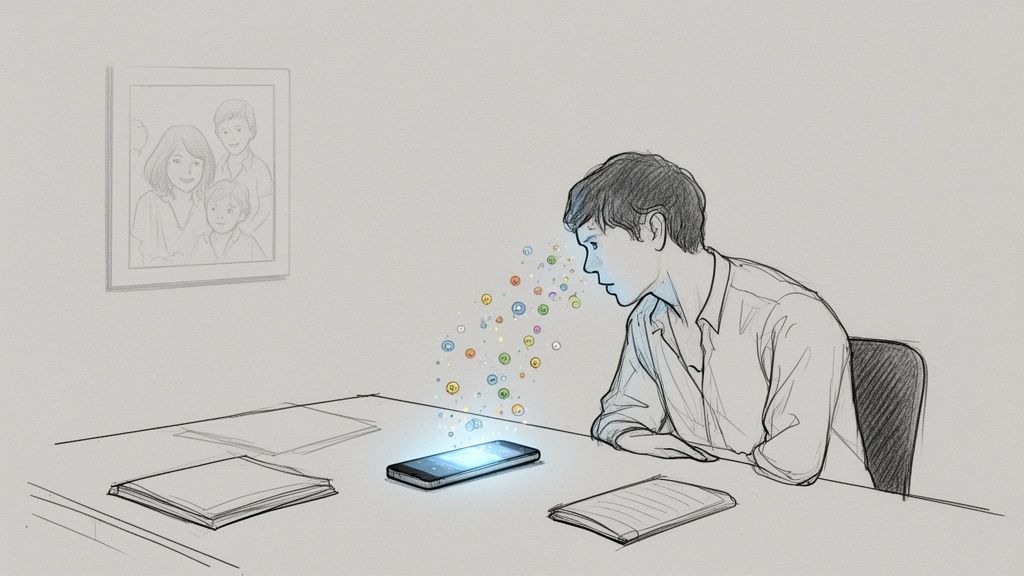
For many of us, reaching for the smartphone has become an unconscious reflex. Whether during a short break, at the supermarket checkout, or even in the middle of a conversation, the digital world seems to draw us in as if by magic. This behaviour is not simply a lack of willpower, however, but the result of some rather clever design.
Apps and social networks are deliberately designed to appeal to the reward system in our brain. Every notification, every like, and every new message delivers a small hit of the happiness hormone dopamine. Over time, our brain learns to keep craving these little digital rewards.
When willpower reaches its limits
This constant stream of stimuli fragments our attention and makes it incredibly hard to focus on a single thing for any length of time. You try to finish an important project, but your brain is already primed for the next digital impulse. The result? A feeling of being overwhelmed and declining productivity. Many people recognise this pattern in themselves.
A Deloitte study shows just how widespread the problem is: 84 percent of 18- to 24-year-olds feel they use their smartphone too often. A full 93 percent even notice negative effects such as stress or difficulty concentrating.
These figures make it clear that the desire for a real solution that goes beyond mere self-discipline is enormous. The findings of this study underline just how much we need tools to get a better handle on our digital habits. You can find out more in the results of the Deloitte study on smartphone use in 2024.
The solution: a conscious hurdle
This is exactly where the idea of a physical device comes in. Instead of relying solely on your own mental strength, an external aid creates a very real, tangible barrier. It forces us to make a conscious decision rather than simply giving in to the automatic impulse.
This additional step, this “friction” in the process, is often precisely what makes the difference. It allows us to break digital habits for good and reclaim control. If you are wondering whether your own behaviour might already be problematic, our article on signs that you may be addicted to your smartphone offers helpful pointers.
How a device against phone addiction actually works
Picture a light switch for your digital distractions. A device against phone addiction works on a very similar, refreshingly simple principle: it is a tangible tool that requires a conscious action to break the vicious cycle of mindless scrolling.
The core concept behind this is called positive friction. While app developers do everything they can to make their services as seamless and frictionless as possible, a device like this turns the tables. It builds a small but decisive hurdle between you and the temptations on your screen.
The principle of the conscious decision
Instead of relying on willpower alone, which, as we all know, tends to fade quickly after a long working day, the device shifts the focus. The decision to use your phone becomes a conscious, physical action. Even a small step, such as tapping a box, turns an automatic reflex into a considered decision.
This physical act pulls us out of autopilot. The unconscious reach for the phone is replaced by an action that makes us pause for a moment: “Do I really want to do this right now?”
The decisive advantage of a physical barrier over a purely software-based solution is its tangibility. An app can be disabled or ignored with just a few taps. An external device, on the other hand, requires a concrete action in the real world, which noticeably raises the threshold.
From simple boxes to smart helpers
This principle can be put into practice in very different ways. The simplest devices are basic timer boxes, often jokingly referred to as “phone prisons”. You lock your smartphone away for a preset time, and the box only releases it again once the timer has run out.
This method may be radical, but it is often inflexible too. What if a truly important call comes in? That is why modern solutions like the Zenbox take a smarter approach to finding a healthy balance between availability and focus.
Here is how a smart solution like the Zenbox works in practice:
- Setting up in the app: You decide for yourself which apps and notifications should be blocked during your focus time. So you stay fully in control.
- Physical start: To start a focus session, briefly hold your smartphone to the Zenbox. This NFC tap is the conscious starting signal for your undisturbed time.
- Ending the mode: To lift the block again, you have to hold your smartphone to the box once more. So if you deliberately place the box out of reach, you create an even greater hurdle to ending your focus early.
This clever combination of flexible software and a simple physical trigger creates exactly the right kind of friction. It does not force you to give up everything, but rather to pause and make a conscious decision about your attention, instead of being steered by digital impulses.
The different types of focus tools compared
The market for digital helpers that promise to boost our concentration is huge, and, honestly, rather confusing. Each device against phone addiction follows its own particular philosophy. To shed a little light on the matter, most solutions can be sorted into three broad categories. Each has its place and suits different people and needs.
The following graphic really sums it up. It shows the simple but decisive choice a focus tool puts in front of us: the conscious step into concentration rather than the familiar drift into distraction.
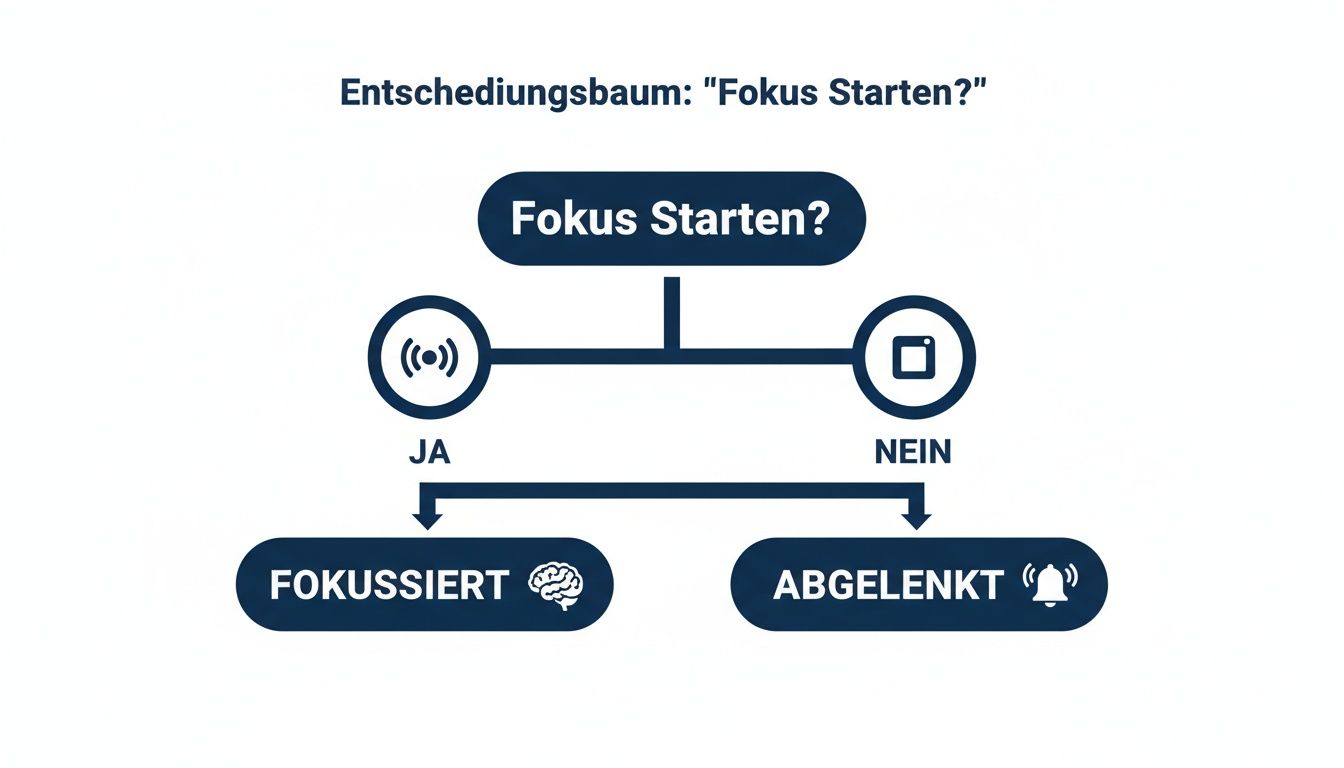
You can see clearly here how a small physical action, in this case a brief tap, can make all the difference. It is the conscious choice between productive time and the digital rabbit hole.
Physical phone prisons and timer boxes
The sledgehammer method, if you like. Lockable boxes, often somewhat dramatically called “phone prisons”, work on a wonderfully simple principle: phone in, set the timer, lid shut. The box stays locked until the time is up. Full stop.
For people who know they need a very hard limit, this can be worth its weight in gold. When willpower alone is not enough, a box like this creates an insurmountable physical barrier. You simply cannot get at the device.
The catch? You are unreachable in an emergency, and for many of us that is simply not an option. On top of that, this approach is extremely inflexible – it is a pure all-or-nothing affair.
Pure software solutions and timer apps
At the other end of the spectrum we find purely software-based solutions. The App Store is full of them: countless apps that promise to block distractions, limit screen time, or remind us to take breaks. The huge advantage is obvious: they are available instantly, and many of them are even free.
Apps like these are a great way to start engaging with the topic of digital mindfulness at all. They raise awareness of your own (bad) habits and can bring some early little successes.
Their biggest weakness, however, is built in: they are themselves part of the very device they are meant to tame. An app can be disabled or bypassed with just a few taps. The necessary “positive resistance” that truly breaks a habit is often missing here.
Hardware-software combinations: the smart middle ground
The most elegant and, in my experience, also the most sustainable solution is a clever mix of a physical device and intelligent software. Systems like the Zenbox use exactly this hybrid approach and combine the best of both worlds.
It is best thought of less as a prison and more as a conscious light switch for focus. The app in the background allows flexible settings (what exactly should be blocked?), while the external NFC device is the physical trigger to start focus mode.
This combined approach has decisive advantages:
- Flexibility: You decide for yourself which apps are muted. Important calls still come through, though.
- Conscious action: The physical act of tapping the box is a very deliberate decision. It breaks the automatic habit of simply reaching for the phone and creates a genuine mental hurdle.
- Effectiveness: Because focus mode can only be ended by touching the box again, the threshold for simply breaking it off is much higher. That is a huge difference compared to a purely app-based solution.
It is precisely this combination that makes tools like the Zenbox such a powerful companion for anyone looking for a balanced yet genuinely committed way to reclaim control over their attention.
Comparison of different devices against phone addiction
To make the differences even clearer, I have put the most common types of tools for reducing screen time side by side in a table. It compares how they work as well as their respective pros and cons at a glance.
| Device type | How it works | Advantages | Disadvantages |
|---|---|---|---|
| Physical boxes | The smartphone is physically locked away for a set period of time. No access possible. | Extremely effective, as it creates an insurmountable barrier. No way around it. | Completely inflexible. No availability in an emergency. All-or-nothing principle. |
| Software/apps | Installed apps block access to other apps or functions for a preset duration. | Cheap or free, easily available, customisable settings (what gets blocked). | Easy to bypass, requires a lot of self-discipline, since the app itself runs on the very device causing the distraction. |
| Hybrid systems | A physical action (e.g. an NFC tap) starts an app-configured focus mode on the phone. | Combines a physical hurdle with flexibility. A conscious decision-making act; availability is retained. | Upfront cost for the hardware. Requires both the device and the accompanying app. |
This overview shows that there is no single perfect solution for everyone. Choosing the right tool depends heavily on your personal needs – on the question of how much self-discipline you bring with you and how radical the separation from your smartphone needs to be.
Practical use cases for more focus in everyday life
Theory is one thing, but how exactly does a device against phone addiction like the Zenbox change everyday life? The true strength of such helpers shows in the small but decisive moments when we consciously reclaim control over our attention. Let us take a look at a few very concrete scenarios that make the difference clear.
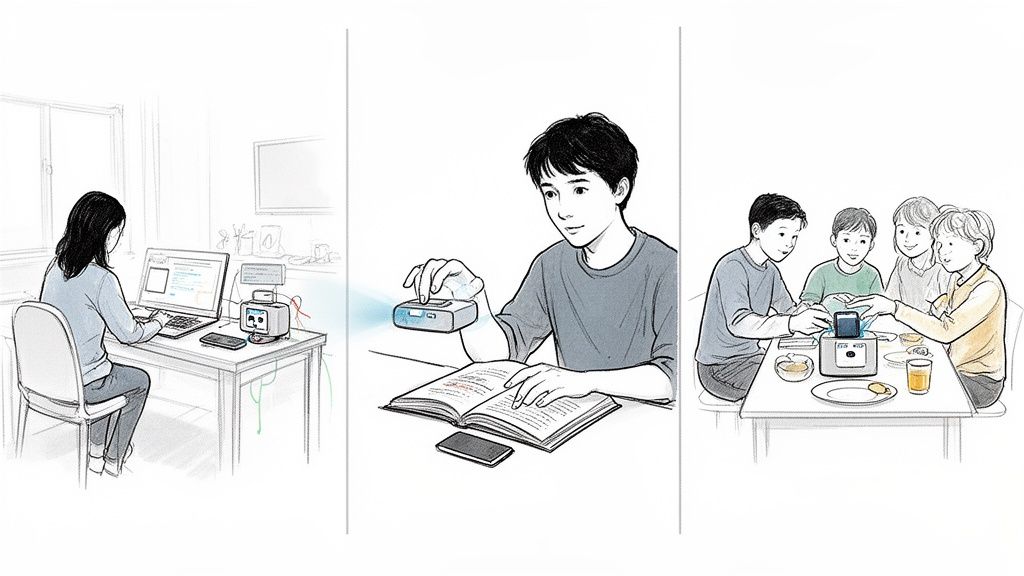
The undisturbed home office in the morning
Imagine Lena, a knowledge worker who works from home. Her most productive hours are the first two in the morning, before the flood of emails and calls comes crashing down on her. In the past, reaching for the phone was almost a reflex, just to “quickly” check the news – and suddenly she was caught in the endless social media whirlpool.
Today, a Zenbox sits on her desk. Every morning, after her first coffee, she briefly holds her smartphone to the box. A single tap is enough, and her “deep work” mode is activated. For the next 90 minutes, all social media apps and unimportant notifications are muted. This small, conscious action is her clear starting signal for a phase of undivided concentration. The result? In that time she often gets more done than she used to in an entire morning.
The study boost during exam season
Now to Tim, a student in the middle of preparing for his exams. The material is demanding, and even the smallest distraction sets him back. His greatest enemy is the constant temptation to scroll through Instagram or TikTok – just for a “quick break” that then quickly turns into half an hour.
Tim has simply stuck his Zenbox magnetically to the shelf above his desk. When a study session begins, he stands up for a moment, holds his phone to the box, and starts his study timer. All distracting apps are immediately locked. Should he want to end the mode early after all, he would have to get up again and consciously repeat the action. This small physical hurdle is usually enough to interrupt the impulse and keep him focused on the task. That is how procrastination turns into real progress.
The shared dinner without screens
Let us take a look at the Meyer family. Dinner together was often a rather quiet affair, accompanied by the soft tapping on phones. Real conversations? Nowhere to be found. Everyone was somehow caught up in their own digital world.
Their solution is a Zenbox that hangs on the fridge and has become the central collection point for the family's phones. Before everyone sits down at the table, they activate “family time” mode. The result surprised even them: suddenly people are talking about their day again, there is laughter, and everyone really listens to one another. The simple tap on the box has created a small but incredibly important tradition that noticeably strengthens their bond.
A device against phone addiction is not a ban, but rather an invitation. An invitation to shape the moment more consciously – whether at work, while studying, or in precious time with the people who are dear to us.
The evening routine for better sleep
Another crucial point is the evening routine. Many people, especially teenagers, take their phone to bed with them, which can massively impair sleep quality. A JIM study found that 30 percent of teenagers are tired in the morning because they spend far too long on their smartphones at night.
This is where the Zenbox can draw a healthy line. You deliberately place it out of reach, for example in the living room, and activate a night mode before going to bed. This spatial separation alone prevents endless scrolling in bed and ensures a calmer, more restful sleep. If you would like to delve deeper into the topic, you can find all the details in the full JIM study on media use among teenagers.
These examples show how a simple tool can help you make more conscious decisions in everyday life and set the course for greater mindfulness. If you would like to learn more about how to use mindfulness in everyday life as a tool against stress, we have a fitting article for you on the subject.
The science behind physical focus tools
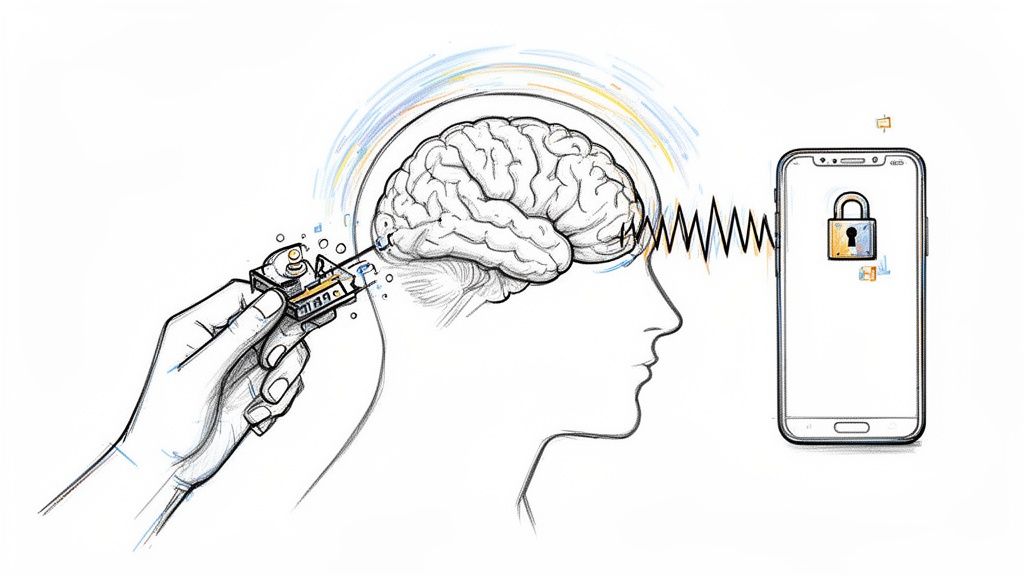
Sometimes it feels like a battle against yourself: you want to concentrate, but your hand reaches for the phone as if on its own. Why is it so much easier to stop this urge with a physical box than with an app alone? The answer lies deep in our psychology and in the way our brain forms habits.
A physical device against phone addiction, like a Zenbox, breaks the autopilot. The unconscious reach for the smartphone suddenly becomes a conscious action. This small but decisive hurdle gives our rational brain the chance to regain control before the impulse wins.
The principle of the “commitment device”
In behavioural psychology, a tool like this is called a “commitment device”. In essence, we use it to make a pact with our future self. We know from experience that our willpower is sometimes stronger and sometimes weaker. So, here and now, we create a small barrier that makes it harder for us to give in to temptation later. The Zenbox does exactly that: it safeguards our good intentions.
By committing to our decision through a physical action, we increase the likelihood that we will actually stick to it. It is like laying out your sports clothes the evening before – a small gesture that makes a bigger, positive habit possible in the first place.
How we make our environment work for us
This strategy is part of what is known as “choice architecture”. The idea behind it is that we can shape our environment so that it helps us make better decisions. If we deliberately place the Zenbox out of reach, for example, we make it easier for ourselves to stay focused and harder to be distracted. We actively design our environment for our success.
The need for this is unmistakable. Data from the German Federal Ministry of Health shows that young adults already spend 27 to 29 hours a week on media. This massive consumption makes it clear that we need effective strategies that go deeper than mere software blockers and that prompt real changes in behaviour. You can find more information on online addiction directly from the ministry.
The power of a concrete plan
Another psychological trick at work here is the “implementation intention”. This means nothing other than forging a concrete “if-then plan”. The intention “When I sit down at my desk, I tap the Zenbox” is psychologically far more effective than the vague wish “Today I want to concentrate better”. This clear linking of a situation to an action is a real booster for self-control.
If you would like to delve even deeper into the psychological mechanisms behind such tools, we recommend our article on the science behind the Zenbox.
The first step towards a more conscious relationship with your smartphone
Our little journey through the world of focus tools has made one thing very clear: constant distractions are a serious problem, and willpower alone is often simply not enough. A physical device against phone addiction, like the Zenbox, is a genuinely sustainable and clever solution that builds on simple psychological principles.
Perhaps the most important insight here is that a very conscious “positive friction” is the key to finally breaking entrenched digital habits. So instead of merely fighting against the constant urge to reach for your phone, a tool like the Zenbox gives you a clear, physical action to perform. You make a conscious decision once again.
Switching off the autopilot
This simple act – putting the phone away – breaks the autopilot. Control shifts from unconscious reflexes back to you. This is not about banishing the smartphone forever, but about finally shaping the way you use it on your own terms again.
The start of your journey towards greater digital mindfulness is just one small step away. It is the conscious decision to create an environment that protects your concentration and gives you back valuable, undisturbed offline time.
A tool like this is more than just a box. It is an investment in your productivity, your inner peace, and not least the quality of your relationships. Take the first step now.
Frequently asked questions about focus tools
The thought of integrating a physical device against phone addiction into everyday life naturally raises a few questions. That is perfectly normal. Before establishing a new habit, you understandably want to know what you are getting into. So we have gathered the most common questions for you and answered them in a very practical way.
Here you will find the answers that give you a sense of how such helpers work in real life and whether they really suit you.
Can I still access my phone in an emergency?
Yes, absolutely. A good system like the Zenbox has prepared for exactly this case and offers an emergency unlock. The clever part: the function is available at any time, but it is tied to a small, conscious hurdle. This prevents you from bypassing the lock on a mere whim.
This thoughtful balance gives you the security to focus fully on your task, without losing the certainty that you can act immediately if it really matters.
Does a device like this work for the whole family?
Yes, many of these devices are even designed specifically for families. The Zenbox, for example, can be connected to several smartphones with ease.
A single box on the fridge or in the living room quickly becomes the central spot for the whole family's digital downtime. Perfect for dinner together or a games night where the screens really do stay off. And if you like, you can simply combine several boxes for different rooms.
Why use a physical device instead of a free app?
Apps can be a good start, but they have one decisive drawback: they are often far too easy to outsmart or ignore. A physical device like the Zenbox creates a real, tangible barrier. That is precisely what makes the difference.
The conscious action of actually holding your phone to the box breaks the automatism of mindless scrolling far more effectively than a purely software-based timer. Another plus: the Zenbox is a one-time purchase with no subscription trap, and it works completely without batteries.
What happens if I switch smartphones?
Don't worry, modern systems are flexible. With the Zenbox, you can easily connect your new smartphone to your existing box. Your progress and your personal settings are safely stored in the app.
So the transition is absolutely seamless. Your journey towards more focus and conscious use of your time continues without interruption – you simply pick up where you left off.
Would you like to reclaim control over your attention and finally create real focus time again? Discover the Zenbox and begin your journey towards greater digital calm. At https://www.thezenbox.de you will find out how easy it can be to get your distractions under control.