

Overcoming Phone Addiction: How to Regain Focus and Concentration
The first step in overcoming phone addiction is often the hardest: honestly admitting to yourself that your own behaviour is becoming a problem. This isn't about banishing your smartphone entirely. Instead, the key lies in regaining control – through small but conscious adjustments in everyday life, such as deliberately switching off notifications or setting up phone-free zones.
Recognise the true signs of your phone addiction
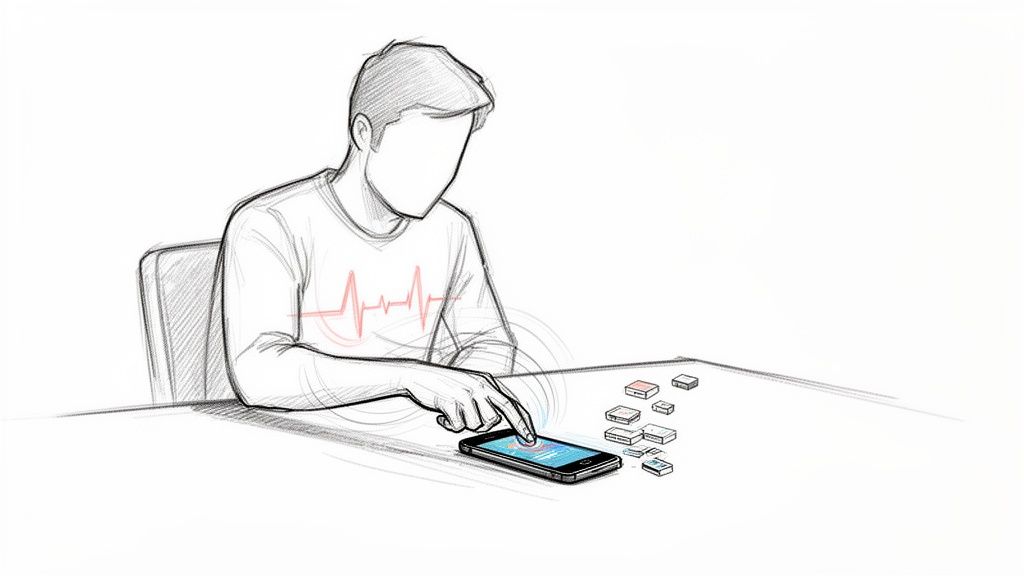
Do you sometimes feel that your smartphone is controlling you rather than the other way around? To overcome phone addiction, we need to look beyond mere screen time. Far more telling are the subtle, often unconscious behavioural patterns that point to problematic use.
Most of us associate addiction with extreme images. But in truth, it's the small, everyday automatic responses that gradually rob us of control. A classic example: the moment a hint of boredom sets in, your hand is already reaching for the phone.
The subtle signals in everyday life
Take a moment and honestly reflect on your habits. Do you know the feeling of endlessly scrolling through negative headlines? This phenomenon even has a name: doomscrolling. Or perhaps you feel an almost panicky restlessness when the device isn't within easy reach? There's a term for that too: nomophobia, the fear of being without your phone.
These behaviours are far more than just bad habits. They are often deeply rooted in our brains and serve as a kind of coping strategy for stress, social insecurity, or simply a way to avoid uncomfortable thoughts. If you'd like to delve deeper into these mechanisms, you'll find further information in our article on smartphone addiction.
The compulsive reach for the phone is rarely a conscious decision. Rather, it's a learned response to emotional triggers such as boredom, stress, or feelings of loneliness.
Your personal self-test
To better assess your own usage habits, honest self-reflection can work wonders. The following checklist will help you identify typical behavioural patterns.
Checklist for reflecting on your phone use Use this checklist as a quick self-test to question your own usage habits and recognise the first signs of problematic use.
| Behavioural pattern | Everyday example | Applies to me (Yes/No) |
|---|---|---|
| Phantom vibration | You feel your phone vibrate in your pocket – you check, but there was no notification. | |
| No real downtime | After work, or even at the weekend, you're constantly checking work emails and chats. | |
| Neglected hobbies | Activities you used to enjoy keep fading into the background. Instead, you spend that time on the screen. | |
| Social procrastination | In company, you instinctively reach for your phone to avoid awkward pauses or conversations. | |
| Sleep problems | You take your phone to bed and scroll until your eyes close, making it harder to fall asleep. |
Did you recognise yourself in one or more of these points? Don't worry, you're not alone.
The issue is alarmingly widespread. A study in Germany shows that around 25% of 10- to 17-year-olds display problematic social media use. 4.7% are already considered dependent – an alarming increase of 126% since 2019. You can find more on these worrying figures in this report on media addiction.
Recognising and accepting these patterns is your crucial first step on the way to a healthier relationship with your smartphone.
First steps for immediately noticeable results
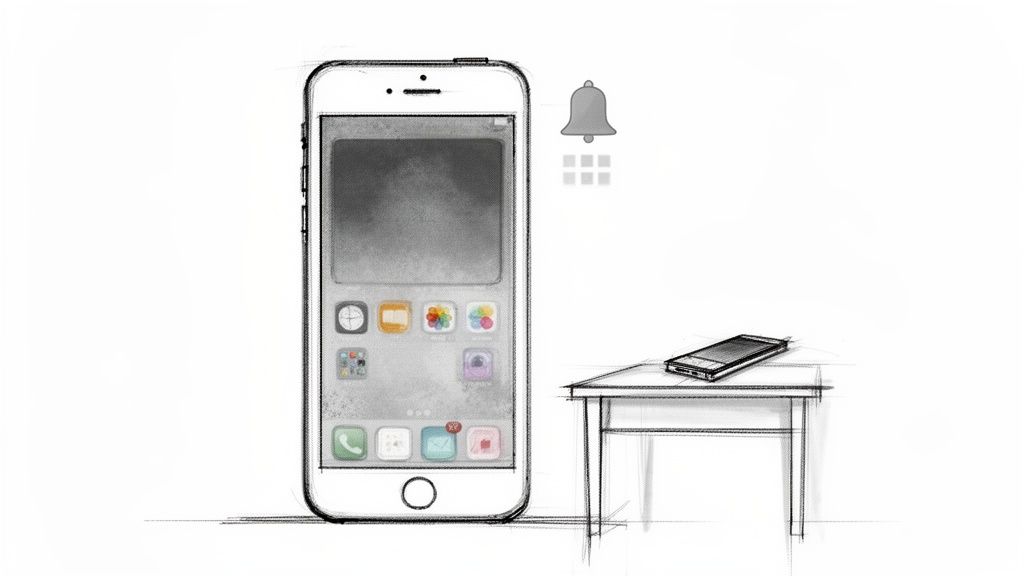
If you want to get your phone use under control, what you need most at the start is quick wins. They are the best fuel for motivation. Forget radical bans – the trick lies in reshaping your digital environment so that it simply leaves you in peace. It's about creating deliberate hurdles that interrupt the automatic reach for the smartphone.
The first and by far the most effective lever is control over your notifications. Every flash, every sound is a targeted attempt by apps to hijack your attention.
Turn this barrage down drastically. Disable push notifications for almost everything. A proven rule of thumb: only notifications from real people stay on, so messaging services or calls. Everything else – from social media and news to shopping apps – can wait until you actively decide to take a look.
Redesign your digital environment
Your home screen is like a shop window. If colourful, tempting apps sit there, you're unconsciously prompted to keep "coming in". Make this space deliberately unappealing and minimalist.
- Declutter radically: Banish everything from the home screen that you don't need daily for productive purposes. Only tools like the calendar, notes, or the camera may stay.
- Hide distractions: Push all time-wasting apps (social media, games, news) into a folder right at the back, on the second or third page. Every extra swipe or tap is a small but surprisingly effective hurdle.
- Cut the visual stimuli: Colourful app icons are psychologically designed to release dopamine and tempt you to tap. Activate greyscale mode (usually found in the accessibility settings). The world on your display instantly becomes less exciting and loses much of its magical pull.
This deliberate minimalism ensures that you use your phone again as what it should be: a focused tool, not a temptation machine.
A grey screen is a boring screen. That's exactly the point. When the reward of bright colours and animations disappears, so does the urge to keep scrolling endlessly.
Create phone-free zones and times
Your physical surroundings have a huge influence on your habits. Just as the bed is for sleeping and the desk is for working, you can deliberately declare certain places phone-free.
Start with the two most important zones: the dining table and the bedroom. At the dining table, it encourages mindfulness and conversations with others. In the bedroom, though, it's even more crucial. The blue light of the display has been shown to disrupt the production of the sleep hormone melatonin, ruining sleep quality.
In the evening, deliberately put your smartphone to charge in another room. Buy yourself an old-fashioned alarm clock for a few euros. This small spatial separation is one of the most effective ways to put an end to night-time scrolling and the morning reach for the phone right after waking up. These simple adjustments don't require iron willpower – instead, they create clever routines that give you back control.
Using analogue tools as a deliberate barrier
Digital solutions for self-control, meaning app blockers or time limits on your phone, usually have one catch: they're too easy to outsmart. A few taps and the lock is gone again – and you instantly fall back into old patterns. Real, lasting change, though, needs more than just a digital switch. It needs a tangible, physical hurdle in everyday life. And this is exactly where analogue tools come into play.
The crucial point is physical friction. While a digital lock exists only in your head, an analogue barrier creates a real, tangible distance between you and the distraction. This little detour forces you to step out of autopilot and make a conscious decision. There's a huge difference between dismissing a pop-up message and having to get up and walk into the next room to fetch your phone.
The Zenbox as a physical focus switch
A perfect example of this principle is the Zenbox. This small, minimalist NFC device works like a physical "off button" for all your digital distractions. The concept behind it is brilliantly simple: in the app, you choose what you want to block – for example Instagram, TikTok, or your emails.
Then you briefly tap the box with your phone, starting a focus timer. From that moment on, the selected apps are locked. But the clever part comes when unlocking: to regain access, you have to deliberately hold your smartphone to the Zenbox.
Physical friction breaks the cycle of habit. When you have to get up and walk across the room to unlock your phone, you've gained precious seconds to ask yourself: "Do I really need this right now?"
This simple action has an enormous psychological effect. It turns the unconscious reach for the phone into a considered act. You can place the box strategically to amplify this effect:
- In the study: Attach it magnetically to the leg of your desk. Just having to bend down creates a small hurdle.
- For family time: Place it on a shelf in the hallway, nicely far away from the dining table.
- For your evening routine: Put it in the bathroom to guarantee that the bedroom stays phone-free.
This approach is simply far more effective than software alone when it comes to establishing firm routines such as undisturbed deep-work phases or precious, screen-free family time. If you'd like to dive deeper into how such a device against phone addiction works in detail, you'll find more here.
That such tools are becoming ever more important is shown by the current figures. In Germany, 82 per cent of all people aged 16 and over own a smartphone; among 12- to 13-year-olds it's even 100 per cent. The average usage time is a startling 4.4 hours per day. This not only leads to poorer grades or lack of sleep, but also kills productivity when working from home. You can find more on current smartphone use in Germany at Statista. Tools like the Zenbox, which build a real barrier, thus become an indispensable helper for regaining control and making digital mindfulness the new normal.
Developing your own routine for digital balance
Honestly: radical bans rarely work and are usually doomed to fail. If you want to overcome phone addiction, the real key lies in new, better habits. A well-thought-out yet flexible plan helps you reclaim control over your day without it feeling like deprivation.
The basic idea is simple. Instead of constantly reaching for your phone unconsciously, you create conscious time slots for different things. This way you draw clear boundaries: focused work here, permitted relaxation on the screen there, and precious, genuine offline time in between.
The building blocks for your mindful weekly routine
A good plan has to adapt to your life, not the other way around. See the following points as a kind of toolkit from which you can assemble your very own personal routine.
- Focus blocks: Set fixed times in which you work undisturbed and with full concentration. The Pomodoro technique is a fantastic tool for this – classically 25 minutes of focus, then a 5-minute break. During these phases the phone is off-limits, ideally out of sight and out of reach. A Zenbox can work wonders here by creating an insurmountable physical barrier.
- Scheduled social media windows: Instead of aimlessly scrolling through feeds, treat yourself to deliberately defined breaks. For example, set aside 15 minutes in the morning and 15 minutes in the afternoon for it. This satisfies the urge to stay up to date without letting it dominate the whole day.
- Screen-free zones: Define absolute no-go times and places for screens. Most importantly: mealtimes, the first hour after waking up, and the last hour before going to sleep.
This graphic perfectly illustrates the path from the unconscious, automated response to a new, healthy habit.
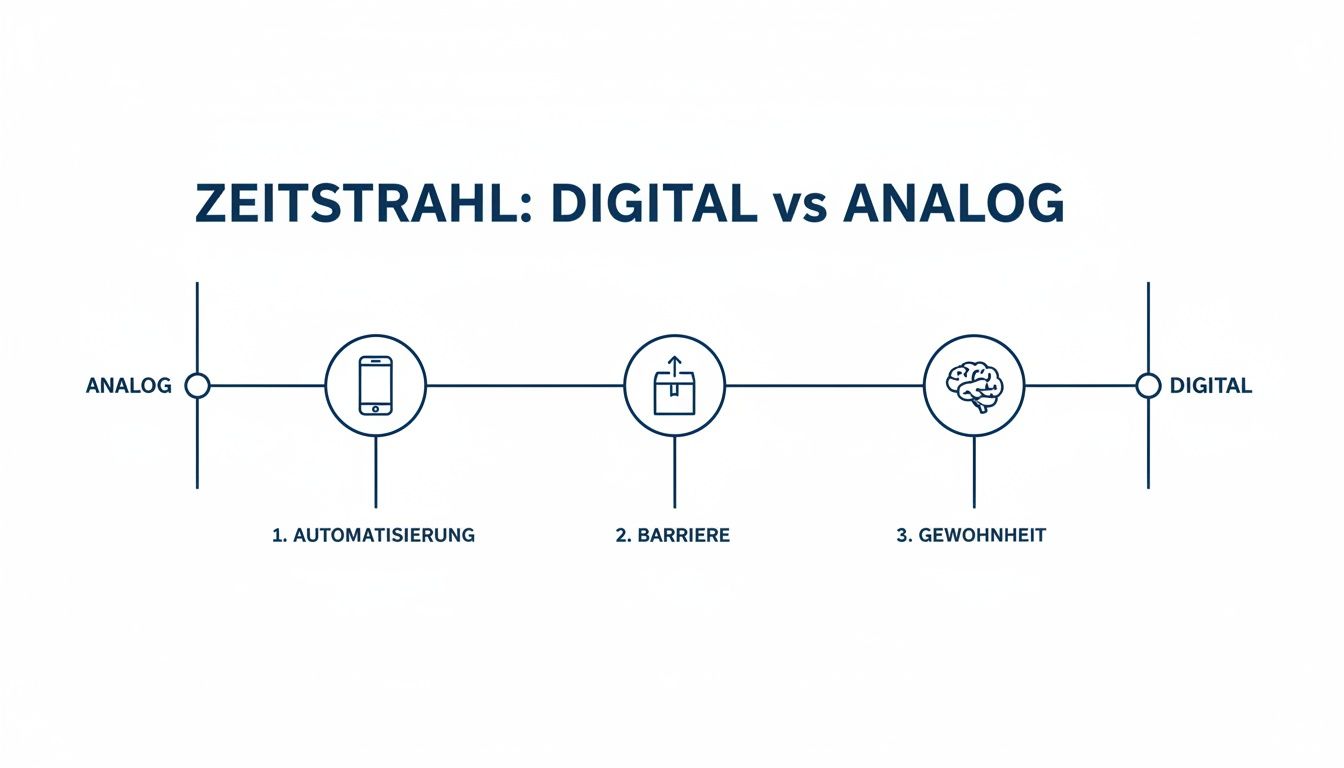
You can clearly see that a physical hurdle – such as a lockable box – is the decisive intermediate step. It breaks the automatic response and gives the brain the chance to anchor a new, better routine.
A typical day working from home
So what might this look like in practice? Let's picture the daily routine of a knowledge worker who wants to regain their productivity and truly switch off in the evening.
Morning routine (7:00 – 8:30 am): consistently analogue The day starts not with scrolling through the phone, but with an analogue alarm clock. A short workout, a coffee in peace, or a few pages of a real book – this creates a conscious and, above all, calm start to the day.
Focus block 1 (8:30 am – 12:00 pm): time for deep work The phone goes into the Zenbox, the timer is set to three hours. Out of the way. Emails and team chats are only checked at fixed times, perhaps every 90 minutes.
Lunch break (12:00 – 1:00 pm): eat screen-free The lunch break takes place without the smartphone. A short walk in the fresh air is the perfect reset for the mind.
Digital sunset (from 9:00 pm): Establish a clear evening ritual. One hour before bed, all screens – phone, tablet, TV – are switched off. This is the signal to the body: now it's time to wind down. Sleep quality improves noticeably as a result.
The time you gain this way may feel a little empty at first. That's normal. But it's also the perfect opportunity to revive old hobbies or take up new ones. Read a book, listen to music attentively, have a real conversation, or calmly prepare for the next day. This is how you overcome the fear of missing out (FOMO) and instead fill your life with genuine, fulfilling moments.
Celebrate successes and see setbacks as opportunities
Anyone who wants to get their smartphone use under control is setting out on no straight path. It's more of a marathon with ups and downs than a short sprint. To stay on track, it's incredibly important to see and celebrate your own progress. Just as important is not branding a setback as failure, but seeing it for what it is: a valuable lesson.
The pure screen time our phones show us can be quite misleading here. Far more important are the small successes that show you're regaining control.
What really counts: more than just minutes and hours
Instead of fixating only on screen time, you'd do better to look at the qualitative successes. These make progress tangible and motivate far more strongly than abstract numbers.
- How many focus phases were there? Count the moments in which you finished a task or a conversation without being disturbed by the phone.
- How often did you resist? How often did you notice that automatic reach for the phone and consciously decide against it? Each of these moments is a victory.
- How was your offline time? How many meals did you truly enjoy without your smartphone this week? How often did you reach for a book in the evening instead of the news feed?
Celebrate these small successes! Perhaps even keep a short journal about them. Making yourself aware of these moments is an extremely effective way to cement new, healthy habits. If you'd like to dive deeper and learn even more strategies, you'll find many further approaches in our comprehensive guide on overcoming phone addiction.
A relapse does not undo your progress so far. It's simply an indication of where your strategy still needs a little fine-tuning.
How to deal constructively with relapses
There will be days when, despite all your good intentions, you're glued to the phone for hours. That is absolutely normal and human. What matters is not that it happens, but how you deal with it. Instead of letting it discourage you, you can use these moments to learn and improve your tactics for the future.
A relapse is not a sign of weakness, but a chance to better understand your own triggers. Most of the time there's an unmet need behind it: perhaps for relaxation, social contact, or simply a short break from a demanding task.
To learn from a relapse, a simple three-step approach has proven effective:
- Understand the trigger: What exactly happened before you reached for the phone? Were you stressed, bored, lonely, or overwhelmed? Try to identify the feeling or situation that triggered the impulse.
- Be gentle with yourself: Self-reproach achieves nothing. On the contrary, it only creates more stress – which often makes reaching for the phone even more likely. Accept that it happened. It's part of the process.
- Adjust your strategy: What could you do differently next time? Do you need a better alternative for stressful moments, for example a short walk around the block? Was the hurdle too low? Perhaps in such situations the phone simply needs to go into another room or into the Zenbox.
Once you internalise this process, every setback becomes a step forward. You don't give up – you adjust your course. With each repetition you become more resilient and more conscious in how you handle your digital companion.
Common questions on the way to less phone time
When you set out to use your smartphone more consciously, sooner or later you stumble upon the same questions. Here I've collected the most common stumbling blocks and concerns, and give you tried-and-tested answers to help you on your way.
Habit or already addiction – where's the line?
A habit is something we do automatically, almost without thinking. Reaching for the phone on the underground, while waiting for a coffee – these are classic examples. The good news: with conscious effort, we can break and replace such habits.
With an addiction, it's different. Here we noticeably lose control. You notice it has negative consequences – sleep suffers, work gets left undone – but you still can't stop. When the phone isn't within reach, restlessness, nervousness, or even irritability set in. These are clear withdrawal symptoms. At that point at the latest, it's advisable to seek professional support.
The core difference is control. A habit can be steered. An addiction steers you.
Do these digital detox apps actually do anything?
Yes and no. Apps can be a fantastic tool for first creating awareness. They hold up to you, without mercy, just how much time you really spend on the screen and where the time-wasters lurk.
The catch, though, is your own discipline. A digital lock is often just a few taps away and quickly deactivated again. That's why they work best in combination with other methods. A truly effective strategy combines several levels:
- Digital helpers: Apps for tracking and blocking, to recognise patterns.
- New routines: Deliberately create phone-free zones and times, for example during meals.
- Physical barriers: This is where aids like a Zenbox come into play, building a real, tangible hurdle. You can't simply tap it away.
So how long does it take until I've got my phone use under control?
That's the question everyone asks, and the answer is, unfortunately: it depends. The process is very personal. But you'll feel the first positive effects immediately! Simply switching off most notifications brings tremendous calm to everyday life.
But until truly new, healthy habits are firmly established and conscious use becomes second nature, you should stay realistic. Plan for several weeks to a few months for that. The most important thing isn't speed, but staying with it and being patient with yourself.
What do I do if my partner or my friends don't understand the problem?
A very common and frustrating problem. The best approach here is to communicate openly and honestly, but without reproach. Explain why this change matters to you personally and what you hope to gain from it.
Instead of saying "You're glued to your phone too", try it like this: "I've noticed how often I'm distracted, and it bothers me. I want to be more present again when we're together, so we can enjoy the time more." Then suggest something concrete, like a phone-free dinner. Often the most effective way is simply to lead by good example. When the people around you notice how much good the change does you, understanding usually grows too.
Would you like to create a real, physical barrier that helps you break out of autopilot? The Zenbox was developed for exactly that. Discover at https://www.thezenbox.de how you can regain control with a simple tap of a finger.