

How to Really Avoid Your Phone Before Sleep
Setting your smartphone aside in the evening is perhaps one of the simplest and at the same time most effective adjustments you can make for better sleep. It is mainly about eliminating two major disruptive factors: the blue light of the displays and the mental roller coaster that apps like social media send us on. Both keep the brain busy and slow down the production of the important sleep hormone melatonin.
Why Scrolling in Bed Sabotages Your Sleep
Let's be honest, who doesn't know it? You are already lying in bed, you only want to relax for a moment, and almost automatically you reach for your phone. One last round through Instagram, a quick glance at the news, or one more funny video. What feels like a harmless habit is often the main reason for restless nights and the feeling of waking up the next morning completely worn out. The problem has two faces: a biological one and a psychological one.
The Biological Sleep Trap
Our body has an internal clock that has been ticking for thousands of years in harmony with the natural day-night rhythm. As soon as it gets dark, the brain gets the signal to produce the sleep hormone melatonin. Melatonin makes us tired and prepares the body for a restful night.
This is exactly where the smartphone interferes. The bright, bluish light of the screens is very similar to daylight and tricks our brain. It gets the wrong signal: “Hey, it's still light out, stay awake!” The result? Melatonin production is suppressed, the feeling of tiredness does not set in properly, and falling asleep becomes a test of patience.
The Mental Disruption
But it is not only the light. The content we consume is pure poison for a relaxed mind too. Emails from the boss, the unsettling news of the day, or the endless feeds on social media – all of this puts our brain into a state of tension and activity.
Instead of switching off and finding calm, the mind is suddenly busy processing information, comparing itself with others, or already planning the next day. In this state of mental overstimulation, relaxed falling asleep is hardly possible.
This vicious circle is anything but a niche problem. A representative study shows that for 54 percent of 18- to 49-year-olds in Germany, the phone is a fixed part of the evening routine. And a full 75 percent even keep their smartphone in the bedroom at night – a well-known sleep killer. If you would like to dive deeper into the numbers, you can find the complete study on nighttime phone use here.
So the conscious decision to put the phone away before sleep is not an exaggerated act of self-discipline, but a truly decisive step for your health and energy the next day.
How to Create a Digital Evening Routine
Forget radical bans – they rarely work. A successful change begins with a thoughtful plan that is realistic. Instead of banishing the phone from one moment to the next, we shape an evening routine that consciously and gradually sends digital devices into their downtime.
The most important first step? Set a fixed “screen-off time.” That is your personal cut-off.
Ideal is a window of 60 to 90 minutes before going to bed. This gives your brain enough of a buffer to process the flood of stimuli, to come to rest, and to ramp up the production of the important sleep hormone melatonin.
Why this is so decisive is shown at a glance by the following graphic. The blue light from the display is essentially a wake-up call for our brain.
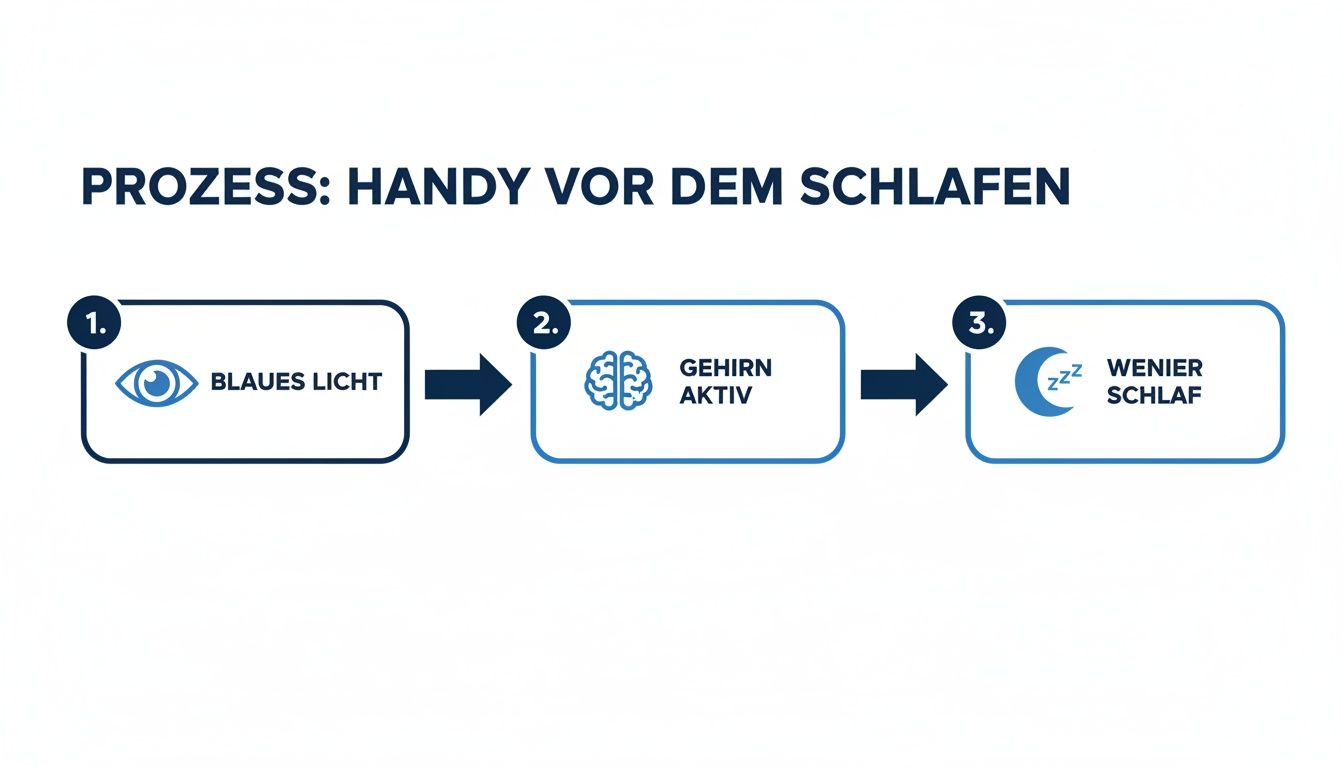
You can clearly see it: the blue light fools our mind into thinking it is daylight. The consequence? The brain stays in high gear, natural tiredness is suppressed, and falling asleep becomes noticeably harder.
What to Do With the Time You Gain?
The new, screen-free hour naturally needs to be filled. Otherwise boredom strikes, and your hand wanders almost automatically back to the smartphone. So deliberately seek out activities that truly relax you and that you look forward to every evening.
Here are a few proven alternatives that clear the mind:
- Pick up a real book. The feeling of paper between your fingers is something completely different from swiping on a glowing screen.
- Add some gentle stretches. A few minutes of light stretching or simple yoga exercises release the tension of the day and signal to the body that it is time for rest.
- Savor a soothing herbal tea. The ritual alone of brewing a cup of tea and drinking it in peace can be incredibly calming.
- Start a gratitude journal. Briefly write down three things that went well during the day. This shifts the focus away from brooding and toward positive thoughts.
Start small. No one expects you to establish a perfect, hour-long routine overnight. Choose a single activity and give it just 15 minutes at first.
A little tip from experience: make it as easy as possible for yourself. Set up a cozy reading nook with a warm blanket, or lay out the yoga mat in advance. The fewer hurdles there are, the more likely you are to stick with it.
Even better: involve your partner or your family. Together, a relaxed evening culture is much easier to establish, and you can motivate one another.
Comparing Digital and Analog Evening Activities
To illustrate the difference, this table compares the effects of typical digital evening activities with relaxing analog alternatives.
| Activity | Effect on the Brain | Impact on Sleep |
|---|---|---|
| Scrolling social media | Constant sensory overload, dopamine release | Keeps the brain active, delays falling asleep |
| Reading the news | Confrontation with negative headlines, stress | Raises stress levels, can lead to brooding |
| Reading a book | Calms, encourages concentration and imagination | Reduces stress, makes it easier to switch off |
| A relaxing bath | Releases physical tension, lowers body temperature afterward | Signals to the body that the rest phase is beginning |
The comparison makes it clear: while digital activities rev up our system, analog habits help us to consciously wind down and prepare the body optimally for a restful night.
Making the Phone Unappealing in the Evening – With Technical Hurdles
When the day has been long and tiredness sets in, willpower often fades. Reaching for the smartphone is then less a conscious decision than a deeply ingrained reflex. Pure discipline alone makes that hard to overcome.
It is much smarter to outwit yourself and build in conscious hurdles that interrupt this automatic behavior. Let technology work for you instead of fighting against it.
Out of the Bedroom – the Most Effective Rule of All
By far the most important step is a clear physical separation. Consistently banish your smartphone from the bedroom. The idea of using it as an alarm clock is usually just a convenient excuse. Better to invest in a simple, classic alarm clock. Its only job is to wake you – without distracting you beforehand with notifications.
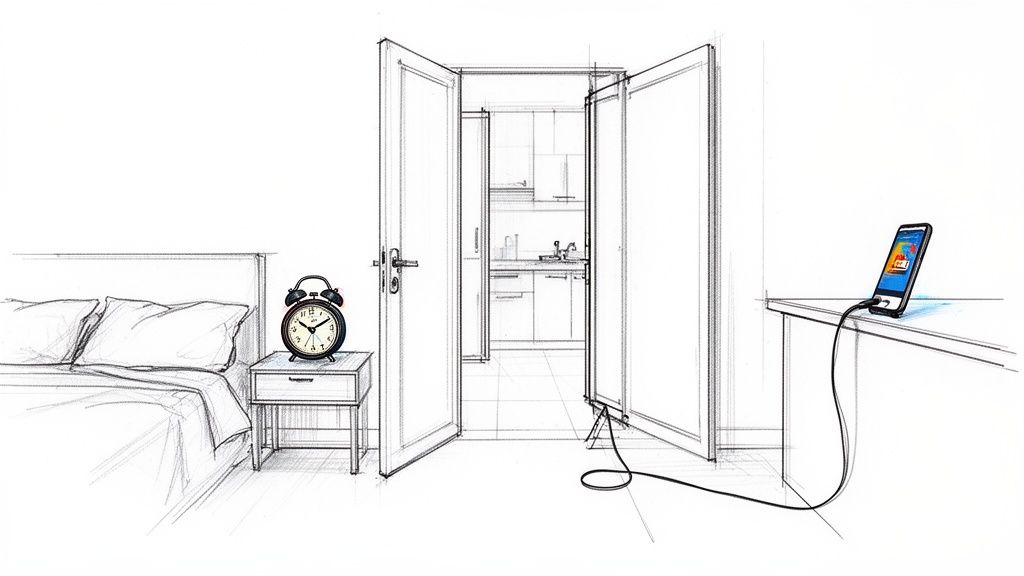
Set up a fixed charging station in the kitchen or the living room. This small detour makes a huge difference. If you wake up at night and the urge to scroll arises, you would have to get up specially and walk into another room. That turns an unconscious reflex into a conscious effort – one you would usually rather skip.
Digital Barriers: Your Smartphone's Settings
In addition to physical distance, you can set up your device so that it simply loses its appeal in the evening. You can put these technical tricks into practice right away:
- The “Do Not Disturb” mode as your bouncer: Schedule this mode so that it activates automatically every evening at the same time, ideally an hour before your bedtime. Calls and notifications are then put on hold.
- The grayscale trick: Colorful app icons and glowing images are specifically designed to stimulate our brain. Switch to grayscale mode. You will notice how boring and unappealing your display suddenly seems.
- Cut notifications deliberately: Take five minutes once and go through your list of apps. Disable notifications for everything that is not truly important, especially for the time after 8 p.m.
With these settings, your smartphone turns from a colorful entertainment center into a plain, rather uninteresting tool. The urge to pick it up fades, because it simply no longer sends out any new stimuli.
For everyone who needs an even more insurmountable barrier, there are physical aids. A lockable box can work wonders here. Take a look at how a Zenbox works to understand how such a physical lock truly prevents nighttime access. Tools like these are perfect for establishing a new habit without having to rely constantly on your own willpower.
Overcoming the Evening Urge to Reach for the Phone in Your Mind
Technical hurdles are a good start, but the real battle against evening smartphone use takes place in the mind. This habit is often more than just a bad habit – it is deeply anchored in our psyche and is usually driven by unconscious needs. To truly break this cycle, we have to understand what is actually driving us.
Most of the time it is the reaction to a particular feeling. Ask yourself quite honestly: what exactly am I really looking for when I reflexively reach for the phone in the evening? Is it pure boredom that I want to fill with endless feeds? Or is it the stress of a long day that I want to numb with distracting videos? Perhaps it is also the nagging fear of missing something important – the notorious “Fear of Missing Out” (FOMO).
Recognizing and Redirecting the Inner Triggers
Once you know your very own trigger, you can begin to develop healthier alternatives. The trick is not to suppress the feeling, but to give it a new, constructive direction.
Here are a few mental tools that have proven themselves in practice:
- When stress weighs on you: Instead of scrolling endlessly, try a simple five-minute breathing exercise. Concentrate only on how the air flows in and out. That calms the nervous system far more effectively than any social media feed.
- Against boredom: Keep a good book, a magazine, or an e-reader within reach on your nightstand. The goal is to have an appealing yet relaxing alternative at hand that does not require much willpower.
- With FOMO or worries: Keep a small gratitude journal. Simply write down three things that went well on that day. This shifts the focus away from what you supposedly are missing toward what you already have.
Techniques like these help you to deal with your own impulses more consciously and mindfully. If you would like to go deeper, in our article you can learn how to deliberately use mindfulness in everyday life as a tool against stress.
It should not be underestimated how widespread this nighttime behavior is. A study from 2020 found that working people in Germany use their phone after 11 p.m. on 60 percent of nights. The apps most frequently opened are the alarm clock, WhatsApp, and Instagram. You can find more details in the findings of the sleep study by Murmuras.
A very important point: A setback is not a failure. If you do reach for the phone again, do not see it as a defeat. Regard it as a learning opportunity. Ask yourself: what triggered this impulse just now, and what can I do differently next time?
It is about developing a forgiving attitude toward yourself. Progress is so much more important than perfection. Every evening that you let wind down without the phone is an enormous gain for your sleep and your mental health.
How to Deliberately Block Distractions With the Zenbox
Hand on heart: sometimes pure willpower simply is not enough. Especially when the day has been long, tiredness sets in, and reaching for the phone is already almost a reflex, we often fight a losing battle. This is exactly where physical aids come in, creating a real, insurmountable hurdle. A brilliant example of this is the Zenbox, which makes switching off digitally incredibly easy.
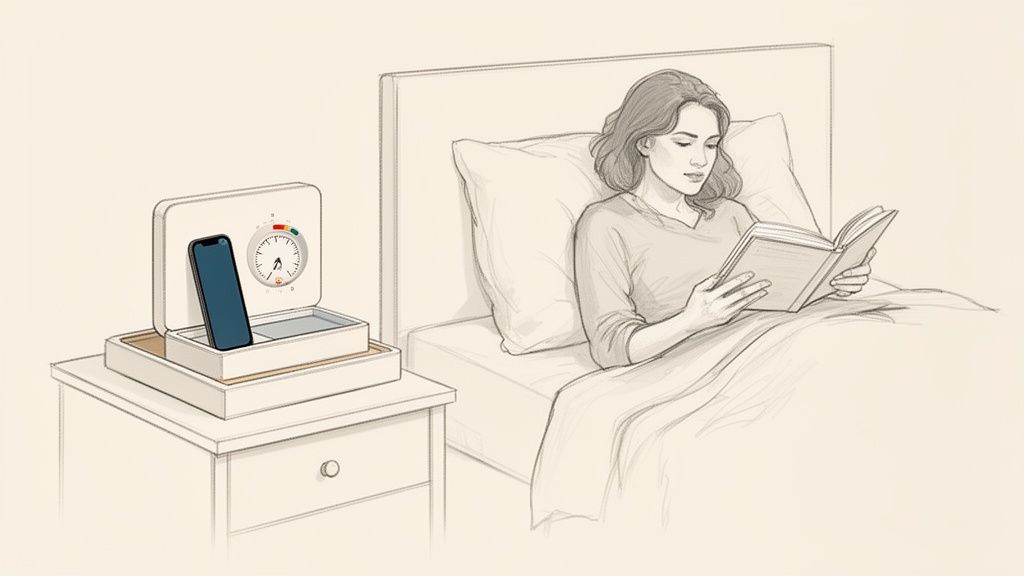
The principle is as simple as it is effective: you place your smartphone in the box, set the timer to the desired time – let's say until 7 a.m. the next morning – and that's it. The box stays shut. The impulse to “just quickly” scroll through Instagram or check the news is thereby immediately stopped.
Outsourcing the Decision
The real trick with tools like these is that you make the decision while you are still clear-headed – and not when you are lying in bed tired and short on willpower. You set the course for a calm night hours in advance and no longer have to rely on your fading discipline in the evening.
- No more internal debates: The box is locked. Period. There is nothing left to negotiate with yourself.
- Creating clear boundaries: You set a fixed, screen-free time that you cannot simply throw overboard in a weak moment.
- Establishing a new routine: Locking the phone away itself becomes a fixed part of your evening routine and helps to cement the new habit.
This method is a real game changer, especially for those who have already tried a few times to put the phone away and have failed again and again. The physical separation from the device practically forces you to turn to the analog alternatives you actually intended to pursue.
By actively blocking access to your smartphone, you take away all the power of the impulse. The habitual reach into the void quickly becomes a conscious signal that it is now really time to switch off.
Tools like these turn the good intention of “no more phone in bed” from a vague wish into a concrete, unavoidable action. They create exactly the friction it takes to break old automatic behaviors. If you would like to dive deeper into why this works so well, read our article about the science behind the Zenbox and how aids like these outwit our brain.
Reaping the Rewards: What a Screen-Free Evening Routine Really Brings
Once the technical hurdles are cleared and the mental course is set, perhaps the loveliest part of it all begins: you start to feel the positive changes quite concretely. Putting the phone away in the evening is far more than just a new rule – it is a conscious decision for more quality of life.
Often it only takes a few days before the first effects become noticeable. Sleep feels deeper, more restful. Your body finds its way back into its natural rhythm, and you notice that above all in the morning. Instead of dragging yourself out of bed worn out, you start the day with noticeably more energy.
More Than Just Better Sleep
This newly gained energy quickly radiates into other areas of life. Suddenly concentration at work or in your studies comes more easily, because at night the brain could finally truly switch off and regenerate. Perhaps you also notice that you react more calmly and patiently to small moments of stress in everyday life.
The screen-free time in the evening is not lost time. It is a valuable gift to yourself – a genuine chance for relaxation, a good conversation, or losing yourself in an exciting book.
Of course there will always be days when the routine wobbles. While traveling, in stressful phases, or simply when everything turns out differently. That is completely normal. What matters is staying flexible and not putting yourself under pressure. It is not about perfection, but about consciously returning again and again to this good habit.
At the end of the day, the decision to banish the smartphone from the bedroom is one of the best investments in your own physical and mental health. You gain not only valuable sleep, but also undisturbed time – for yourself and for the people who matter to you.
Common Questions and Honest Answers
On the path to a screen-free evening routine, almost always the same questions and hurdles come up. Don't worry, that is completely normal. Here are a few honest answers and practical tips to help you stick with it.
“But I need my phone as an alarm clock!”
That is probably the classic among the objections – and usually a convenient excuse to hold on to a cherished but harmful habit. The solution is wonderfully simple: buy yourself a plain, old-fashioned alarm clock.
An alarm clock can do exactly one thing: wake you. It does not bombard you with push notifications, does not lure you with endless scrolling on Instagram, and gives you absolutely no reason to pick it up in the middle of the night. This clear separation of functions makes it infinitely easier to avoid the phone before sleep, because the main temptation is not even within reach.
How Long Does It Take Until I Notice a Difference?
That varies from person to person, but many report noticeable improvements after just a few nights. It is often said that one falls asleep faster and feels fresher and more rested in the morning.
But give yourself and your body a little time. Deeply rooted habits are not shed overnight. My tip: stick with it consistently for at least a week. That way you give your brain the chance to get used to the new, calmer evening routine and to bring natural melatonin production back into balance.
Do Night Mode and Blue Light Filters Really Help?
Yes, they help, but they are not a miracle cure. Blue light filters do reduce the portion of light that disrupts our sleep the most, but they only solve part of the problem.
The second, often much larger disruptive factor remains: mental stimulation. Even with the filter activated, your brain is wide awake when you scroll through news, emails, or social media feeds. That creates stress rather than relaxation. The most effective strategy is and remains simply to put the device down completely.
When pure willpower is not enough to prevent the evening reach for the phone, a physical barrier can make the decisive difference. This is exactly where the Zenbox comes in. It creates a clear boundary that helps you stick with your new routine without great effort and finally find restful nights again. Take a look at the Zenbox and start a more focused life today.