

Overcoming phone addiction for more focus and quality of life
To really tackle smartphone addiction at its roots, we have to start at the very beginning: with ourselves. The first and most important step is to question our own usage honestly and without sugar-coating it. It's about developing a sense of when and why we actually reach for our phones. Often it's pure automatism, a deeply ingrained habit. Only once we recognize these patterns and the triggers behind them can we develop effective strategies.
Recognizing the creeping danger of phone addiction
Before we dive into concrete solutions, let's take an honest look at our own habits. The line between normal, heavy use and genuine dependency is blurry. Most of the time we only notice that something is wrong once the negative consequences become tangible in everyday life. It often starts quite harmlessly: the smartphone becomes a constant companion that serves as a quick escape route in every little break, in every moment of quiet, or even in the middle of a conversation with friends.
This behavior, by the way, is no coincidence but the result of clever psychological tricks. Every notification, every like, and every new post triggers a tiny dopamine release in our brain. That feels good, like a small reward, and unconsciously drives us to keep wanting more. This creates a vicious circle of stimulus, response, and reward that anchors itself deep in our daily life.
When digital habits sabotage everyday life
The consequences of this constant stimulation are more far-reaching than many of us want to admit. Let's take a look at two very typical scenarios from real life:
- The knowledge worker working from home: He sits in front of an important analysis that requires full concentration. But every few minutes the screen lights up. An email here, a Slack message there, a breaking-news alert over there. Every quick glance pulls him completely out of his train of thought. By the end of the day he is exhausted, frustrated, and unproductive, even though it felt like he was busy the whole time.
- The student during exam season: She urgently needs to study for an important exam. She deliberately sets her phone aside, yet her thoughts still keep circling around whether she's missed a message. After a few minutes she gives in to the impulse to take “just a really quick look” at Instagram. Seconds turn into minutes, and minutes quickly turn into a whole hour. Valuable study time is gone and her stress level skyrockets.
These examples make it clear: excessive phone use doesn't just cost us time. It destroys our ability to concentrate and diminishes the quality of our work, our learning, and our recovery. The feeling of having to be permanently reachable creates a constant inner restlessness and makes it impossible to truly focus on one thing.
Constantly reaching for the smartphone is rarely a conscious decision. Rather, it's a trained reflex to compensate for boredom, insecurity, or social pressure. The real art lies in switching off this autopilot.
This trend can also be backed up with impressive figures. Especially among young people in Germany, daily smartphone use has risen dramatically in recent years. Current surveys show that teenagers between 16 and 19 years old spend on average up to 261 minutes per day on their phones. This intense usage makes the fight against smartphone addiction a genuine societal task. If you'd like to dive deeper into the numbers, you'll find more on this in the findings of the JIM study on handyhase.de.
To make self-assessment easier for you, I've compiled some of the most common warning signs here. See it as a kind of checklist for recognizing whether it might be time to recalibrate your own digital balance.
Typical signs of problematic phone use
An overview of common symptoms that can indicate it's time to rethink your own smartphone use.
| Symptom | Description in everyday life | Possible impact |
|---|---|---|
| Loss of control | You use your phone longer or more often than planned. The intention to “just quickly check” often ends in hours of scrolling. | Loss of time, putting off important tasks (procrastination), missed appointments. |
| Phantom sensations | You feel vibrations or hear ringtones even though there is no notification. You feel incomplete without your phone. | Inner restlessness, anxiety (FOMO – Fear of Missing Out), constant distraction. |
| Tolerance development | You need more and more screen time to achieve the same feeling of satisfaction or distraction. | Lower productivity, social withdrawal, neglect of hobbies and friendships. |
| Withdrawal symptoms | When you can't use your phone (e.g. when the battery is empty), you become nervous, irritable, anxious, or even angry. | Emotional instability, difficulty concentrating, conflicts with those around you. |
| Neglect | Important areas such as work, studies, family, or your own health suffer because of your phone use. | Poor grades or work performance, relationship problems, lack of sleep. |
| Escapism | You deliberately use the smartphone to avoid unpleasant feelings such as stress, boredom, loneliness, or sadness. | Lack of coping strategies for real problems, emotional numbing. |
If you recognize yourself in several of these points, that's no reason to panic—it's an important first step. Awareness of the problem is the foundation for any change. And that's exactly what we want to help you with now.
Reclaiming the morning for a clear head
How the day begins is often how it goes. And for most of us it begins the same way: the first thing we reach for after waking up is the smartphone. Before we're even properly awake, we're swamped by a flood of messages, emails, and social-media notifications. This reactive start sets an unpleasant tone for the rest of the day—constant distraction and stress are practically pre-programmed.
The key to breaking this vicious circle lies in very consciously cutting off this automatism. Instead of starting the day with other people's digital noise, take the morning to focus on what matters: yourself. The goal is a conscious, screen-free morning routine that clears the mind rather than overwhelming it right away.
Physical hurdles as habit breakers
The strongest impulse is usually the one we can give in to most easily. One of the most effective methods is therefore to build a small but noticeable hurdle between yourself and your phone. It's not about banishing the device forever, but about making the reflexive reach impossible.
A very simple yet effective solution: consistently keep your smartphone outside the bedroom overnight. A classic alarm clock comes in handy here once again. This simple spatial separation alone prevents you from reaching for it right after waking up or in the middle of the night.
This is where the Zenbox comes into play—a smart little tool designed for exactly these moments. Deliberately place the unobtrusive box somewhere you only reach after the first steps of your morning. How about right next to the coffee machine, for example? Before you make your first coffee, briefly tap your phone on the Zenbox.
A quick NFC tap is enough and a previously defined timer starts. For the first hour of the day, it then blocks all distractions such as social media, news feeds, or private messengers. This tiny, conscious act creates a crucial buffer.
The following diagram illustrates very well how this cycle of trigger, response, and repetition works and cements our digital habits.
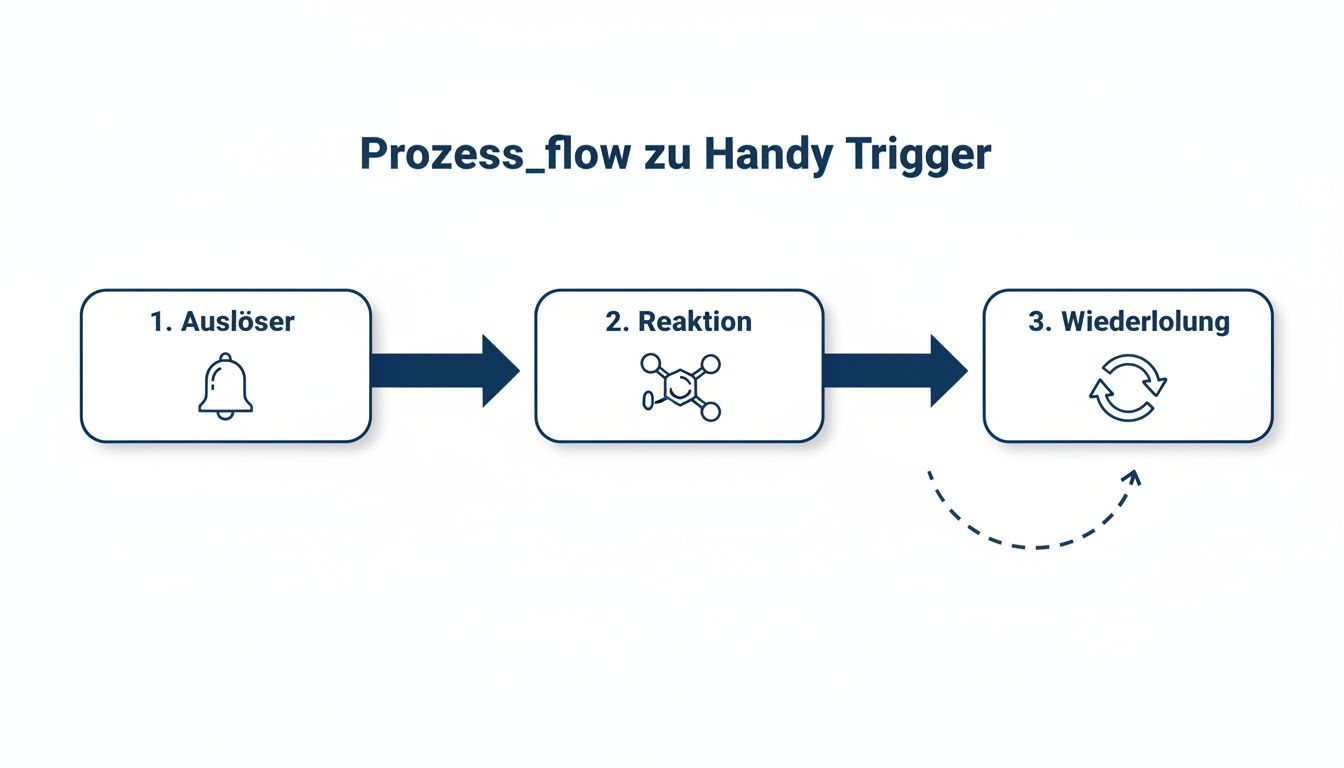
You can clearly see how an external notification (the trigger) causes a dopamine release (the response), which tempts us to repeat the behavior over and over again. This is how the habit grows stronger and stronger.
Creating space for new morning rituals
The time you gain through this newly created hurdle is your chance to completely redesign your morning. Instead of consuming passively, you can use the time actively for yourself. These don't have to be elaborate rituals, don't worry. Even five to ten minutes make a huge difference.
Why not try one of these alternatives:
- Short journaling: Write down three things you're grateful for, or note the one important task for the day.
- Gentle stretching: Get your circulation going gently and loosen up the tension from the night.
- Mindful drinking: Enjoy your first coffee or tea very consciously, without staring at a screen on the side. Taste, smell, feel.
- Reading a few pages: A real book instead of an endless feed. It stimulates the mind in a much calmer, deeper way.
By reclaiming the morning, you lay the foundation for a focused and self-determined day. The first victory of the day is the one over your own autopilot. And it feels darn good.
Finally working and learning undisturbed and focused
Constant interruptions are the absolute productivity killer, especially when working from home or cramming for an exam. Even the smallest distraction, every fleeting glance at the phone because a message lights up, pulls us out of the flow. And it's no myth: after an interruption it takes on average over 20 minutes to be fully back on task.
This problem sits deep in our psyche. Our brain is wired for new stimuli, and the smartphone delivers an endless supply of them. Resisting the impulse to “just quickly” take a look is incredibly hard. Anyone who wants to get their phone addiction at work under control therefore needs more than just good intentions—they need a solid strategy and clear rules.
How to create real focus oases
One of the best-known methods for bundling your concentration is the Pomodoro technique. The principle is simple: you work in fixed blocks, for example 25 minutes of high concentration, and then take a five-minute break. This rhythm preserves your mental energy and prevents burnout. The catch, however, is this: those 25 minutes have to be truly free of interruptions.
This is exactly where the combination of a proven technique and a smart helper comes in. The Zenbox becomes your personal guardian of undisturbed time. You can simply attach it magnetically to a filing cabinet or another metal surface in the office—ideally so that you have to get up to reach it.
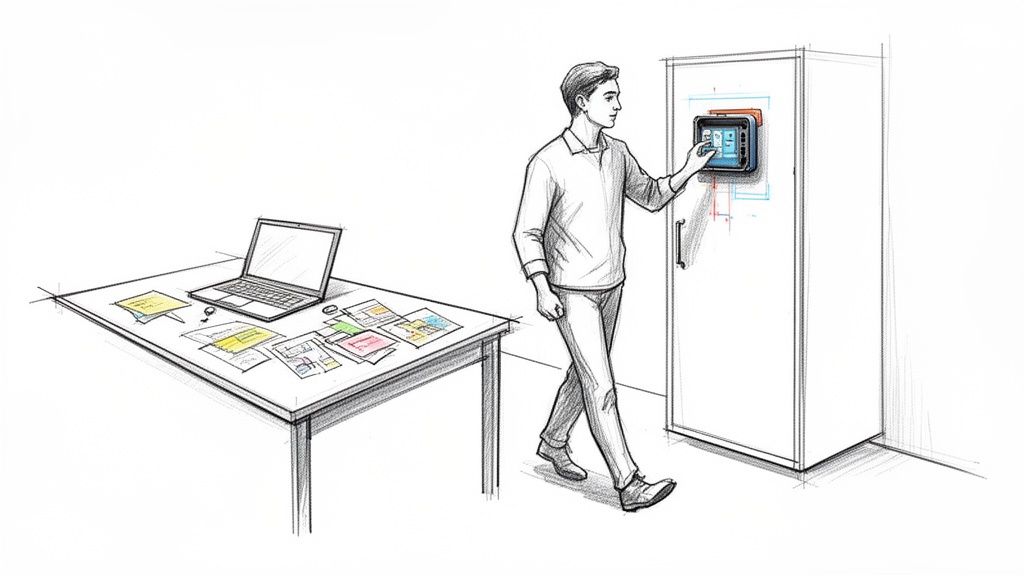
Before you start a task, you specifically select in the app the apps that distract you the most: social media, private messengers, news portals. A quick tap on the box, and the focus timer starts. This small, conscious act is your starting signal for a phase of real, deep work.
The trick lies in the physical hurdle. To lift the lock early, you have to get up and walk over to the box. This small extra effort breaks the automatic reach for the phone and gives you that decisive moment to ask yourself: “Is this really that important right now?”
Individual focus modes for every task
Not every activity demands the same kind of concentration. Creating a presentation is something completely different from working through emails. That's why you can set up various “focus modes” in the app, perfectly tailored to your particular tasks.
- “Deep Write” mode: Here everything that isn't needed for writing is blocked. Maximum calm for creative or demanding texts.
- “Research” mode: Allows the browser and note apps, but reliably blocks all social networks and messenger services.
- “Admin stuff” mode: Leaves email and calendar apps open, but puts a stop to time-consuming news feeds and shopping apps.
Such presets don't just save time, they also help you flip the right mental switch for the next task with a single tap. Over time you'll develop a much better sense of which digital tools you really need and which are just distraction traps. If you'd like to dive deeper into the topic of how to create such moments of calm in everyday life, take a look at our article on mindfulness as a tool against stress.
The numbers speak for themselves: 81 percent of people in Germany aged 14 and over own a smartphone—that's around 57 million users. For students and knowledge workers, this constant reachability often means a flood of distractions that costs valuable concentration. By consciously creating interruption-free zones, you reclaim control over your most valuable resource: your attention.
Creating conscious offline islands for family and leisure
The smartphone doesn't just disrupt our focused work, it also creeps into our most precious private moments. It's time to take back control and turn leisure time back into a genuine place of recovery, instead of filling it with endless scrolling.
We combat constant distraction most effectively by establishing very conscious, screen-free zones in our daily life. These “offline islands” are fixed times or places where the smartphone simply goes off air. A perfect starting point for this is dinner together.
Rediscovering shared time as a family
For families in particular this is a special challenge, but also a huge opportunity. A simple rule like “no phones at the dinner table” is easy to implement and has an enormous effect. Suddenly real conversations arise again, you look each other in the eye and share the day's experiences. The same principle can be wonderfully applied to game night or the weekend outing.
To make such rules fair and easy for everyone to follow, a helper like the Zenbox can come into play. The clever part: every family member can pair their own smartphone with the same box.
Picture this: before dinner, the box—perhaps stuck magnetically to the fridge—becomes the central collection point. Everyone briefly taps their phone, starts a shared “family time” timer, and the digital troublemakers are put out of action for that period.
This small, almost playful act creates a clear boundary and directs attention back to where it belongs: to being together. It doesn't feel like a ban, but like a conscious decision in favor of shared time. You can see exactly how the Zenbox works and makes everyday life easier directly on the product page.
Reclaiming leisure time for yourself too
But it's not only in a group—it's also crucial for us as individuals to create digital free spaces. Think about your hobbies and passions. How often has a good reading session, a workout, or a creative project been interrupted by the quick, almost unconscious reach for the phone?
To prevent exactly that, targeted offline rituals help:
- During exercise: Consciously leave your phone in the locker room or use a focus mode that only allows your music app. That way you can fully concentrate on your body and the movement.
- While reading: Very deliberately place your smartphone in another room. Physical distance is often the most effective method for not giving in to the temptation in the first place.
- During creative hobbies: Whether painting, making music, or crafting—these activities thrive on the flow state. Every notification immediately pulls us back out. An activated timer via the Zenbox can create the protective space needed here to truly immerse yourself.
By creating such conscious offline islands, you don't just win back time. You increase the quality of your recovery, strengthen your relationships, and rediscover a deeper connection to the things that truly bring you joy.
Ending the day relaxed with a “Digital Sunset”
Just as a conscious morning lays the cornerstone for a productive day, a calm evening routine determines the quality of our night's rest. And yet the end of the day looks frighteningly similar for many of us: endless scrolling through social-media feeds, answering a last few emails, or binge-watching videos right before falling asleep. The best way to counter this deeply rooted habit is with a clear structure, in order to combat phone addiction.
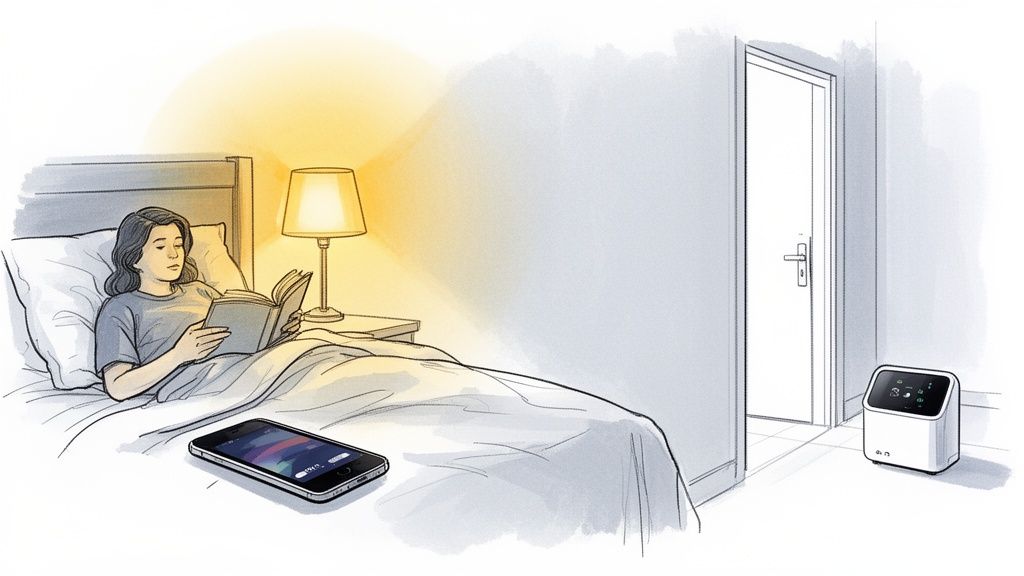
The problem here is twofold. On the one hand, the blue light of displays demonstrably inhibits the production of the sleep hormone melatonin. The result: we have a harder time settling down and our sleep quality suffers. On the other hand, the constant flood of information and stimuli keeps us mentally on edge, precisely when our brain should actually be switching off. A so-called “Digital Sunset”—that is, a deliberately screen-free phase before going to bed—is therefore not a nice luxury but a real necessity for restful sleep.
Establishing a relaxing evening routine
The key to success lies in breaking the autopilot. Instead of reaching for your phone out of pure habit, deliberately create a relaxing alternative for yourself. It's about developing a routine that unmistakably signals to your body and mind: “Now it's time to wind down.”
A very concrete suggestion: decide that one hour before bedtime the screen-free time begins. In this hour it's about finding activities that genuinely relax you rather than stimulate you.
- Read a real book: Immerse yourself in another world, entirely without the distraction of popping-up notifications.
- Listen to an audiobook or a podcast: A wonderful way to enjoy stories without having to stare at a screen.
- Have a conversation: Talk with your partner or your family about the day—one of the best ways to strengthen genuine connections.
- Write down a few thoughts: A simple journal can work true wonders for clearing your head and letting go of worries.
To minimize the temptation to take “just one more quick look” at your phone, a physical barrier is worth its weight in gold. Here too the Zenbox can play a decisive role. Place it deliberately outside the bedroom, for example in the living room or the hallway.
A quick tap on the box is enough to activate a preset “evening calm mode.” It blocks all stimulating apps such as social media, news portals, and messengers for the last hour of the day.
This simple step eliminates the impulse to take the phone to bed with you. It creates exactly the free space needed so that your new, healthy evening routine can become a firm habit. By letting the day wind down consciously and mindfully, you pave the way for a deeper, more restful night's sleep—and wake up noticeably fresher the next morning.
Celebrating successes and staying on track—this is how change becomes a habit
Establishing a new routine is a bit like a long-distance run, not a sprint. At first you're often highly motivated, but to really keep your phone in check for the long term, you need more. The key lies in making your own progress tangible and fine-tuning the plan again and again. That's the only way to stick with it without falling back into old patterns.
So make your successes visible. The Zenbox app has a clever tracking tool for this. Take a few minutes at the end of each week and look at the statistics. You'll see in black and white how your focus hours grow and the number of interruptions—that is, the moments when you end a timer early—steadily decreases. Seeing that is a real motivation booster.
Cleverly building new routines into everyday life
The trick to anchoring a new habit permanently is to couple it with one that already exists. This is called “habit stacking” and works surprisingly well because it costs hardly any additional willpower.
So instead of just vaguely intending to “be on the phone less,” create very concrete links. That could look like this, for example:
- In the morning: “After I've made my first coffee, I put the phone in the Zenbox for a 60-minute session.”
- At work: “Before I open the laptop for an important task, I activate ‘Deep Work’ mode.”
- In the evening: “As soon as I start brushing my teeth, I start the ‘Digital Sunset’ timer.”
These small, fixed rules fit quite naturally into the daily routine. Over time, the conscious phone break becomes a completely normal automatism.
Setbacks are no drama, but part of the journey. What matters is not that they happen, but that you pause briefly, ask yourself why it happened, and adjust your strategy accordingly.
So don't be too hard on yourself. If you notice that you keep interrupting a timer, maybe it was simply too long. No problem! Instead, start with shorter intervals of 25 minutes and gradually build up. Adjust your focus times regularly. That way you'll find a balance between digital calm and reachability that truly fits your life.
Your most frequently asked questions about phone addiction
We keep getting questions about how best to tackle the fight against constant distraction. Here I've collected the most common and most important ones and give you practical answers that really help.
What do I do if I need my phone for work?
This is probably the classic dilemma. You have to be reachable, but you don't want to be constantly pulled out of the flow by Instagram, TikTok & co.
The solution lies in clear boundaries. Set fixed work and break times. During these "Deep Work" phases you can use tools like the Zenbox to specifically block only the troublemakers—that is, social-media apps and other time wasters. Your work apps such as email or Slack naturally stay active. That way you stay productive and reachable for important matters, without being exposed to the constant ping of notifications.
How long does it take before I feel a real change?
You'll often notice first successes, such as significantly better concentration, after just a few days. That's hugely motivating!
But to genuinely change an old, deeply ingrained habit for the long term, it takes time and patience. Realistically count on a period of at least 30 to 60 days. During this time your new routines solidify and the brain learns to no longer constantly crave the next dopamine hit.
The key doesn't lie in being perfect overnight, but in staying the course. Many small, consistent steps ultimately lead to a big and lasting change.
Does the Zenbox work with every smartphone?
Good question! The Zenbox was designed to work with the vast majority of modern smartphones.
The crucial technology for this is NFC (Near Field Communication). Almost every current Android device and iPhone has it on board. You can then simply download the Zenbox app for free from the Google Play Store or Apple App Store.
For very precise details and a list of compatible devices, it's best to look directly in our frequently asked questions about the Zenbox.