

Overcoming Phone Addiction: How to Succeed – Overcoming Phone Addiction in Everyday Life
The first and perhaps most important step to overcoming your phone addiction is an honest assessment. Before you change anything, you need to understand what exactly is happening. It's about uncovering your own behavioral patterns: When do you reach for your smartphone, why do you do it, and how often does it actually happen? Only with this awareness can you take focused action and regain control.
Recognize the True Signs of Your Phone Addiction
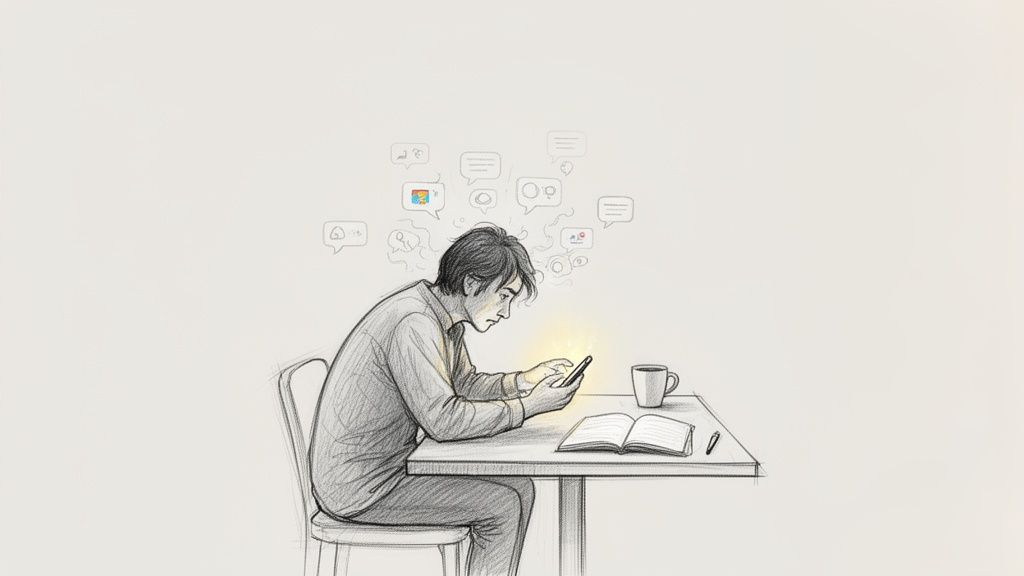
Does this sound familiar? You only wanted to quickly answer a message, and suddenly half an hour has passed. What was meant to be a useful tool increasingly feels like an invisible opponent. Many people share this feeling. A harmless habit can gradually develop into a pattern that noticeably weighs on your focus, your productivity, and even your relationships.
The way out of this spiral begins with recognizing the real signs. And these go far beyond mere screen time. It's often the small, almost unconscious behaviors and feelings that signal to you that your digital balance has begun to falter.
More Than Just Screen Time
The hours and minutes your statistics app shows are only part of the story. Far more important are the emotional warning signs that creep into your everyday life. Pay close, conscious attention to the following:
- FOMO (Fear of Missing Out): A nagging feeling that you constantly have to be online so you don't miss any messages, updates, or social events.
- Phantom vibrations: You feel or hear your phone even though there was no notification at all. A clear sign that your brain is waiting for the next stimulus.
- Inner restlessness: You become nervous or irritable when your phone isn't within reach or the battery is running low.
- The automatic reach: The moment a gap of emptiness appears – in the elevator, at the checkout, during the commercial break – your hand is already on your smartphone. Completely without thinking.
These reactions are no coincidence. They are deeply anchored in our reward system. Every like, every message, and every new piece of information triggers a small dopamine hit. That feels good, and our brain wants more of it.
Awareness is the first step toward change. Without an honest assessment of your behavior, you're fighting against an invisible enemy. Only when you know your personal triggers and patterns can you develop an effective strategy.
Typical Scenarios and Your Personal Triggers
Ask yourself quite specifically: In which situations does your phone become an escape? Do you reach for it to put off a difficult task while working from home? Do you scroll through feeds to distract yourself from the stress of studying? Or is it your companion when you feel lonely or overwhelmed? Identifying these triggers is worth its weight in gold.
Be aware: You're not alone. In Germany, according to the JIM study, we spend an average of 3 hours and 51 minutes per day on our phones. Even more telling is that 68 percent of respondents admit they often use their smartphone longer than planned because they simply can't put it down.
These numbers show how real the battle for our attention is. It's not a sign of weak willpower, but a normal reaction to cleverly designed apps.
Quick Self-Test on Smartphone Use
Answer these questions honestly to better gauge your usage behavior and recognize initial patterns.
| Behavior or Feeling | Description | Often Applies to Me (Yes/No) |
|---|---|---|
| First & Last Reach | I reach for my phone first thing in the morning and last thing at night. | |
| Social Neglect | I often use my phone while I'm together with friends or family. | |
| Missed Reality | I catch myself missing important moments because of my phone. | |
| Feelings of Guilt | After prolonged use, I often feel bad or unproductive. | |
| Failed Attempts | I've already tried to reduce my phone use, but I failed. | |
| Irritability | I become impatient or annoyed when I have no reception or the Wi-Fi is slow. |
How many "Yes" answers do you have? Each one is a hint that it's time to take a closer look and become active.
If you'd like to dive deeper into the signs, also read our article on whether you're already addicted to your smartphone. The journey begins here and now – with an honest answer to yourself.
Develop Conscious Digital Habits
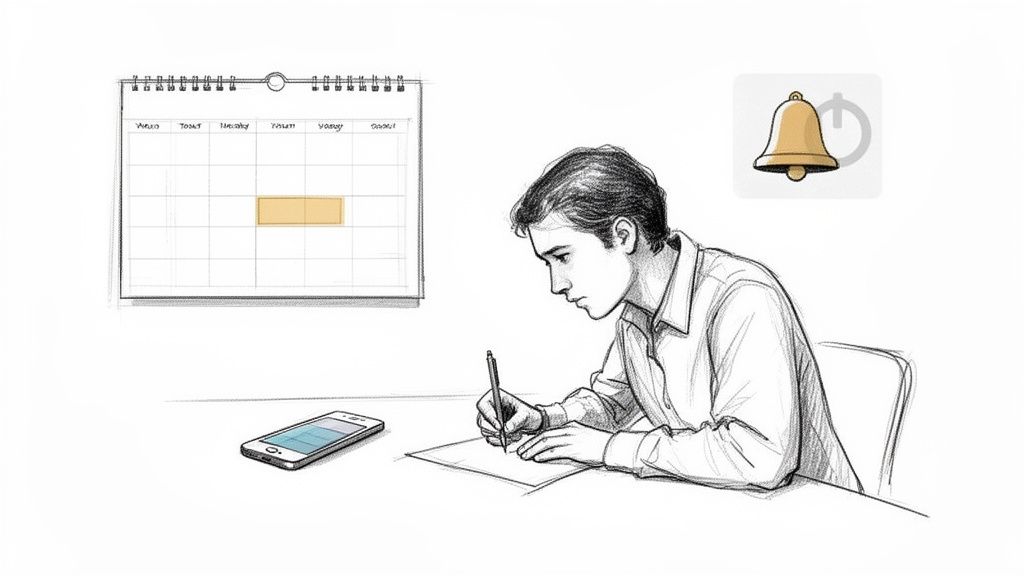
Okay, you now have your triggers and patterns on your radar. The next step is to actively counteract them. The goal isn't to demonize the smartphone – it's a useful device. It's about making it a tool you control again, and not the other way around. To do this, we replace the unconscious reach for the phone with conscious routines.
We're essentially building small but noticeable hurdles into your everyday life. Each one helps you interrupt the autopilot and reclaim control over your time and attention piece by piece.
Structure Your Smartphone Time with Timeboxing
One of the most effective methods I know is timeboxing. Instead of vaguely resolving to “be on your phone less,” you set quite specific time windows for certain activities. This creates incredible clarity and frees you from that nagging feeling of constantly missing something.
Imagine planning your private online time just as disciplined as your professional appointments. This could look something like this:
- Social media slots: You allow yourself to scroll through your feeds from 12:30 to 12:50 p.m. and in the evening from 7:00 to 7:20 p.m. Outside these times, the apps stay closed. Period.
- Batching messages: Instead of reacting to every single message immediately, you gather this task together. Only check your emails and messengers three times a day: in the morning at 9 a.m., at midday at 1 p.m., and at the end of the workday at 5 p.m.
This simple technique protects your most valuable blocks of time for focused work or genuine, undisturbed leisure. At the same time, you train your brain that there isn't an instant digital reward with every impulse. This greatly strengthens your mental focus.
Defuse the Visual Stimuli on Your Home Screen
Your smartphone is deliberately designed to capture your attention. Colorful app icons, red notification counters, and constant pop-ups are visual lures that entice your brain to tap. An incredibly powerful trick is to deliberately minimize these stimuli.
Your home screen is the desk of your mind. A cluttered, noisy desk creates a restless mind. Design it deliberately minimalist so you can think clearly again.
Start with these small but meaningful adjustments:
- Turn off (almost) all notifications: Keep only the absolutely most important alerts – calls or perhaps messages from your family. All badges, banners, and sounds from social media, news portals, and shopping apps? Get rid of them.
- Banish the tempters from your home screen: Social media, news, and gaming apps have no place on the first screen. Move them into a folder on the second or third page. That little extra swipe alone is a hurdle that often interrupts the automatic reach.
- Activate grayscale mode: A colorless screen instantly makes endless scrolling through Instagram feeds unappealing. You'll usually find this function in your phone's accessibility settings. Just try it for one day – you'll be amazed at how little appeal your phone suddenly radiates.
These small changes throttle the constant dopamine release triggered by the visual stimuli. Your phone becomes what it's meant to be again: a functional tool, not a flashy slot machine.
Create Phone-Free Zones and Times
Just as important as digital order are clear spatial and temporal boundaries. Certain places and moments in your home should become protected, screen-free oases. Such rules help you be more present in the here and now and finally truly switch off again.
Probably the most important rule for better sleep and a calmer mind: the “no phone in the bedroom” rule. The blue light of the display demonstrably disrupts the production of the sleep hormone melatonin, and constant availability prevents your brain from truly coming to rest.
More ideas for phone-free zones:
- The dining table: Meals are there to connect with the people around you. Make it a firm family rule: at the table, all smartphones stay in your pocket.
- The bathroom: Use these short breaks to simply just be, instead of filling them with mindless scrolling.
- Your reading corner: When you deliberately retreat to read, intentionally leave your phone in another room.
By creating such zones, you not only establish new habits. You signal to yourself and others that your undivided attention is something valuable.
Creating Physical Barriers: The Easiest Way to Outsmart Distraction
Let's be honest, pure willpower is often just a drop in the bucket. Digital habits are deeply anchored in our daily lives, and reaching for the phone is usually an unconscious automatism. It's triggered by boredom, stress, or the smallest moment of downtime.
To break this vicious cycle, it takes more than good intentions. We have to build noticeable, physical hurdles. Such barriers act like a built-in stop sign for our brain. They pull us out of autopilot mode and force us to ask a conscious question: “Do I really want this right now?” Often that little pause for thought is enough to ward off the impulse and stay on task.
The “Out of Sight, Out of Mind” Strategy
The best method is often the simplest: deliberately create distance between yourself and your smartphone. When you really need to concentrate, put it in another room. No, not just at the other end of the desk, but in a way that you no longer see it and can't simply reach for it.
This simple act has an enormous psychological effect. You increase the so-called activation energy – that is, the effort you have to make to give in to the distraction. Instead of just briefly extending your hand, you'd now have to stand up, change rooms, and actively fetch the device. In most cases, that's enough to nip the fleeting impulse in the bud.
Here's what this looks like in everyday life:
- At work: During an important work phase, deliberately place your phone in the living room or a hallway drawer.
- While studying: Leave it in the kitchen while you sit at the desk in your room.
- During dinner together: Introduce a “phone garage,” a basket or a bowl in which all devices are parked during the meal.
Physical barriers are not a punishment, but a form of intelligent self-care. You create a protected space in which your focus can grow – free from constant digital temptation.
The Focus Box: Your Personal Off Switch
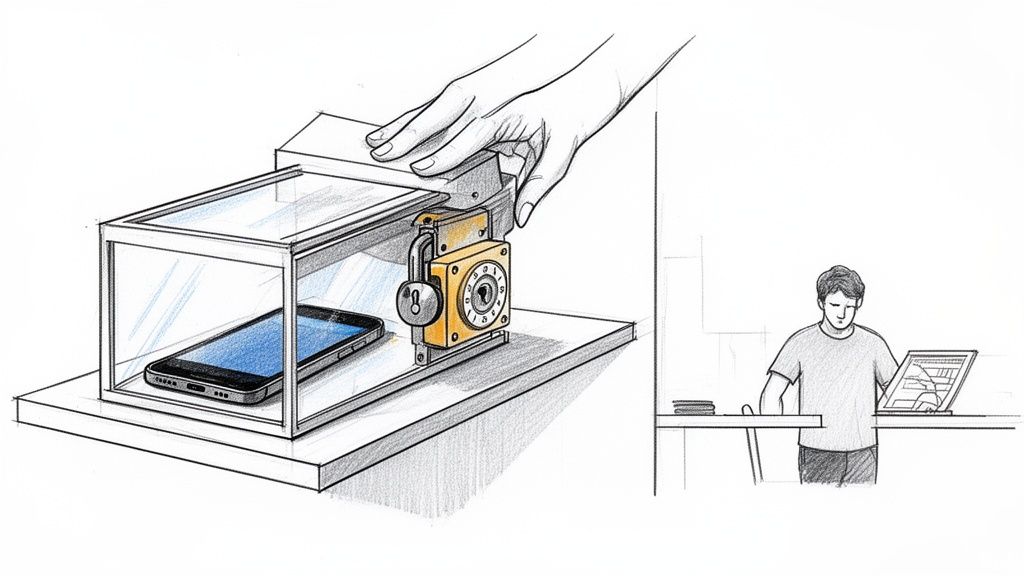
Sometimes it's not enough to simply put the phone away. It needs an even clearer boundary. This is where a focus box comes into play – a tool that combines physical distance with a hard time-based lock. Think of it like a small safe for your smartphone that you lock for a predetermined period.
This conscious act of locking it away sends an unmistakable signal to your brain: “It's focus time now. End of discussion.” You hand over control for a certain period and thereby mentally free yourself from the constant option of “just quickly” checking. This reduces the cognitive load of having to constantly fight against this urge. That way, valuable mental capacity is freed up for what truly matters.
A physical box makes the decision tangible and final. It creates an insurmountable hurdle that holds up even in the weakest moments – a decisive advantage over pure app blockers, which can be bypassed with a few clicks.
Using the Zenbox Cleverly in Everyday Life
The idea, of course, isn't to lock your phone away forever. Rather, it's about using the box in a targeted way to reclaim valuable, undisturbed blocks of time. It becomes your accomplice for more mindfulness and productivity.
Scenario 1: The undisturbed morning routine Instead of sinking straight into your news feed after the alarm, you lock your phone in the box for the first hour of the day. Use this time for meditation, a few pages of a book, or a quiet breakfast. You'll notice how much more present and calm you start your day.
Scenario 2: The deep-work sprint You have to work on an important project. Lock your phone in the box for 90 minutes and deliberately place it out of reach, for example on a high shelf. During this time, there's only you and your task. No chance for distraction.
Scenario 3: The present family evening You want to have a game night, but someone keeps glancing at their phone. Set a rule: for two hours, all smartphones go into the box. Suddenly the conversations are deeper and the time together feels real again.
By using such a tool, you actively train your “focus muscle.” If you'd like to know exactly how that works, you'll find more information about The Zenbox, which helps you reach your goals. It's about regaining great mental freedom through a small physical action.
Establish Mindful Morning and Evening Routines
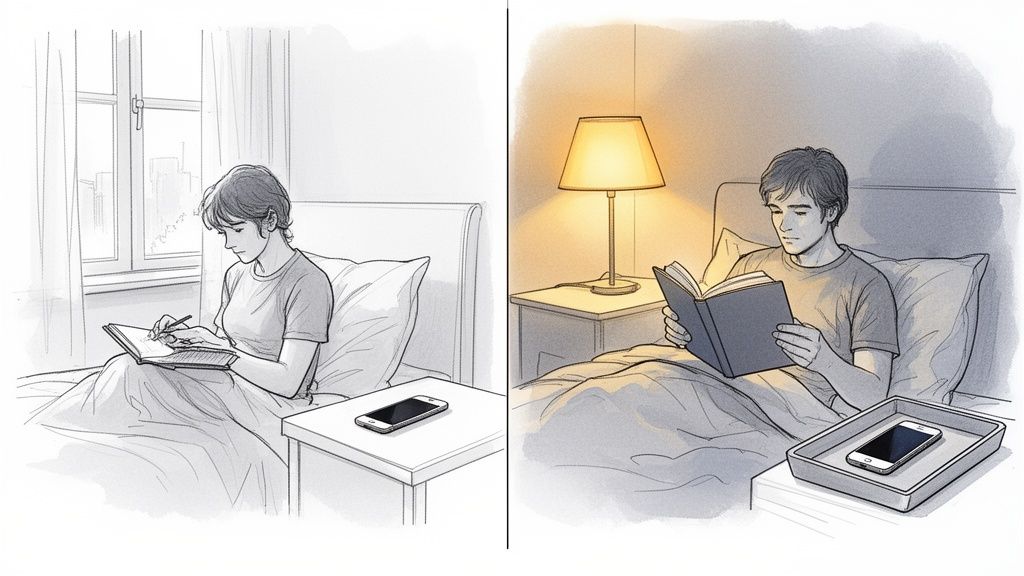
How we start the day and how we end it shapes us more than we often want to admit. These two time windows, the first and last hour of the day, are crucial for our mental state and productivity. Yet this is precisely where a habit has crept in for most of us that harms more than it helps: reaching for the smartphone.
This automatism is no coincidence and has long ceased to be purely a youth phenomenon. Data from Statista shows how deeply the smartphone is rooted in our lives: 16- to 29-year-olds spend an average of 212 minutes a day on their phones, for 30- to 49-year-olds it's 158 minutes, and even 50- to 64-year-olds still reach 148 minutes. Apps are designed to keep us hooked with likes and notifications. To understand what our smartphone time really looks like, it's worth taking a closer look at the mechanisms behind it.
To break out of this cycle, we need conscious alternatives – rituals that give us strength rather than draining it.
Start Your Day Without a Screen
Eyes barely open, and the phone is already in your hand? That instantly catapults your brain into stress mode. You're confronted with messages, emails, and the glossy productions on social media before you've even properly arrived with yourself. That way, you hand over control of your day's start completely.
Take it back! Establish a morning routine that truly belongs to you and in which the smartphone is off-limits for the first hour.
- Journaling: Grab pen and paper and write down three things you're grateful for. It takes less than five minutes but immediately directs your focus to the positive.
- Movement: A short walk around the block, a few stretches at the open window, or a little yoga session gently awaken body and mind.
- Stillness: Simply sit down and take a few deep breaths. A few minutes in silence help you enter the day centered and calm. At first, apps like Headspace or Calm can help, but the goal should be to manage it without a digital crutch too.
Such analog activities create a valuable buffer between waking up and the flood of digital stimuli. You decide with what energy your day begins.
Your morning routine sets the tone for the rest of the day. Do you hand the scepter over to your smartphone, or do you keep it in your own hand? The decision you make in the first 60 minutes is one of the most important of the day.
Introduce a “Digital Dusk” in the Evening
At least as important as the morning is the evening. The blue light from screens disrupts the production of the sleep hormone melatonin, which makes falling asleep harder and massively impairs sleep quality. So introduce a “digital dusk”: at least 60 minutes before going to bed, the phone is off-limits – and ideally outside the bedroom.
What can you do instead?
- Read: A real paper book helps the mind come to rest.
- Listen: Let the day wind down with relaxing music or a calm podcast. Deliberately choose content that brings you down, not stirs you up.
- Relax: A warm bath signals to the body that it's time to power down and relaxes the muscles.
- Talk: Use the time for an undisturbed conversation with your partner or your family – entirely without distraction.
These phone-free rituals not only improve your sleep but also noticeably reduce stress. You finally give your brain the chance to process the impressions of the day instead of overloading it with new stimuli. Such conscious breaks are a central building block for overcoming your phone addiction in the long term. You can learn more about how to shape such moments in our article on mindfulness in everyday life as a tool against stress.
Digital Balance as a Shared Family Project
Phone addiction is rarely an individual's problem. Far more often it's a symptom that affects the whole family and provides plenty of friction. The partner who only stares at the display during dinner, the child who becomes unbearable without their smartphone – such situations gradually create distance and frustration where there should actually be closeness.
The good news? Shared solutions are almost always more effective than the lonely struggle. When the whole family pulls together, digital balance doesn't become a forced sacrifice but a shared goal that can even strengthen relationships. It's about tackling the whole thing as a team instead of blaming each other.
From Conflict to Cooperation
The first and most important step is to address the problem openly – but without wagging your finger. Instead of an accusatory “All you ever do is hang on your phone!” an I-message works wonders: “I sometimes feel quite alone at the dining table when we both look at our phones. I wish we'd use this time more for each other again.”
Such an opening opens the door to an honest conversation in which everyone can describe their point of view. Often it turns out that everyone is actually suffering from the situation, but no one really knew how to break the vicious cycle.
A family is a team. Instead of making the smartphone the enemy, you can together demote it to a tool that serves your togetherness – and not the other way around. Real connection happens offline.
The goal is to set up clear rules that everyone can understand. Don't see them as punishments, but as agreements for more shared time and a better quality of life for all.
Concrete Rules That Really Work
To avoid power struggles from the outset, the rules should be worked out together. Everyone, including the children (age-appropriately, of course), should be allowed to bring in their wishes and boundaries. This greatly increases acceptance and each person's sense of responsibility.
Three simple but extremely effective family rules:
- Phone-free meals: The dining table becomes an absolute no-go zone for smartphones. Set up a “phone garage” – a small basket in the hallway is enough, in which all devices are parked during the meal. That takes the temptation directly out of view.
- The first and last hour of the day: The first hour after waking and the last before going to bed belong to the family and to your own rest, not to the screen. This demonstrably promotes better sleep and a much more conscious start to the day.
- Shared offline adventures: Each week, deliberately plan an activity where the phones intentionally stay at home. It doesn't have to be anything big: a walk in the woods, a fun game night, or trying out a new recipe together. The main thing is that you're together and present.
The All-Decisive Role-Model Function
Children learn above all through one thing: imitation. When parents themselves constantly reach for their smartphone, all the rules that have been set up lose their credibility. This discrepancy is one of the most common sources of family conflict. A survey by Bitkom shows that three quarters (75 percent) of parents regularly argue with their children about their phone use, while 14 percent even consider their child addicted.
So be honest with yourself: Do you model the rules you expect from your children? If you demand the phone-free hour in the evening but scroll through the Instagram feed yourself, you're sending a clear message – just the wrong one.
The path out of phone addiction becomes so much easier when it turns into a positive, shared project. It's not about giving something up, but about gaining something priceless: undisturbed time, deeper conversations, and genuine, present moments together.
Measure Your Success and Plan for When Things Slip
Changing a habit is a marathon, not a sprint. On the path to getting your phone addiction under control, there will be good days and bad days. That's completely normal. What's decisive isn't being perfect, but consistently staying with it. For that you need above all two things: visible successes that keep you motivated, and a clear plan for the moments when you do slip back into the old pattern.
Instead of fixating only on the big metric of “screen time” – which, honestly, can often be pretty demotivating – focus instead on small, positive changes. It's precisely these little victories that make your progress tangible and give you that important feeling of regaining control.
Make Your Progress Visible
Choose simple, concrete metrics that relate directly to the new routines you want to build. Tracking these small successes gives you the positive feedback you need to stay motivated.
- Phone-free morning hours: Simply count how often per week you manage to start the first hour of the day without your smartphone. Every day is a win!
- Focus phases at work: Note how many undisturbed work blocks (say, 90 minutes) you manage in a day during which your phone was completely out of reach.
- Conscious breaks: Record how often, in a typical waiting situation – at the bus stop, in the supermarket queue – you deliberately did without your phone and observed your surroundings instead.
A plain notebook or a simple app is entirely enough for this. It's not about the perfect statistics, but about seeing your efforts in black and white. Every checkmark on your list is proof: You can do this.
Prepare for Setbacks – They're Part of It
A relapse is not a failure, but simply valuable feedback. It happens to all of us. It shows you exactly where your strategy still has a gap. So instead of beating yourself up because you scrolled aimlessly through social media for an hour again, look at the situation like a detective.
Ask yourself quite honestly: What exactly was the trigger?
A setback doesn't mean you've failed. It's information. It doesn't tell you that you're weak, but shows you where your next learning step lies. Use this insight to adjust your strategy and be stronger next time.
Often it's the same triggers again and again that let us fall into the trap. Find your personal weak spots and develop a quite concrete “if-then” plan for each one.
Typical triggers and your counter-strategy:
| If-Situation (The Trigger) | Then-Action (Your Plan) |
|---|---|
| I'm stressed and looking for a quick distraction. | I stand up and walk around the block or to the open window for five minutes. |
| I'm bored and don't know what to do with myself. | I reach for the book that's been sitting on my nightstand forever. |
| I feel lonely and want to look for connection online. | I call a good friend or a family member – for a real conversation. |
This proactive approach takes all the power away from the setback. You're prepared and have a healthy alternative at hand, even before the automatic reach for the phone can happen at all. That way, every stumbling block becomes another step on your path toward a sustainable digital balance.
Frequently Asked Questions About Phone Addiction
When you set out to use your phone more consciously, very similar questions and uncertainties often come up. I've gathered and answered the most common ones here, to give you a bit more clarity on your path out of phone addiction.
Is Phone Addiction Actually a Recognized Illness?
Even though we all use the term “phone addiction,” it's not yet found as an independent illness in the official diagnostic catalogs like the ICD-11. Experts speak more of problematic media use or a behavioral addiction. The symptoms, however, are strikingly similar to those of recognized addictions: loss of control, withdrawal symptoms when the phone is gone, and the neglect of important areas of life.
Can You Really Do It on Your Own?
The good news is: Yes, for many it's absolutely possible. When you set up the right strategies for yourself – that is, introduce conscious routines, create real physical barriers, and have a plan for bad days – you can regain control yourself.
The key lies in being honest with yourself. If you notice that the pressure simply becomes too great, your everyday life suffers massively, and you're stuck in place, professional help is not a sign of weakness, but the bravest step you can take.
And What If I Do Have a Relapse?
A relapse is not the end of the world. Don't see it as a failure, but as an important lesson. Instead of beating yourself up, look closely at the situation: What was the trigger? Was it stress at work? Boredom in the evening? Use this insight to refine your “if-then plan.” Tomorrow is a new day, and every conscious step counts.
How Long Does It Take to Overcome Phone Addiction?
Unfortunately, there's no standard answer to that – it's a very personal process. It's also less about reaching a fixed goal than about developing lasting healthy habits.
- You'll often feel the first positive changes, like better sleep or more concentration, after just a few days.
- But it can easily take several weeks to months for new routines to really settle in and become second nature.
Be patient with yourself. The goal isn't to be perfect, but to build a healthy relationship with your smartphone that serves you and no longer controls you. Every single day on which you decide consciously is a win.
To give you the decisive advantage and effortlessly integrate physical barriers into your everyday life, The Zenbox developed the Zenbox. It's your personal off switch for distractions. Start reclaiming your time and your focus today. Discover The Zenbox now and step into a more present life.