

Phone Addiction: What to Do? Your Practical Guide to More Digital Balance
When the question “Phone addiction, what to do?” comes up, the first and most important step is an honest assessment of your own habits. Do you reach for your phone compulsively, even when there's no notification? Do you get restless when you don't have it with you, or do you notice that your hobbies are falling by the wayside? These are often the first, clear warning signs. Recognizing them is the decisive impulse to change something.
Recognizing and Understanding the Signs of Phone Addiction
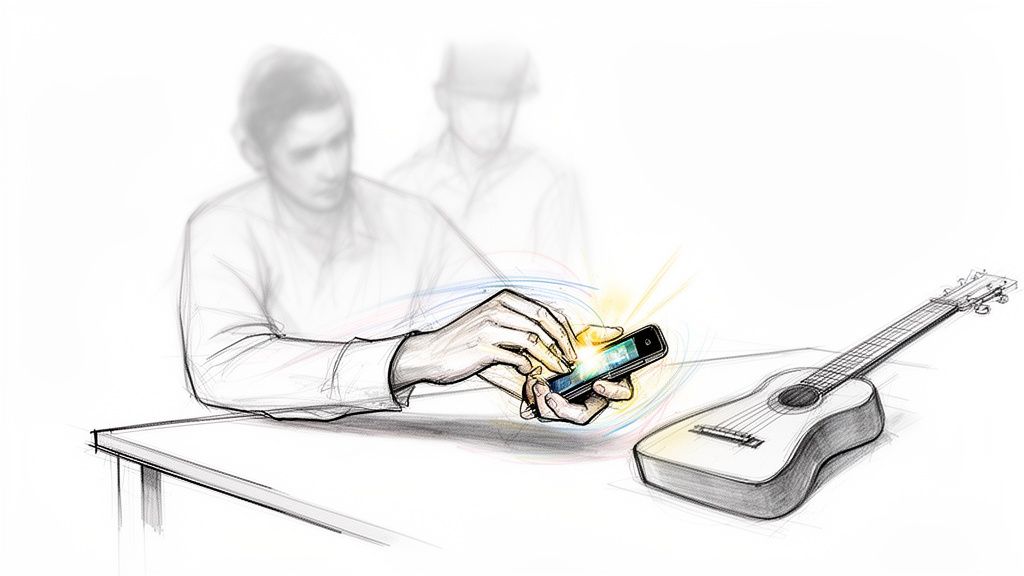
The shift from intensive use to a problematic habit happens gradually. Many people ask themselves: “Am I addicted to my phone?” But usually it's less about a clinical addiction than about unhealthy patterns that weigh on everyday life, concentration, and even our relationships.
The first step is to look at your own behavior without reproach. It's about creating an awareness of the small automatic habits that have crept into our lives over time.
Concrete Symptoms in Everyday Life
Problematic phone use often shows up in very specific situations that may feel familiar to you. Do you recognize yourself in any of these scenarios?
- Phubbing: You look at your phone while a friend or partner is talking to you. This often isn't ill will, but an almost uncontrollable reflex. It quickly makes the other person feel unimportant.
- FOMO (Fear Of Missing Out): The fear of missing something important drives you to constantly check feeds and messages. Even a short time without your smartphone feels uncomfortable and makes you anxious.
- Neglecting hobbies: The guitar in the corner gathers dust because scrolling on the couch in the evening is simply more comfortable. Activities that once brought you joy increasingly fade into the background.
- Sleep problems: You take your phone to bed — just to check something “quickly.” An hour later, you're still scrolling. The blue light disrupts your sleep rhythm, and the stimulating content keeps your brain awake.
These behaviors are widespread. A comprehensive DAK study from 2025 shows how prevalent risky media use already is among children and adolescents. Over 25 percent of 10- to 17-year-olds show problematic social media use or even addiction tendencies, with boys affected almost twice as often as girls. The complete study on media addiction among young people offers alarming insights.
The key to change is not prohibition, but conscious recognition. Don't just ask yourself how often you reach for your phone, but above all why you do it. Is it boredom, stress, or an escape from unpleasant feelings?
Your Quick Self-Check
To better gauge your own habits, a simple self-assessment helps. The following checklist is not a diagnosis, but a guide to recognizing patterns that might indicate unhealthy use.
Self-Check: Typical Signs of Problematic Phone Use A self-assessment checklist to recognize behavioral patterns that point to unhealthy phone use.
| Behavior or Feeling | Often true | Sometimes true | Rarely true |
|---|---|---|---|
| I reach for my phone without noticing. | ☐ | ☐ | ☐ |
| I get restless when my battery is dead. | ☐ | ☐ | ☐ |
| I look at the screen even during conversations. | ☐ | ☐ | ☐ |
| I often lose track of time while scrolling. | ☐ | ☐ | ☐ |
| I sacrifice sleep for my screen time. | ☐ | ☐ | ☐ |
| My thoughts often revolve around my phone. | ☐ | ☐ | ☐ |
This table is meant to serve as a mirror for you. The more checks you place in the left column, the clearer the signal to take action. If you'd like to dive deeper into the topic, read our post on whether you're addicted to your smartphone. The goal is to develop a clear awareness of these subtle warning signs and thereby regain control.
Why We Constantly Reach for Our Smartphones
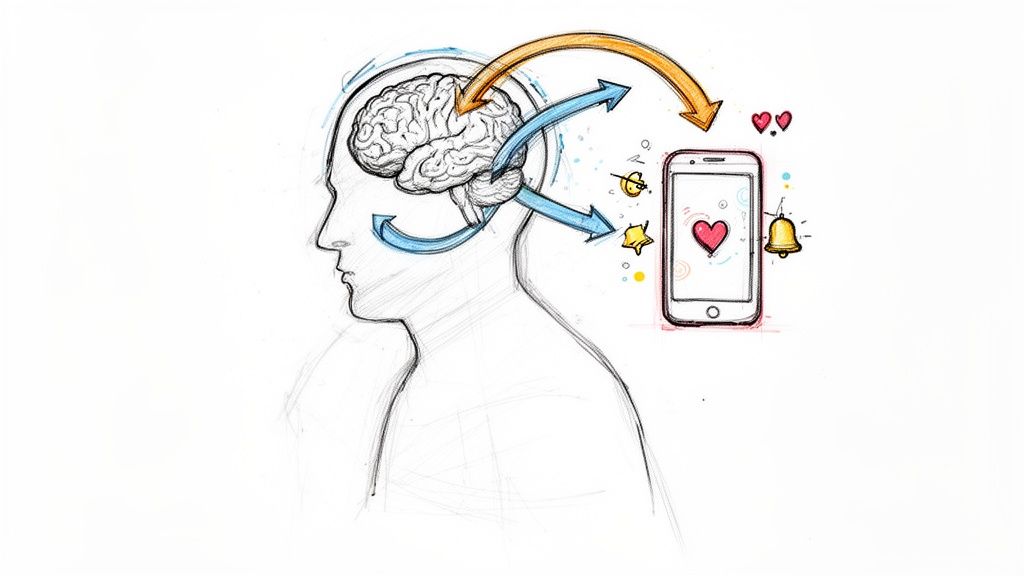
Be honest: How often do you reach for your phone reflexively? At the bus stop, while waiting for your coffee, in every little break — and there it is in your hand. Often without us really wanting to or thinking about it.
This automatic behavior is no accident, and certainly not a lack of willpower. Sophisticated psychological mechanisms lie behind it. To answer the question “Phone addiction, what to do?”, we first need to understand why it's so incredibly hard for us to simply put the device down. The answer lies deep in our brain chemistry.
The Power of the Dopamine Loop
At the heart of our digital dependency is a small messenger substance called dopamine. It's the engine of our reward system. Originally, it secured our survival by rewarding us with a good feeling for useful things like eating or social contact. It's precisely this ancient system that gets hijacked by our smartphones.
Every like, every new message, every positive reaction to a post triggers a small dopamine hit. It feels good. Our brain learns lightning-fast: open app = reward. These unpredictable but constant little rewards create an extremely powerful behavioral loop that keeps pulling us back to the screen.
Essentially, we carry a slot machine in our pocket. We never know when the next reward will come — a new like, an exciting message — but the hope of it keeps us going tirelessly.
These mechanisms are no accident, but the result of a design with only one goal: to capture our attention for as long as possible. And it works frighteningly well. In Germany in 2024 there were around 68.5 million smartphone users, and among 14- to 49-year-olds the usage rate is nearly 100 percent. The average time spent on social media alone is almost two hours per day. Every minute of that feeds these dopamine loops. If you'd like to dive deeper: Current surveys provide fascinating facts on smartphone use in Germany.
Recognizing Your Personal Triggers
Reaching for your phone is rarely a conscious decision. Far more often, it's an automated reaction to a particular cue — a so-called trigger. If you really want to change your behavior, you first have to expose these personal triggers.
Often it's very specific feelings or situations that provoke reaching for the phone:
- Boredom: The line at the supermarket checkout, the waiting room at the doctor's, the commercial break on TV. The phone is the perfect escape from emptiness.
- Stress: A tough day at work, an argument in the family. Endless scrolling feels like a release valve that numbs unpleasant feelings for a moment.
- Social insecurity: At a party where you hardly know anyone. A quick glance at your phone signals that you're busy and helps bridge awkward silences.
- Habitual places: The first reach in the morning goes to the nightstand, during a coffee break to your pocket. Certain places and times are firmly linked to phone use for many of us.
My tip: Just observe yourself quite consciously for a day or two. Each time you reach for your phone unconsciously, note what was happening and how you felt. This exercise alone creates enormous awareness of your deeply rooted patterns.
Breaking the Automatic Habit
Once you know your triggers, you can begin to deliberately interrupt this cycle. It's not about demonizing the smartphone or banning it entirely. It's about replacing the automatic reaction with a conscious action.
Imagine a simple three-step method you can apply right away:
- Pause & Recognize: You're standing in line and feel the impulse. Pause for a moment and tell yourself inwardly: “Ah, there it is again, the boredom.”
- Choose an alternative: Instead of giving in to the impulse, consciously choose a small alternative. Something very simple.
- Establish a new habit: Repeat this new action every time the trigger appears. This way you slowly overwrite the old habit.
What could such alternatives be? Here are a few ideas that really work:
- Take three deep, conscious breaths.
- Look around curiously and observe your surroundings.
- Stretch briefly or loosen your shoulders.
- Take a sip of water.
This may sound trivial, but these tiny moments of mindfulness are incredibly effective. They create a small gap between impulse and action — and it's precisely in this gap that your freedom to decide for yourself lies.
Quick Tips: How to Break the Constant Digital Distraction
Do you want to counter the constant sensory overload right away and take your phone use back into your own hands? Then you need a kind of first-aid kit. This isn't about radical withdrawal, but about small yet incredibly effective adjustments that stop the autopilot in your head.
With these strategies, you'll finally shape your digital environment consciously again, instead of letting it steer you. The first step? Taking away the smartphone's most powerful weapon: the relentless interruptions. Every message that pops up, every red badge on an app is a tiny lure that hooks your attention and pulls you out of your focus. Merely silencing the phone is unfortunately only half the battle.
Cutting Off Notifications Rigorously
Open your smartphone's settings and turn off all push notifications that aren't absolutely vital. With every single app, ask yourself honestly: Do I need this information right now, or is it enough to decide for myself when I check?
- Social media (Instagram, TikTok & Co.): Disable notifications completely. Likes, comments, and new posts won't run away.
- News apps: No more breaking-news alerts. You'll learn the truly important things even if you open the app once a day on purpose.
- Emails: Turn off instant syncing. One or two fixed time windows per day to check mail are more than enough in the vast majority of cases.
- Shopping apps: Discount promotions are pure distraction maneuvers that want only one thing: your attention. Get rid of them.
Only allow notifications for the essentials, such as calls, texts from important contacts, or calendar reminders. You'll be amazed at how much mental calm this simple step brings. Your phone goes from being a demanding boss back to a useful tool that you control.
Breaking the Lure of Colors
Our brains are wired for bright colors. App icons and red notification badges are deliberately designed to jump out at us and entice us to tap. You can elegantly outsmart this psychological trick with one simple setting.
The grayscale method strips your display of all visual temptation. Activate black-and-white mode (usually found under “Accessibility” or “Digital Wellbeing”), and your colorful screen turns into a dull affair. Endless scrolling through an Instagram feed loses much of its appeal without the rich colors.
My personal tip: Set up a shortcut (e.g., triple-pressing the side button) to switch between color and grayscale mode in a flash. That way you can deliberately turn the colors on when you really need them — for example, to look at photos — and then immediately return to the calm mode afterward.
Strategically Redesigning Your Home Screen
Think of your home screen like the display case of a pastry shop. If the most tempting little cakes are right up front, you'll inevitably reach for one at the slightest craving. So deliberately create obstacles and make access to your biggest time-wasters harder.
Start with a radical cleanup:
- Banish the time-wasters: Social media, news, and shopping apps have no place on the first home screen. Off they go!
- Use inconspicuous folders: Move these apps into a folder with a nondescript name like “Tools” or “Misc.”
- Hide the folder: Place this folder on the second or third page of your home screen, where it's not constantly in view.
Every extra swipe and tap needed to open an app is a small barrier. This barrier gives you a tiny but decisive moment to pause and ask yourself: “Do I really want this right now?” Often this brief thought is enough to break the impulse and put the phone away again. That's how an unconscious reflex becomes a conscious decision.
Sustainable Routines for a Healthy Digital Balance
Long-term change isn't achieved through willpower alone, but through cleverly designed routines that anchor themselves firmly in everyday life. If you're asking yourself, “What to do about phone addiction?”, then the most sustainable answer lies in consciously shaping your day. It's about creating new habits that replace the unconscious reach for the phone with something more meaningful.
Such a structured approach turns good intentions into firm automatic behaviors. Instead of constantly fighting against the impulse, you create an environment in which digital mindfulness becomes the new normal. Let's focus on the three crucial phases of the day to lay a strong foundation for your new digital balance.
Reclaiming the Morning — Completely Without a Smartphone
The morning sets the tone for the entire day. If your first reach is for the smartphone, you immediately start in reactive mode. You let yourself be controlled by messages, emails, and social media feeds. The goal has to be to declare the first hour after waking up a phone-free zone.
This may feel strange at first, but the gain in mental clarity and calm is priceless. Banish the smartphone from the bedroom. A classic alarm clock is a simple but extremely effective investment in your mental health. That way you won't even be tempted to “quickly” check the world before getting up.
What to do with the newly gained time? Here are a few ideas:
- Journaling: Write down three things you're grateful for, or note your goals for the day. It only takes five minutes and directs your focus to the positive.
- Movement: A short walk in the fresh air or a few stretches wakes up body and mind.
- Mindful breakfast: Enjoy your first meal of the day without distraction. Taste your coffee instead of scrolling through a newsfeed.
These small rituals create a valuable buffer zone between waking up and digital sensory overload.
By consciously shaping the morning for yourself, you take control from the very first moment. You decide what gets your attention — not the algorithm.
Focus Blocks and Screen-Free Breaks in the Workday
During the day, the smartphone is often a necessary tool. But this is exactly where the danger lurks that professional use seamlessly slides into private distraction. The solution? A clear structuring of your time through deliberate focus blocks.
Use techniques like the Pomodoro method: Work 25 minutes highly focused on a task, followed by a five-minute break. During this break, however, reaching for the phone is off-limits. Instead, stand up, get a glass of water, or simply look out the window.
Even more effective are firmly scheduled, screen-free breaks. Plan your lunch break consciously without screens. Eat somewhere other than at your desk and leave the phone behind. Even 15 to 30 minutes without digital input give your brain the chance to recover and reorganize. This form of mindfulness in everyday life is a powerful tool for reducing stress and sharpening your concentration for the next work phase.
Ending the Day with a “Digital Sunset”
Just as you began the day, you should also end it: consciously and without a screen. The “Digital Sunset” routine is a clear signal to your brain that it's time to wind down. Set a fixed time — for example, 9 PM — after which all screens are switched off. This applies to smartphone, tablet, laptop, and TV.
This phone-free time before going to sleep is crucial for your sleep quality. The blue light of displays inhibits the production of the sleep hormone melatonin and can noticeably make falling asleep harder. Use the last hour of the day for relaxing, analog activities:
- Read a real book (not an e-reader with a backlit display)
- Have a conversation with your partner or family
- Listen to calm music or an audiobook
- Drink a cup of tea and reflect on the day
Such routines not only reduce your daily screen time. They demonstrably improve focus, sleep quality, and your overall well-being. They give you back control over your most valuable resource: your attention.
Smart Helpers Against Phone Addiction
Sometimes good intentions and new routines simply aren't enough. The unconscious reach for the phone is often stronger than your own willpower. This is exactly where intelligent tools come into play, building a physical or technical barrier between you and the digital distractions. They can make the decisive difference.
The goal is to deliberately build hurdles. These tools don't make access to distractions impossible, but they make it more inconvenient. And it's precisely this small extra effort that breaks the automatic habit and gives you back control.
The Zenbox: Your Physical Focus Anchor
One rather clever solution that turns technology against itself is the Zenbox. Imagine a small, unobtrusive NFC chip that you place in a strategic spot — perhaps magnetically on the fridge or discreetly on your desk. This little thing becomes your analog “off button” for the digital flood.
The principle behind it is brilliantly simple: In the matching app, you define which apps should be blocked for a certain time. To start the focus timer, you simply tap your smartphone briefly to the Zenbox. That's it. From that moment on, the designated troublemakers are locked.
But the real twist comes when you want to lift the block. To do that, you have to hold your phone consciously and physically to the box again. This built-in “resistance” is the decisive advantage over pure software solutions, whose timers can often be bypassed with a single click.
This physical act breaks the unconscious habit loop. It forces you into a conscious action and makes quick, mindless checking of social media nearly impossible.
Concrete Use Cases from Everyday Life
The real strength of such tools lies in how flexibly they integrate into your everyday life. Here are a few practical examples of how physical focus helpers like the Zenbox become truly useful:
- For distraction-free family meals: Attach a Zenbox to the fridge. Before the meal, all family members tap their phones to start a shared timer. The result? Real conversations without constant interruptions from glowing screens.
- For concentrated deep-work phases: Place a Zenbox in your office, but a bit out of reach. Start a 90-minute focus session. Just the thought of having to get up to end the timer effectively keeps you from brief distractions.
- For a relaxed morning routine: Mount a box in the bathroom. After waking up, activate the timer and treat yourself to an hour for breakfast, meditation, or exercise before the digital world claims you.
The need for such solutions becomes increasingly clear when you look at the numbers. According to the JIM study, 95% of adolescents now own their own smartphone, and daily usage time is steadily rising. Physical tools like these create a real hurdle against the impulse to be constantly online.
The decisive advantage of physical tools is the “friction.” They raise the effort required for a distraction so much that your inner couch potato thinks twice about it.
This decision tree gives you an idea of how to choose different tools and strategies to fit your daily routine.
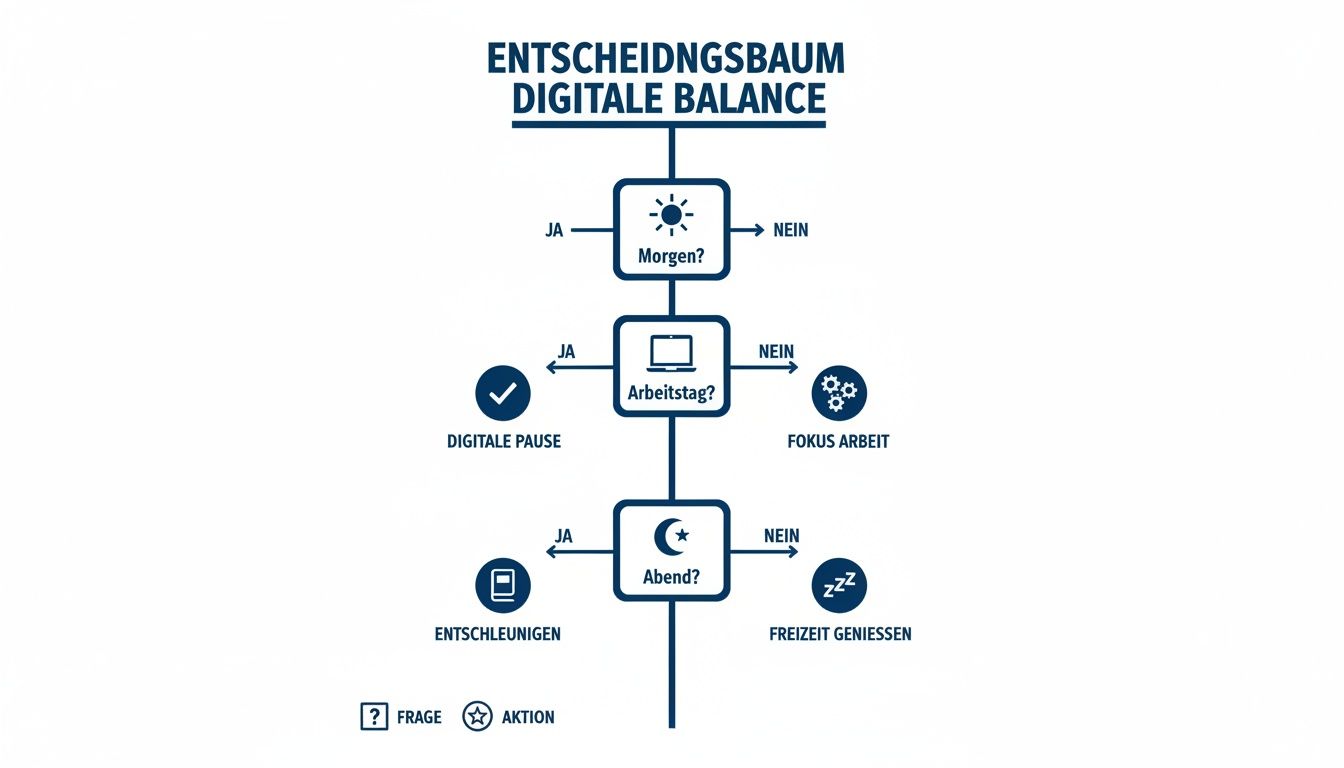
As the graphic shows, for every phase of the day — from morning through the workday to evening — there's a fitting strategy to find a healthy digital balance.
More Tools Compared
Besides NFC solutions like the Zenbox, there are of course other helpers that can support you in the fight against phone addiction. Each tool has its own strengths and suits different needs. If you like the idea of a physical barrier, the Zenbox as a minimalist focus tool might be exactly right for you.
Here's a quick overview of the most popular options:
Comparison of Tools Against Phone Addiction An overview of various technical and analog tools, how they work, and who they're best suited for.
| Tool | How It Works | Advantages | Ideal For |
|---|---|---|---|
| Focus apps (e.g., Forest) | Software-based app blockers, often with gamification (e.g., a tree grows as long as you stay focused). | High flexibility, right on the device, motivating elements. | Students and anyone looking for playful motivation to concentrate. |
| Phone safes | A physical, lockable box with a time lock. The phone is locked away and only accessible again once the time has elapsed. | Maximum security, no cheating possible, enforces a complete separation. | People who need a radical solution for certain periods (e.g., the evening). |
| The classic alarm clock | A simple, analog device with just one function: to wake you up. | Inexpensive, reliable, effectively banishes the smartphone from the bedroom. | Anyone who wants to improve their sleep quality and start the day without a screen. |
Which tool suits you best depends heavily on your personality and your goals. While a focus app is enough for one person, another may need the unavoidable barrier of a phone safe. The best approach is often a combination: an alarm clock for the night, a focus app for work, and a physical anchor like the Zenbox for shared family time. Just experiment and find out what works for you.
Common Questions About Phone Addiction
On the way to a healthier relationship with the smartphone, very similar questions often come up. Don't worry, you're not alone in this. Here I've gathered the most frequent questions and try to give you practical answers from my experience.
How Long Does It Really Take to Overcome Phone Addiction?
This is probably the most common question — and the honest answer is: it's different for everyone. It's also less about “overcoming” the addiction once and for all than about learning a lastingly conscious relationship with the device. Think of it as an ongoing process, not a race with a finish line.
The good news is that you often feel positive effects like more inner calm or better concentration after just a few days, if you stay consistent. But until new habits really take hold and run almost automatically, experience shows it usually takes between 30 and 90 days.
The most important thing is your attitude toward it: occasional relapses are not failure. They are a normal and even important part of the learning process. What matters is that you keep at it, not that you're perfect overnight. Be patient with yourself.
What Can I Do If My Partner or My Child Is on Their Phone Too Much?
Direct reproaches like “You're always glued to your phone!” usually accomplish nothing. The result is almost always a defensive stance. It works much better to seek out a conversation in a calm moment and to speak about yourself — that is, about your own feelings and observations.
Try using “I-statements.” Instead of saying “You never listen to me,” phrase it differently: “I sometimes feel unseen when we're talking and you're looking at your phone.” That's not an accusation, but an invitation to a conversation.
A few concrete ideas that can help:
- Suggest shared, phone-free activities: A walk in the woods, a game night, or cooking together — this strengthens the connection in real life.
- Be a good role model yourself: Especially with children, your own behavior is decisive. If you consistently put your own phone away during meals, it's much easier to ask the same of others.
- Set shared rules: Together, define phone-free zones (such as the bedroom) or fixed times (for example, during meals).
- Use playful helpers: A tool like a Zenbox can turn phone-free times into a positive, shared experience instead of making them feel like a prohibition.
In the end, it's about empathy and the shared wish to make your time together more valuable again.
I Need My Phone for Work — How Can I Still Reduce My Usage?
A challenge many people know, especially when working from home. The line between job and private distraction blurs incredibly quickly there. The key lies in creating a very clear separation between these two worlds, even if they take place on the same device.
Plan fixed work blocks during which you really only use apps that are necessary for the job. And very importantly: communicate clear availability times to your team. That relieves you of the inner pressure of feeling you have to be on call around the clock.
What also works well in practice:
- Set up profiles or focus modes: Modern smartphones often offer the option to create a “work profile” and a “personal profile.” This lets you simply hide private apps during working hours.
- Block distractions deliberately: With focus apps or a Zenbox, you can deliberately lock access to social media and other time-wasters during work.
- Make a conscious end to the workday: At the end of the workday, deliberately set the phone aside for an hour. This clear break greatly helps the brain switch into relaxation mode.
It's not about becoming unreachable. It's about regaining control and deciding for yourself when and on what you spend your attention.
Would you like to build a simple but effective hurdle between yourself and your digital distractions? The Zenbox is a minimalist, physical tool that helps you integrate conscious focus time into your everyday life — without complicated settings and without a subscription.