

Addicted to Your Phone? Here's How to Take Back Control of Your Smartphone
Just quickly checking your emails, scrolling through your Instagram feed for a moment, replying to one WhatsApp message – and suddenly another half hour is gone. For most of us, smartphones are indispensable. But the line between a useful everyday routine and the nagging feeling of being addicted to your phone is getting thinner and thinner.
The Smartphone: Everyday Helper or Time Thief?
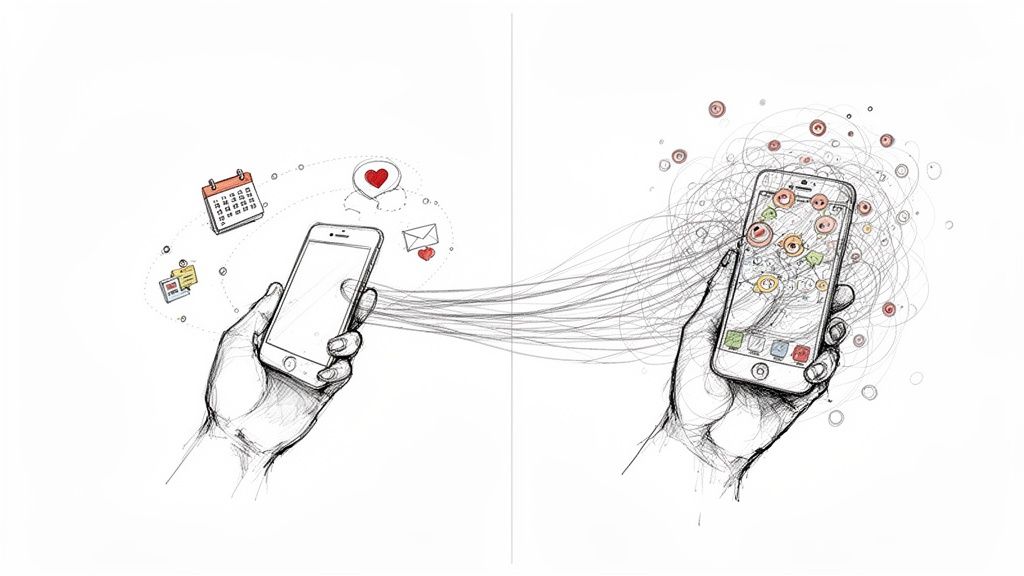
No question, our smartphone is a little marvel. It organizes our calendar, connects us with friends and family, and is navigation system, bank branch, and entertainment hub all in one. This very versatility is what makes it such an incredibly powerful tool – but this is also exactly where the danger lurks.
Constant availability and the endless stream of messages, videos, and updates can quickly turn from an advantage into a real burden. Reaching for the phone becomes a reflex, an unconscious movement, even when there's no reason for it at all. This behavior is often so deeply ingrained in our daily lives that we barely notice it anymore.
Why This Topic Concerns All of Us
More and more people sense that they are losing control over their screen time. That's no coincidence. The apps and platforms we use every day are cleverly designed. Push notifications, likes, and endless feeds are psychological triggers that appeal to the reward system in our brain. They create a cycle of short-term gratification and the constant craving for the next “kick.”
This guide aims to expose exactly these mechanisms. It's about developing a sense of when intensive phone use truly becomes a problem. The goal is not to demonize technology, but to learn how we can use it consciously and on our own terms.
A mindful approach to your smartphone doesn't mean banishing it. It means turning it back into what it was meant to be: a tool that you control – and not the other way around.
What you'll find in this article:
- Background: We dive into the psychology and explain why the urge to look at your phone is so strong.
- Self-check: You'll get simple tools to honestly question your own behavior.
- Concrete solutions: We show you proven strategies and tools to help you reclaim control.
See this article as an invitation to rethink your habits and take the first step toward a more focused and balanced digital life.
Am I Addicted to My Phone? A Little Test for You
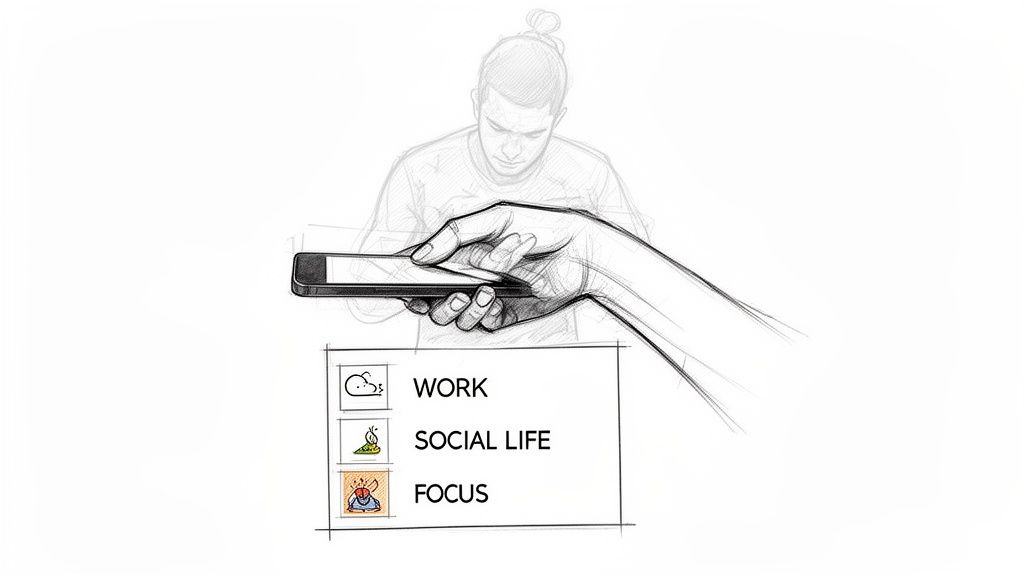
The question “Am I maybe addicted to my phone?” creeps into the conscience of many of us every now and then. Usually accompanied by an uneasy feeling. There is no simple yes-or-no answer here, because the line between intensive use and true dependency is fluid and very personal.
What matters isn't the sheer number of hours you spend in front of the screen at all. The crucial point is the loss of control over your own behavior and the noticeably negative consequences for your life.
An addiction almost never develops overnight. At the beginning, there's often just the reflexive reach for the phone in every free minute – at the bus stop, in the waiting room, sometimes even in the middle of a conversation. At some point, the feeling may set in of being incomplete, naked, or nervous without the device. Then it's no longer about getting something specific done, but about numbing an inner restlessness or emptiness.
Questionnaire: An Honest Inventory
Forget clinical diagnoses for a moment. This is about honest self-reflection. Take a little time and go through the following questions for yourself. The more often you find yourself nodding inwardly and answering “yes,” the more likely it is that your phone use has taken on problematic traits.
-
Mental preoccupation: Do your thoughts constantly revolve around your phone, even when you don't have it in your hand? Are you already planning the next moment when you can finally check your feeds?
-
Loss of control: Do you often intend to look at your phone “just for a moment” and then notice that another hour has gone by? Do your attempts to reduce your screen time keep failing?
-
Withdrawal symptoms: Do you become restless, irritable, or even anxious when the battery is dead, you've forgotten your phone, or you're supposed to consciously put it away?
-
Tolerance development: Do you notice that you need more and more screen time to feel the same sense of gratification or distraction as you used to?
-
Neglect of other areas of life: Do your work, your hobbies, your friendships, or your sleep suffer because of your phone use? Do you cancel plans or put off important things because you got “stuck” on your phone?
-
Use despite negative consequences: Do you keep scrolling even though you know full well that you urgently need to sleep, play with your children, or meet an important deadline?
These questions are meant to help you look beyond mere habits and recognize the deeper patterns behind them. If you find yourself recognizing several points, that's no reason to panic. On the contrary: it's the most important first step toward changing something. If you want to dig even deeper, take a look at our post that deals with exactly the question of whether you're addicted to your smartphone.
Warning Signs at a Glance
Sometimes it's the small, inconspicuous everyday behaviors that reveal the most. The following table summarizes the typical signs and helps you quickly assess your behavior.
Warning Signs of Problematic Phone Use
This table helps you recognize typical signs of problematic phone use in yourself. It distinguishes between thoughts, feelings, and concrete behavior.
| Area | Typical Sign | Concrete Example |
|---|---|---|
| Thoughts & Feelings | Constant mental preoccupation | During dinner with friends, you're already thinking about which notifications are waiting for you. |
| Thoughts & Feelings | Emotional restlessness without the device | You feel nervous or panicked when you've left the house without your smartphone. |
| Behavior | Compulsive checking | You automatically unlock your phone every few minutes, even when it hasn't rung or vibrated. |
| Behavior | “Doomscrolling” | In the evening in bed, you scroll for hours through negative news, even though it makes you feel bad. |
| Social Life | “Phubbing” (phone snubbing) | You ignore the person you're talking to because you're looking at your phone. |
| Daily Life & Health | Neglect of responsibilities | You put off housework or professional tasks because you're absorbed in an app or a game. |
Take an honest look: these examples may seem familiar to you. They are clear indications that the smartphone is taking on too large a role in your life.
The most honest indicator is often your own gut feeling. If you have the sense that your smartphone has more power over you than you have over it, then it's time to act.
The realization that something isn't right is the most powerful starting point of all. It gives you the motivation to deliberately steer in the other direction and reclaim control over your time and attention.
Why We Just Can't Put the Phone Down
What exactly makes this little, glowing rectangle of glass and metal so incredibly captivating? If you've ever wondered why you can hardly put it down, then rest assured: this has less to do with sheer lack of willpower than you might think. The real reasons lie deep in our brain chemistry and in the sophisticated psychological mechanisms that technology companies very deliberately use to their advantage.
It really is no coincidence that reaching for the phone happens so reflexively. Behind it lies a powerful cycle, driven by the neurotransmitter dopamine. Our brain is programmed by nature to seek rewards. Every new notification, every like under a photo, or every unexpected message is like a little surprise that releases a tiny dose of dopamine. A brief, pleasant tingle.
The problem? This feeling of happiness is extremely fleeting. No sooner is it there than it fizzles out again – and our brain immediately demands the next little kick. This is how an endless loop arises that we all know: we reach for the phone, get a mini-reward, the feeling fades, and the craving immediately drives us back to the screen.
The Brain on the Hook
Picture your reward system like a slot machine in Las Vegas. You never know when the next win will come, but you know that it will come eventually. Social media apps and games exploit this exact principle of variable, intermittent reinforcement to perfection.
The endless feed on Instagram or TikTok is the prime example of this. You scroll and scroll, always expecting to discover the next funny video or a fascinating image. This constant unpredictability is what makes it so damn hard to simply stop. After all, the next “jackpot” could be waiting for you right behind the next swipe.
The designers of apps and social networks aren't evil people. They are simply extremely good at understanding how the human brain works and using it for their purposes – to hold our attention for as long as possible.
These strategies are part of a larger system, often referred to as the “attention economy.” In this world, your time and your attention are the currency. Companies compete relentlessly over who can keep you glued to the screen the longest. Read more here about the science that keeps us glued to the screen and how targeted design manipulates our behavior.
More Than Just Chemistry: Social and Emotional Drivers
But it's not only the clever algorithms and dopamine hits that fuel phone addiction. Our smartphone also serves deeply rooted human needs and fears that amplify its appeal exponentially.
Two of the strongest emotional drivers here are:
-
FOMO (Fear of Missing Out): The fear of missing something important, funny, or exciting is a huge motivator. Constantly being online gives us a deceptive sense of control – after all, we don't want to miss anything, whether it's an urgent message, an inside joke, or our friends' spontaneous plans.
-
Escape from negative feelings: Let's be honest, who likes boredom, stress, or loneliness? The smartphone offers an instant and effortless way out. One reach is enough, and we dive into another world where we can simply forget our worries for a brief moment.
These behaviors are deeply human and entirely understandable. It only becomes a problem when the phone becomes the only strategy for dealing with these uncomfortable feelings.
The sheer prevalence of smartphones naturally intensifies this pull even further. In Germany, there are now around 69 million smartphone users, and forecasts assume that by 2030, 83 percent of the population will own one. This ubiquity makes it all the harder to escape the digital pull, and contributes to many of us developing an unhealthy everyday dependency.
So the next time you reflexively reach for your phone, try to pause for a brief moment. Ask yourself what you're really looking for right now: Is it information? Social connection? Or perhaps just an escape from what's happening in the present? This awareness is the first and most important step toward regaining control.
The Invisible Costs of Constant Availability
Let's be honest, a few minutes of scrolling here, half an hour there – that feels harmless at first, doesn't it? The problem is: this time not only adds up, it also leaves marks that we barely notice at first. Like a creeping process, the negative effects seep into our daily lives and our health until the bill for constant availability lies unmistakably on the table.
The price we pay for it is anything but abstract. It ranges from tangible physical complaints to profound psychological burdens that noticeably slow down our quality of life. Time to get to the bottom of these invisible costs.
Your Body Under Constant Stress
Even if it's only the thumb swiping across the screen – our body suffers under the constant digital barrage. The consequences often come gradually, but they are persistent and affect our well-being very directly.
Two of the most common physical problems are:
- Sleep problems: The blue light of displays is a real sleep killer. It massively disrupts the production of the sleep hormone melatonin. Anyone who scrolls through feeds in bed at night signals to their brain: stay awake! The result? Trouble falling asleep, restless nights, and the feeling of being completely worn out the next day.
- Posture damage: The constant downward gaze at the phone puts enormous strain on our cervical spine. This so-called “text neck” leads to nasty tension, headaches, and over time can even cause serious posture damage. Tendon inflammation in the thumb, “texting thumb,” is also no longer a rarity.
These physical symptoms are often the first, very concrete warning signs that our digital habit has become unhealthy.
The following concept map shows how profoundly the mechanisms of phone addiction influence our brain and drive this behavior in the first place.
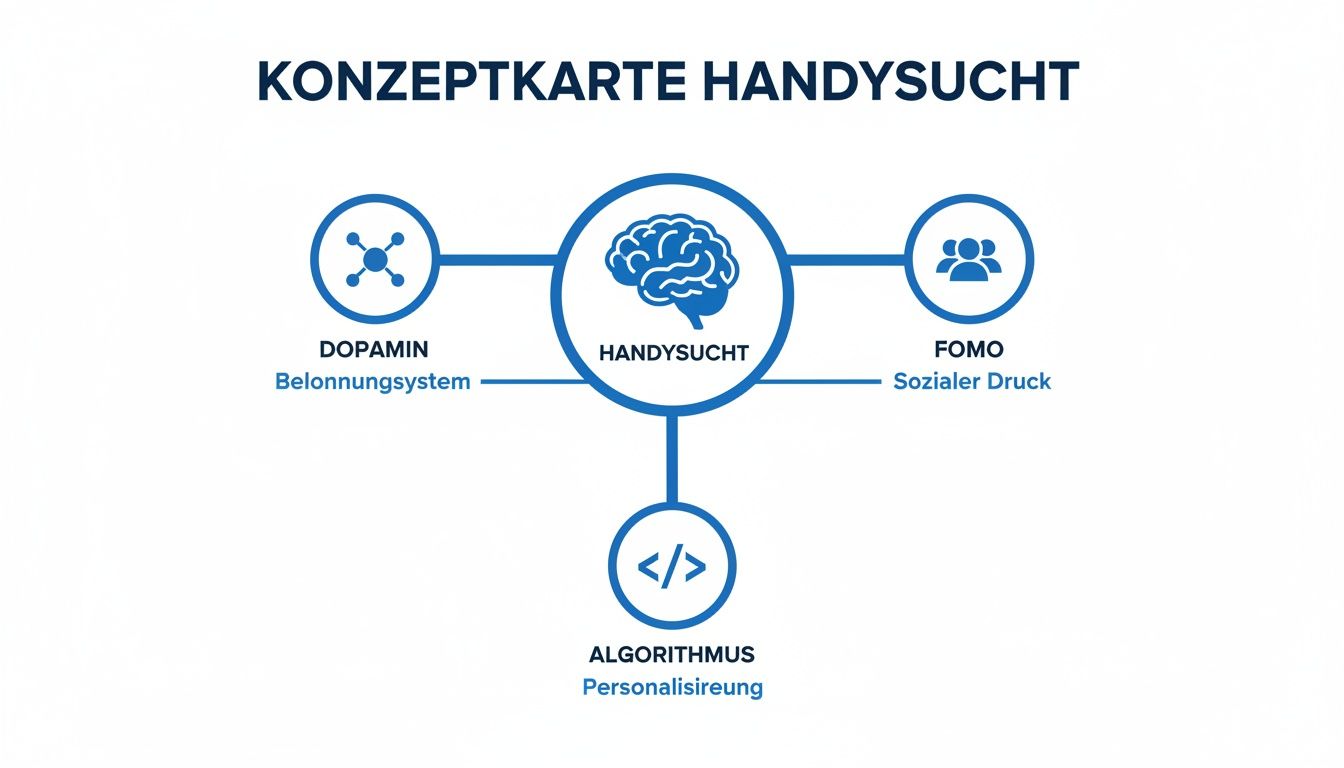
The graphic makes it clear: it's not a single trigger, but an interplay of biochemical reactions like dopamine, social fears like FOMO, and the clever algorithms of the apps.
The Mental and Emotional Consequences
Even more serious are often the effects on our psyche. The constant flood of information, the social pressure on platforms like Instagram, and the permanent availability create a constant mental stress that often runs unnoticed in the background.
Being confronted with perfectly staged lives on social media can downright undermine your own self-esteem. Every post that shows a seemingly happier, more successful, or more beautiful life can feel like a little sting and fuel feelings of envy, inadequacy, or even loneliness.
Anyone who constantly watches the lives of others through a screen easily forgets to live their own. The digital world is often just a facade that obscures the view of what truly matters.
Particularly alarming is the development among children and adolescents. A study on the consequences of excessive phone use in Germany paints a bleak picture: since the coronavirus pandemic, the proportion of problematic users has risen by a staggering 126 percent. Over a quarter of 10- to 17-year-olds use social media in a risky or even pathological way, and 4.7 percent are considered addicted. If you'd like to learn more about these worrying figures, you'll find more information on screen time among children at tessin-zentrum.de.
How Phone Addiction Destroys Your Daily Life
But the negative effects don't stop at health and the psyche – they actively sabotage our daily lives, our productivity, and our most important relationships.
Concentration and productivity in free fall Our brain is simply not made for constant interruptions. Every single push notification tears us out of our concentration. Scientists have found that on average it takes over 20 minutes to regain full focus on a task after a distraction. So anyone who constantly looks at their phone works less efficiently, makes more mistakes, and feels drained and unproductive at the end of the day.
Relationships suffer in silence The perhaps highest price we pay for the constant digital connection is the loss of genuine human closeness. The phenomenon of “phubbing” (a blend of phone and snubbing) – that is, ignoring the person across from you in favor of the smartphone – is now ubiquitous.
Whether at dinner with your partner, playing with the kids, or in conversation with friends: when the phone is always present, we unconsciously send the message that there's something more important right now. These many little moments of disregard add up and can poison relationships in the long run.
Recognizing these costs can be painful, but it's absolutely necessary. It makes clear how urgently we need to regain control in order to consciously decide once again to whom or what we devote our most valuable resource: our attention.
Practical Strategies for Your Digital Balance
The realization that the smartphone is taking up too much space is the first and most important step. But now comes the decisive part: taking action. The good news is, you don't have to turn your whole life upside down. It's the small, conscious changes that make the biggest difference in the end and free you from the vicious cycle of constant distraction.
This section is your very own toolbox. It's full of tactics you can implement right away, further-reaching ideas, and effective aids. All of this is meant to help you find a healthy digital balance again. It's not about banishing the phone. It's about turning it back into what it was meant to be: a tool that you control – and not the other way around.
Immediate Measures You Can Implement Today
The best way to make a change? Start with simple but effective steps that have an immediate impact. These measures reduce the constant sensory overload and break the automatic patterns that keep you glued to the screen.
1. Radically reduce notifications
Every push notification is a targeted interruption that steals your attention. Take ten minutes and turn off everything that isn't absolutely vital. Social media likes, game updates, or news alerts? Get rid of them. This way, you decide for yourself again when to engage with an app.
2. Set up phone-free zones and times
Establish clear areas and fixed times in which the smartphone is off-limits. The bedroom is the most important candidate. Charge your phone overnight in another room and get yourself a good old-fashioned alarm clock. The dining table should also be a phone-free zone, whether you're eating alone or in company.
3. Detox your home screen
Your home screen is the display window of your digital life – so tidy it up! Banish all addictive apps like social media, games, or news feeds from the first page. Instead, place only useful tools there, like calendar, notes, or the weather app. Every additional tap needed to reach the distraction is a small hurdle for your brain.
These first steps immediately create more mental calm and give you back the feeling of control. They are the perfect foundation for everything that follows.
Advanced Concepts for Lasting Change
Once you've cleared the first hurdles, it's time to dig deeper. Now it's about fundamentally reshaping your relationship with the digital world. One concept that helps immensely here is digital minimalism.
The idea behind it is compellingly simple: reduce your digital toolbox to what you truly need. Ask yourself with every app and every service: Does this bring me real added value, or does it just steal my time and attention? This process of conscious decluttering creates an incredible amount of clarity and frees up mental energy.
Digital minimalism doesn't mean giving up technology. It means using technology purposefully and consciously to support your own goals, rather than letting it control you from the outside.
Another important building block is consciously scheduling offline time. Just as you enter appointments for work or sports into your calendar, you should reserve fixed blocks for phone-free activities. That could be a walk in the woods, an evening of reading on the sofa, or an afternoon of crafting with the family. These analog experiences are the best antidote to digital sensory overload.
Effective Aids That Support You
Sometimes sheer willpower simply isn't enough to break deeply ingrained habits. This is exactly where clever helpers come into play that noticeably ease the process for you. Sure, there are plenty of focus apps that block distracting websites or set time limits for certain applications.
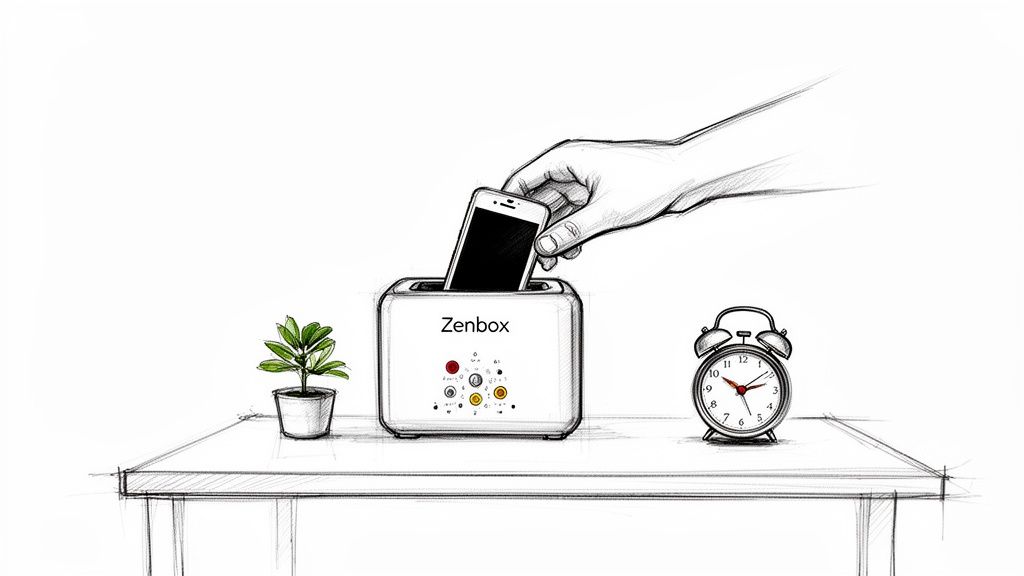
Even more effective, however, are physical tools that build a real, tangible hurdle between you and the digital distraction. An outstanding example of this is the Zenbox. This minimalist tool works like an analog “off button” for your digital craving.
The way it works is brilliantly simple: in the accompanying app, you define which distracting apps you want to block for a certain period of time. To start the focus timer, you briefly tap your phone against the Zenbox. From that moment on, the selected apps are locked. The clever part: to unlock them again, you have to consciously and actively hold your smartphone against the box.
This simple physical act interrupts the automatic reach for the phone. It forces you into a brief pause for thought, in which you can ask yourself: “Do I really want this right now?” This small bit of friction in everyday life is incredibly effective at breaking the automatic patterns of phone addiction and lastingly strengthening self-control.
Here are a few concrete examples for your everyday life:
- Focused morning routine: Place the Zenbox in the bathroom. Start the timer after waking up and begin the first hour of your day completely without messages or emails.
- Undisturbed work phases: Mount the Zenbox out of your direct reach at your desk. Use it for 90-minute “deep work” blocks in which all social media and messenger apps are locked.
- Quality time with the family: At dinner, everyone places their smartphones on the Zenbox and starts a shared timer. This guarantees undisturbed conversations.
- A mindful end to the workday: Tie the unlocking of your personal apps to a conscious action. Mount the Zenbox by the coat rack – only when you come home and touch it do you allow yourself access.
Tools like the Zenbox make the fight against phone addiction tangible. They help you become an active shaper of your time again, instead of a passive consumer. To learn even more about how you can overcome phone addiction, you'll find additional tips and insights in our further article.
Your Path to a Mindful Digital Life
Regaining control over your smartphone is not a sprint, but rather a marathon – the beginning of a new, mindful habit. This isn't about demonizing technology. Instead, you learn to see it again for what it should be: a powerful tool that you steer, and not the other way around.
This path consists of many small, consistent steps. Every single moment in which you consciously decide against the automatic reach for the phone is a small victory. A victory for your attention that strengthens your self-control a little more each time.
Your Core Strategies for Lasting Success
The most effective methods mesh together and reinforce one another. So that you keep the overview, here once again are the most important pillars for your path to a more mindful digital life:
- Create awareness: Observe yourself and your behavior, entirely without judgment. Take an honest look at your screen time. You can only truly change what you know and measure.
- Create friction: Build in small hurdles that make the automatic reach for the phone harder. Turn off notifications, declutter your home screen, and use aids like a Zenbox to stop unconscious scrolling.
- Establish routines: Set phone-free times and zones. The morning after waking up and the hour before going to sleep in particular are incredibly important for your well-being and your concentration the next day.
- Find alternatives: Fill the time you gain with real experiences. A book, a walk, a genuine face-to-face conversation – these are the things that truly and lastingly fulfill you.
Digital mindfulness is the key. It gives you more focus, fosters your creativity, and strengthens genuine human connections. It's the ability to simply be present – whether online or offline.
Don't see setbacks as failure, but as what they are: part of the learning process. It's completely normal for old habits to keep resurfacing. The most important thing is that you simply get back up and find your way back to your goal: a life in which technology serves you, instead of stealing your precious time.
The best thing to do is start today with one small, manageable step. The time and mental freedom you gain through it will be the best motivation to keep going.
The Most Common Questions About Phone Addiction – Short and Sweet
On the way to a healthier relationship with the smartphone, the same questions keep coming up. Here I've collected the most important ones for you and answer them without any jargon – as quick guidance for the typical hurdles.
When Am I Really Addicted to My Phone?
An official diagnosis of “phone addiction,” like the kind you know from the textbook, doesn't exist as such. But far more important than the sheer number of hours is anyway another criterion: the loss of control. If you notice that you use your phone compulsively even though you actually know that it's harming you, your work, or your relationships, then that's a clear sign of problematic behavior.
Pay attention to these typical warning signs:
- You become nervous, restless, or even irritable when the phone isn't within reach.
- Important tasks or hobbies that you once enjoyed are left undone more and more often because you're stuck on the screen.
- You keep intending to spend less time on your phone, but somehow it never works out.
Does a Radical Digital Detox Actually Help at All?
A complete withdrawal can be a real eye-opener, but let's be honest: for most of us, that's hardly sustainable in everyday life. It's far more lasting to learn how to use the device consciously and in a controlled way. Instead of forbidding yourself everything, it's better to create clear rules that truly fit into your life.
The goal isn't to live like in the Middle Ages again. It's about keeping the reins in your hand online and finding a balance that's good for you – not about a complete banishment of technology.
A great start is phone-free zones (the bedroom is a classic!) and fixed offline times, for example during meals or in the first hour of the day.
Is the Issue Really That Bad Among Adolescents?
Yes, unfortunately the figures here are quite alarming. Young people are particularly vulnerable, because their brains are still right in the middle of development and the capacity for self-control isn't yet so strongly developed. The constant social pressure on platforms like TikTok or Instagram and the permanent availability don't exactly make it easier.
In Germany, smartphone use among adolescents is extremely high. A recent study shows: 95 percent of adolescents have their own smartphone and spend almost four hours online every day. Among 18- to 19-year-olds, it's even 261 minutes. This stark integration into everyday life makes distractions and problematic habits practically the norm and shows how important awareness of phone addiction is. If you want to read more about it: insights into smartphone use among adolescents can be found at handyhase.de.
What Role Do App Developers Actually Play in All of This?
A huge one. Many apps are quite deliberately built to captivate us for as long as possible. Just think of the endless feeds, the constant push notifications, or the reward system with likes – all of this targets psychological vulnerabilities directly. So it's not just your lack of willpower when you can hardly put the phone down. You're fighting against a pretty sophisticated design.
Are you ready to take back control and draw conscious boundaries against the digital flood? The products from The Zenbox are made for exactly that. They help you interrupt the automatic reach for the phone and decide for yourself again what you use your time for. Discover the Zenbox now and start a more focused life.