

I'm Addicted to My Phone, What Can I Do? Your Path to Digital Freedom
Maybe you know the feeling: you ask yourself, „What can I do about my phone addiction?“ The good news is that simply asking this question is already the most important step. You've recognized the problem. Now it's about understanding the causes and then regaining control with concrete, small behavioral changes.
„Addicted to your phone“? You're not alone with this feeling
That vague unease that the smartphone simply takes up too much space is something countless people know. You reach for the device reflexively, often without any real reason, and find yourself minutes later caught in an endless stream of notifications and feeds.
This behavior has nothing to do with a lack of willpower. It's the result of clever psychological mechanisms. App developers deliberately rely on triggers like FOMO (Fear of Missing Out) – the fear of missing something important if you're not online. Every notification, every like, and every comment activates the reward center in the brain. This creates a habit loop that is hard to break.
The invisible influence of your smartphone
The urge to be constantly reachable shapes our everyday lives. Current figures show this very clearly: smartphone density in Germany is enormous, and daily usage time keeps climbing higher and higher. A recent study shows that, on average, teenagers spend 231 minutes per day online – a massive increase compared to previous years. Especially striking: 68 percent of those surveyed admit to spending more time on their phone than they actually want to. You can read more about the background of increased phone use here.
The influence goes even further: the mere visible presence of your smartphone – even when it's switched off and lying on the table – can demonstrably reduce your cognitive performance and concentration. Your brain has to actively expend energy to suppress the impulse to reach for the device.
Why understanding is the first step toward improvement
Before we look at the practical solutions, it's crucial to understand these connections. It's not about feeling guilty. It's about seeing through the mechanisms that keep you at the screen. This knowledge is the foundation for not just applying the following strategies mechanically, but for truly feeling their effect.
You are not helplessly at the mercy of these patterns. Once you understand the psychological pitfalls and how your own brain works, you can take targeted countermeasures. You learn to make conscious decisions instead of merely reacting to automatic impulses. The following sections give you a clear roadmap to reclaim digital control and live more consciously again.
First steps toward more digital mindfulness in everyday life
So you've noticed that your phone might have a little too much control over your daily life? The good news is: you don't have to turn your life upside down right away to change something. The path to a healthier relationship with your smartphone begins with small but incredibly effective adjustments that you can implement immediately. It's about building conscious barriers against that almost automatic reach for the device.
Let's start with the constant barrage: notifications. Disable all push messages that aren't absolutely vital. Honestly, do you really need to be informed in the same second about every like or every new email? Probably not. By deciding for yourself when you check for news, instead of letting yourself be interrupted constantly, you reclaim a huge piece of your attention.
Turn your home screen into an oasis of calm
The next lever is your home screen. Take a look at it. A colorful, packed screen is like a candy shelf staring at you nonstop. Temptation lurks at every glance.
- Declutter radically: Move everything that isn't essential (so everything except phone, messages, maybe the camera) away from the first screen. Put the apps in folders on the second page or in the app library. Your home screen should be as empty as possible. A real relief for the eyes and the mind.
- Turn off the colors: Activate grayscale mode in the settings. It's astonishing how unattractive even the most captivating apps suddenly become when the bright colors are gone. This simple trick breaks the reward loop in the brain that is triggered by colorful icons.
This flowchart shows quite well how you can break out of unconscious patterns like FOMO, minimize distractions, and thus step by step regain control.
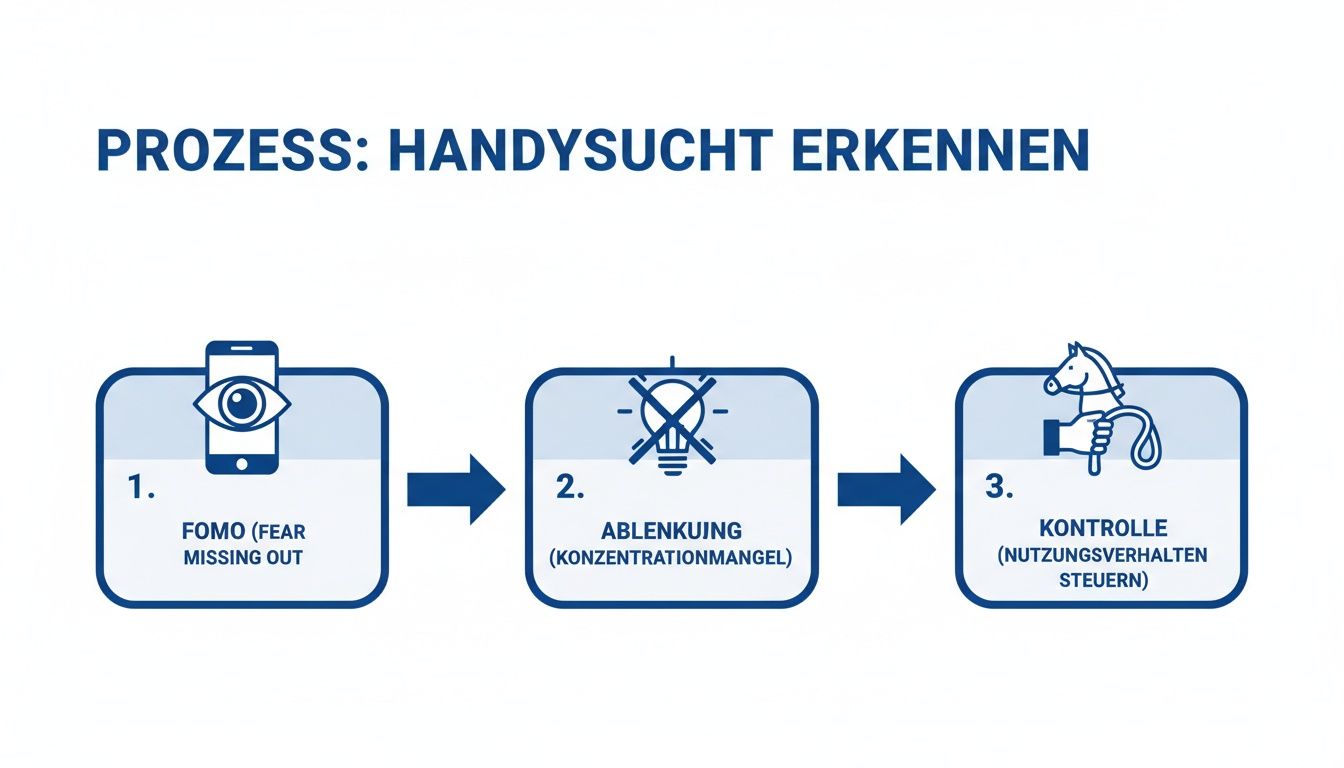
You can clearly see here: the path begins with honest self-awareness and leads, through active decisions, to a more conscious relationship.
The app diet for a clear head
Another method I recommend again and again is the „app diet“. Look at your screen time statistics – they don't lie. Identify the two or three apps that are your biggest time wasters. And then: uninstall them. Just for a week, as an experiment. You'll be surprised how little you actually miss them and how much time you suddenly gain.
Remember: every small change is a success. It's not about perfection, but about planting conscious moments of non-use into your day. These first steps create the mental freedom you need for the next, bigger changes.
These immediate measures are the foundation for more mindfulness in everyday life as a tool against stress and hectic. They dampen the automatic impulses and give you the space to decide for yourself again what you do with your time.
Reclaiming your morning and evening: Fixed routines are your anchor
Once the first immediate measures are in place, it's time for the next, decisive step: redesigning your morning and evening. It's precisely here, in these quiet moments of transition, that it's often decided who determines the day – you or your smartphone. A well-thought-out routine is your strongest ally against that almost automatic reach for the phone.
The morning in particular is a critical zone. If you reach for the smartphone right after waking up, you start the day reactively from the get-go. You flood your brain with other people's agendas, bad news, and the comparison pressure of social media feeds. The result? Often a feeling of overwhelm before the day has even properly begun.
Your analog start to the day
The solution sounds almost too simple, but it has an enormous effect: banish the phone from your bedroom. Really. Invest in a good, old-fashioned analog alarm clock. This small purchase can change everything.
Instead of scrolling through endless feeds in the morning, try something new for the first minutes of your day:
- Have a really good stretch. A few simple stretching exercises wake up the body.
- Drink a large glass of water. This gets your circulation going after the night.
- Go to the window. Consciously take in the daylight and breathe deeply, instead of staring at a glaring display.
This might sound unspectacular, but it's precisely these small actions that help you begin the day calmly and self-determined – instead of sinking straight into digital chaos.
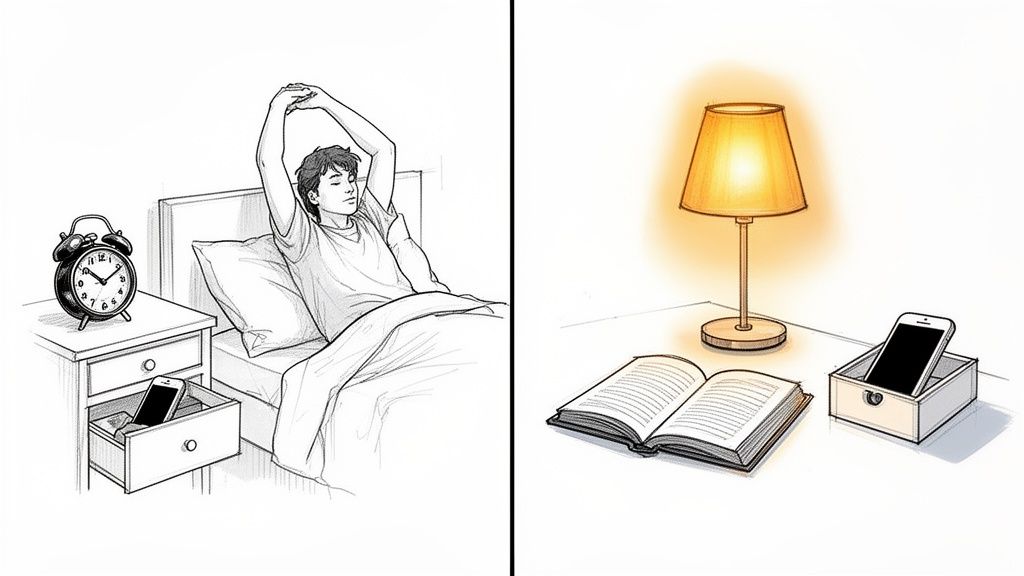
What you do in the first hour after waking up often sets the tone for the entire rest of the day. If you keep this time for yourself, you start with clarity and focus instead of distraction and stress.
The digital curfew for a restful evening
Just as important as the morning is the evening. Everyone knows it, but few stick to it: the blue light of displays disrupts the production of the sleep hormone melatonin. The result is poorer sleep onset and miserable sleep quality. And that's no small problem. A meta-analysis with over 2.1 million participants showed that around 27% develop traits of smartphone addiction, which often leads directly to sleep problems. With an average usage time of an alarming 4.4 hours per day, that's hardly surprising.
So set yourself a clear „digital curfew“. Ideal is 60 to 90 minutes before going to bed. From that point on, the phone is off-limits. It's best to charge it in another room so you aren't even tempted in the first place. Use the time you've gained for relaxing rituals that signal to your brain that it's time to wind down. You can find more ideas on how to avoid your phone before sleep in our related article.
A consistent morning and evening routine without a smartphone isn't a punishment, but pure self-care. You create protected islands of calm in which you can sort out your thoughts and find real rest. That alone is already a powerful answer to the question: „I'm addicted to my phone, what can I do?“
Smart helpers: How to gain the upper hand with technology and analog tricks
Let's be honest: willpower alone is often a blunt sword in the battle against ingrained habits. That's not a failure, but simply human. So instead of putting pressure on yourself, get some clever support instead. There's now a whole range of tools that help you deliberately build small but effective barriers between you and your smartphone.
The principle behind it is brilliantly simple: positive friction. Every small detour, every extra second you place between the impulse and the action, gives your brain a tiny pause. A chance to stop and ask: „Hold on, do I really want this right now?“ That way you make a conscious decision instead of just reacting automatically.
Digital tools for quick focus
The first reach often goes to the software solutions you can install directly on your phone. Focus apps are designed precisely to shut down the biggest sources of distraction for a while.
- App blockers: With these you specifically block access to the usual suspects like social media or news apps. Perfect for a focused work session or when you simply want to read a book undisturbed.
- Focus timers: Many of these tools work according to the Pomodoro technique. You work in intervals – for example 25 minutes of full concentration, followed by a 5-minute break. That's great training for an untrained attention muscle.
The big advantage is clear: these apps are quick to install and often even free. But they also have a weak point. With a few clicks, the block is lifted again when the temptation gets too great. The barrier is purely digital and sometimes simply not high enough.
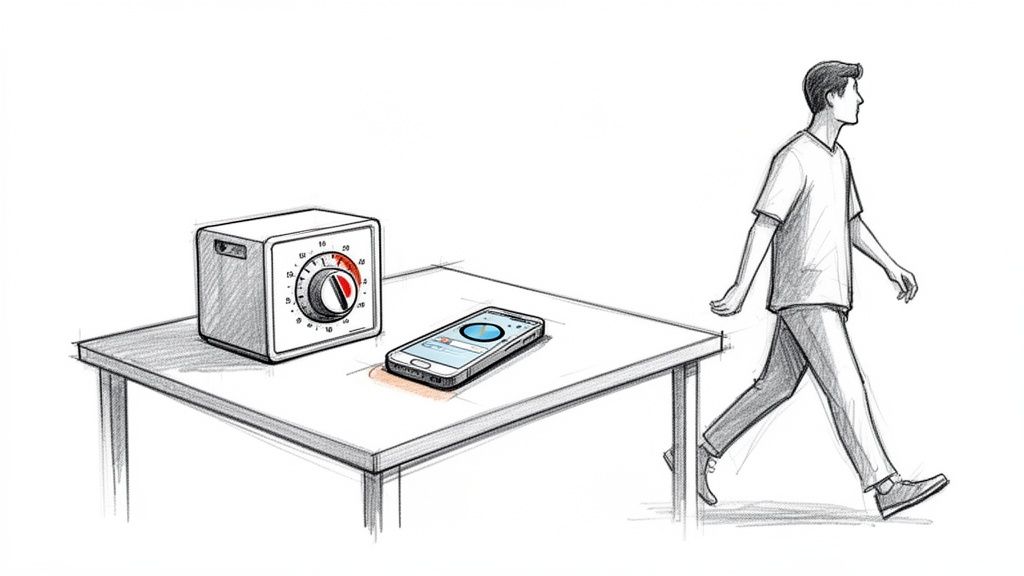
Analog helpers: Real obstacles that truly work
And this is exactly where physical, tangible tools come into play. Their true strength lies in the fact that they require a real physical action to get to the digital distraction. This physical interaction breaks the autopilot far more effectively than any software button.
Think of dinner with your family. Your phone isn't lying next to the plate, but in a box in the hallway. The mere thought of having to get up and walk over there just to quickly scroll through Instagram is often deterrent enough. Considerably more effective than any app block, isn't it?
An exciting approach here are NFC devices that make precisely this physical interaction a requirement. You could, for example, deliberately place such a gadget, like the Zenbox, out of reach – on the fridge, for instance. To unlock your blocked apps again, you have to consciously get up and hold your smartphone to the box.
This small but decisive detour breaks the vicious circle. Whether during an important work session, while exercising, or during a cozy evening reading hour – the physical resistance gives you valuable time to reconsider. Learn more about how such a device against phone addiction can positively change your everyday life.
In the end, it's about finding the right mix for you. Often a combination of digital rules and a real, physical barrier is the most effective protection against the unconscious reach for the phone. That's a powerful answer to the question: „I'm addicted to my phone, what can I do?“
Tackling the addiction at the root for long-term success
After the first hurdles are cleared and you may already be noticing that something is shifting, it's now time to get down to the nitty-gritty. We need to anchor the change deep in your everyday life. Short-term tricks are great for the start, but for real, lasting freedom you have to find out why you actually reach for your phone so often. It's about tackling the problem at the root.
Most of the time, the smartphone is just a symptom, a quick band-aid for a feeling lying underneath. Be completely honest with yourself: in which moments is the urge to reach for the phone strongest?
- When you're waiting for the bus and boredom kicks in?
- When you're sitting in front of an important task and just want to avoid it?
- When you've had a lousy day and just want to switch off?
These very moments are your personal triggers. Recognizing them is the first and most important step to finally switching off the autopilot.
Recognizing and breaking your triggers
Once you know your patterns, you can start to play with them – with small behavioral experiments. Instead of giving in to the impulse right away, you build in a tiny pause. Just a moment of pausing.
Try it like this: the next time you want to reach for the phone out of pure boredom, stop! Instead, consciously look out the window for a minute and simply observe what's happening outside. Or if you're procrastinating: set an alarm for five minutes and take on only the very smallest first step of your task. You'll be surprised how often the urge subsides on its own, once you no longer immediately give it the power.
This isn't about fighting the feeling. It's about learning a new, healthier response to it. You replace an unconscious habit with a conscious, self-determined action.
Build yourself a life you don't need to escape from
Honestly? The best weapon against excessive phone use is a fulfilling life away from the screen. What did you enjoy doing before the smartphone took up so much space? It's time to revive old passions or perhaps even discover entirely new ones.
Make yourself a list of things you can do without a screen. These don't have to be huge, elaborate hobbies. Often it's the small things:
- Having a short conversation with the neighbor.
- Leafing through an old photo album.
- Reading five pages of a real book.
- Going around the block, completely without headphones.
The desire for change, by the way, is enormous. A survey by the FOM University found that 51 percent of Germans intend to take on less stress in the coming year. And especially among the younger generations, the will for a digital break is strong: 37 percent of Gen Z and every third member of Gen Y want to actively spend less time on their smartphone. In the background of this survey you can learn more about the motivation behind it.
And what if a relapse does come?
Now let's get down to brass tacks: there will be days when you're hanging on your phone more than planned again. That's not a failure. That's a completely normal part of the process. What matters is how you deal with it.
Instead of beating yourself up, see it as a valuable lesson. Ask yourself: what was different today? Was I particularly stressed, tired, or bored? Every relapse gives you new, important information about your triggers. Accept the slip, learn from it, and simply carry on the next day. Sustainable change isn't a sprint, but a marathon – and a few detours are simply part of it.
Still have open questions about phone addiction?
Here I've put together the answers to the most common questions that come up again and again in consultations and conversations on the topic of phone addiction. They're meant to help you clear away any last uncertainties and give you even more clarity on your path.
When am I actually addicted to my phone?
The question of the magic number of hours per day is understandable, but it often leads astray. There is no fixed limit beyond which one officially counts as "addicted". Far more revealing is an honest look at your own behavior and how you feel about it.
Pay attention to these typical warning signs. Do you recognize yourself?
- The "just for a sec" effect: You only wanted to quickly check the weather, and suddenly an hour has flown by in which you scrolled through feeds.
- Important things are left undone: Your to-do list gets longer, hobbies gather dust, and you cancel meetups with friends – all for more time at the screen.
- The inner restlessness: You become nervous, jittery, or even really irritable when the phone isn't within reach or the battery is running low.
- Knowing, but not acting: You actually know that your sleep is suffering, your concentration is in the basement, or your relationship is suffering from the constant distraction. Yet you carry on as before.
In the end, it's less a clinical diagnosis that counts, but your personal perception. If you have the feeling that you've lost control and that your smartphone influences your life more negatively than positively, that's the only relevant reason to change something.
Does a radical digital detox actually help at all?
A complete weekend or even an entire week offline – that can be a real eye-opener. Such a radical cut breaks your ingrained routines and often shows you mercilessly how deeply the device is anchored in your everyday life.
But let's be honest: for most of us, that isn't a permanent solution. Such a detox can be a fantastic starting shot to clear your head. More sustainable, however, is to learn a confident and conscious approach. The goal isn't total abstinence, but that you determine the rules again about when and how you use your smartphone.
What if I have to be reachable for work all the time?
I hear this worry constantly, and it's absolutely justified. The solution isn't to make yourself unreachable, but to set clear boundaries and a clean separation between job and free time – even on the same device.
A few strategies that have proven themselves in practice:
- Create a technical separation: Ideal, of course, is a separate work phone. If that's not possible, two SIM cards or separate user profiles on the smartphone can also work wonders.
- Communicate your availability: Speak openly with your team and supervisors. Define clear times for when you're available and when your workday officially ends. That creates clarity for everyone.
- Pull the plug for the end of the day: After work, consistently switch off all notifications from work apps. No emails, no Slack messages, no calls.
It's about regaining control, not about neglecting your professional duties.
How long does it take to get rid of phone addiction?
That's the million-euro question. Unfortunately, there's no blanket answer, because behavioral change is a process, not a sprint with a finish line. The journey is different for everyone.
The good news is: you often feel positive effects after just a few days. Better sleep, more concentration, a feeling of inner calm. But until these new, healthy routines have settled in so firmly that they overwrite the old automatisms, several weeks or even months can easily pass.
Be patient and forgiving with yourself. Every single day on which you manage to handle your phone more consciously is a huge success.
The Zenbox is a simple but immensely effective tool that helps you turn conscious breaks into a firm habit. It erects a real, physical boundary between you and the digital time wasters. This way you reclaim sovereignty over your attention. Discover your path to more focus at https://www.thezenbox.de.