

Successfully Overcoming Concentration Problems in Adults
Do you know the feeling? You actually just want to devote yourself to a single task, but your thoughts bounce from one topic to the next like a rubber ball. If you constantly feel distracted, you are not alone. Concentration problems in adults are no longer a niche phenomenon, but a direct consequence of our modern lives. The cocktail of digital sensory overload, constant stress, and too little sleep is often simply too much for our brain.
Why concentration is a real superpower today
In a world that constantly tugs at us – with countless apps, notifications, and to-dos all competing for our attention at the same time – the ability to concentrate deeply is worth its weight in gold. It is the key to being productive, developing creative ideas, and finding inner calm. Yet this very ability seems to be slipping away from more and more of us.
The main reason for this is a chronic overload of our brain. Imagine your attention as a muscle. If this muscle is constantly interrupted by short, rapid stimuli – an email here, a push notification there – it loses the strength for the truly demanding, sustained tasks. This constant back and forth fragments our focus and makes it almost impossible to reach a state of deep, effortless concentration – the famous „flow“.
The shrinking attention span
The digital flood of information leaves traces that can even be measured. Scientists observe that our collective attention span is shrinking because more and more content is vying for our limited time. A study by the Max Planck Institute for Human Development found that the average attention span in the digital space has dropped from a former 12 seconds to under 8 seconds. This means we can concentrate on one thing for a shorter stretch than a goldfish. You can find more details in the research on the declining attention span.
We feel the consequences every day:
- Less productivity: Tasks seem to take forever, and the susceptibility to errors increases.
- More stress: The feeling of not getting anything done properly leads to frustration and mental exhaustion.
- Lost moments: The constant distraction robs us of the ability to truly enjoy a conversation or a quiet moment.
True concentration does not mean heroically resisting distractions. Rather, it is about denying them fertile ground in the first place and consciously creating an environment in which focus can grow.
But here is the good news: concentration is not an innate gift, but a skill that can be trained. With the right strategies, new habits, and clear boundaries, you can regain control. An excellent starting point is the conscious cultivation of mindfulness in the workplace. This way, you learn to counter the constant digital noise and clear your head again.
Uncovering the real causes of concentration problems
Are you also finding it harder and harder to stay on task? You are not alone. Concentration problems in adults rarely have just a single cause. Most of the time, it is a whole bundle of factors that influence one another and steal your focus.
Imagine your concentration as a muscle: if it is trained incorrectly or one-sidedly, it tires quickly. But if it is strengthened in a targeted way and gets enough recovery, it can deliver peak performance. To find the root of the problem, we need to look at what weakens our „focus muscle“ most in everyday life.
Lifestyle: the foundation for a clear head
Our daily habits are essential for mental fitness. The biggest concentration killer of all is probably lack of sleep. Anyone who chronically sleeps less than seven hours per night overburdens the prefrontal cortex – the control center in our brain responsible for attention, planning, and decisions. The result: we feel as if we are in a fog.
But nutrition and exercise also play a huge role. A diet consisting mainly of sugar and quickly digestible carbohydrates sends blood sugar levels on a rollercoaster ride. This inevitably leads to dips in concentration. By contrast, regular exercise promotes blood flow to the brain and releases messenger substances that keep us awake and alert.
The following concept map summarizes the most important disruptive factors that undermine our focus in everyday life.
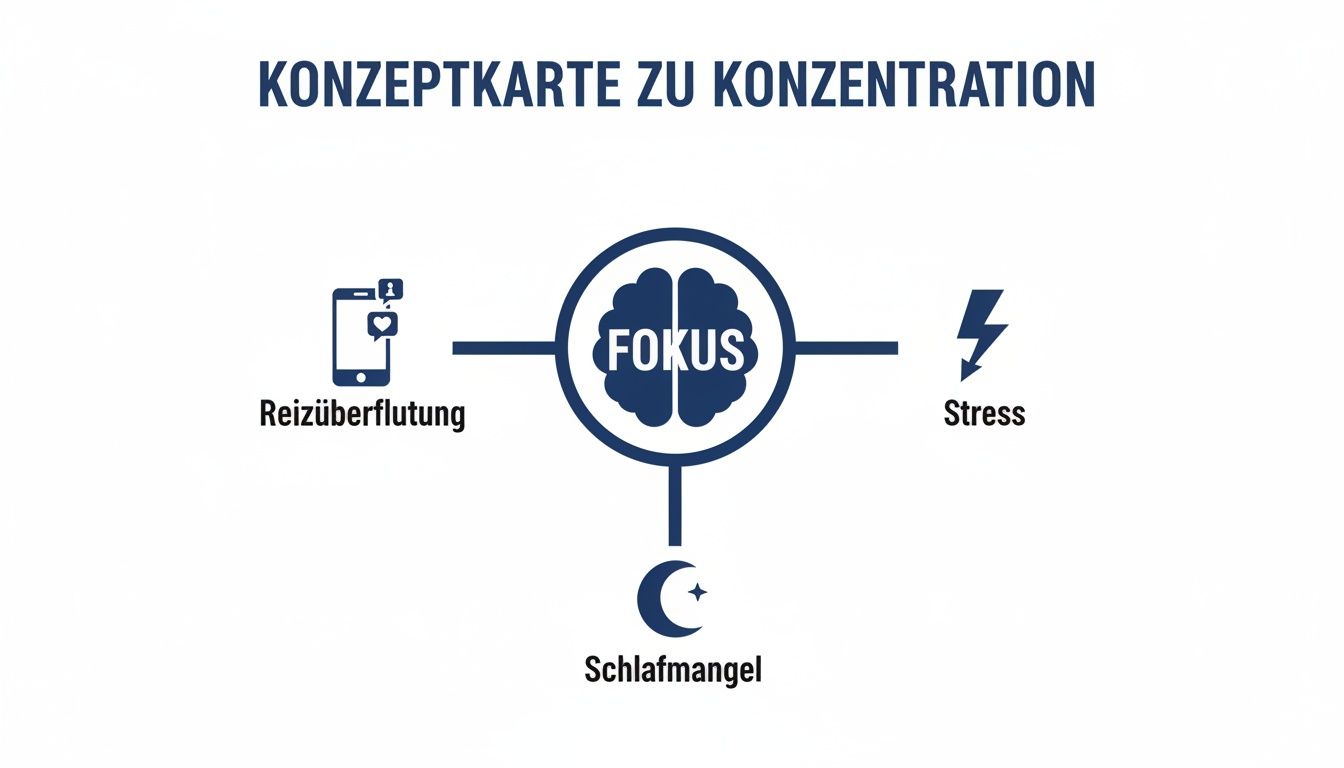
As the graphic shows, external stimuli and internal states such as stress or lack of sleep act directly on our ability to concentrate.
Psychological strain: when your head is simply full
Our mental well-being is inseparably linked to our ability to concentrate. Chronic stress acts like constant background noise that eats up valuable mental energy. It simply becomes impossible to fully engage with a task when the brain is in permanent alarm mode.
Mental illnesses such as depression or anxiety disorders almost always go hand in hand with concentration problems as well. The constant worries or the leaden fatigue consume enormous mental resources.
An often overlooked but important factor is adult ADHD. Estimates suggest that around 2–5% of adults are affected, yet many never receive a diagnosis. They have struggled for years with inner restlessness, forgetfulness, and chaos without knowing the true reason for it.
Concentration problems are not a sign of weak willpower. Most of the time, they are a cry for help from our nervous system, signaling: „I am overloaded!“
Data from the Robert Koch Institute also confirms that mental health and concentration are closely connected. A forsa survey impressively underlined this: a full 78% of stressed respondents reported suffering from fatigue and loss of concentration. You can find more on the epidemiological connections at rki.de.
Environmental factors: the fight against the digital flood
Last but not least, our immediate surroundings have a massive influence. The biggest disruptive factor of our time is digital sensory overload. Our brain is trained by an unceasing stream of notifications, emails, and social media updates to constantly split its attention.
This constant switching between different stimuli has serious consequences: the brain literally unlearns how to immerse itself in a single thing for a longer stretch at a time. We get used to the quick dopamine rewards from new information and increasingly perceive deep, focused work as strenuous or even boring. A noisy open-plan office or a disorganized workspace at home only adds fuel to the fire.
The following table summarizes the most common triggers of concentration problems and points out typical symptoms to make self-reflection easier.
Overview of the main causes of poor concentration
| Cause | Description | Typical signs in everyday life |
|---|---|---|
| Lack of sleep | Chronically too little or poor sleep (under 7 hours) depletes the brain's cognitive resources. | Tired during the day, easily distracted, forgets simple things, takes a long time to start tasks. |
| Chronic stress | Ongoing overload from work, family, or personal worries keeps the nervous system in a state of alarm. | Racing thoughts, feeling overwhelmed, unable to switch off, makes careless mistakes. |
| Sensory overload | Constant digital notifications and multitasking fragment attention and train the brain toward distraction. | Constantly jumps between tasks, finds it hard to immerse in texts, unconsciously reaches for the phone. |
| Mental illnesses | Conditions such as depression, anxiety disorders, or ADHD bind mental energy and impair executive functions. | Lack of drive, constant brooding, inner restlessness, difficulties with organization and planning. |
| Nutrition & lack of exercise | An unstable blood sugar level and insufficient blood flow to the brain impair mental performance. | Tired after eating („food coma“), energy dips in the afternoon, a general feeling of sluggishness. |
This overview is meant to help you recognize possible causes in yourself. Often it is a combination of several factors that needs to be addressed in order to regain your focus.
How stress paralyzes your mental working memory
Do you know the feeling? You sit in front of a task, but your thoughts bounce back and forth like a rubber ball gone wild. Behind this there is often an overloaded system. Just imagine your brain like the working memory (RAM) of a computer. It is there to process information, make decisions, and maintain focus.
But just like a computer that slows down when too many programs are running at once, our brain can also reach its limits. Chronic stress is one such program – one that runs secretly in the background and devours enormous amounts of mental energy. Suddenly even small tasks feel like insurmountable hurdles. These are the typical concentration problems in adults that so many of us know.
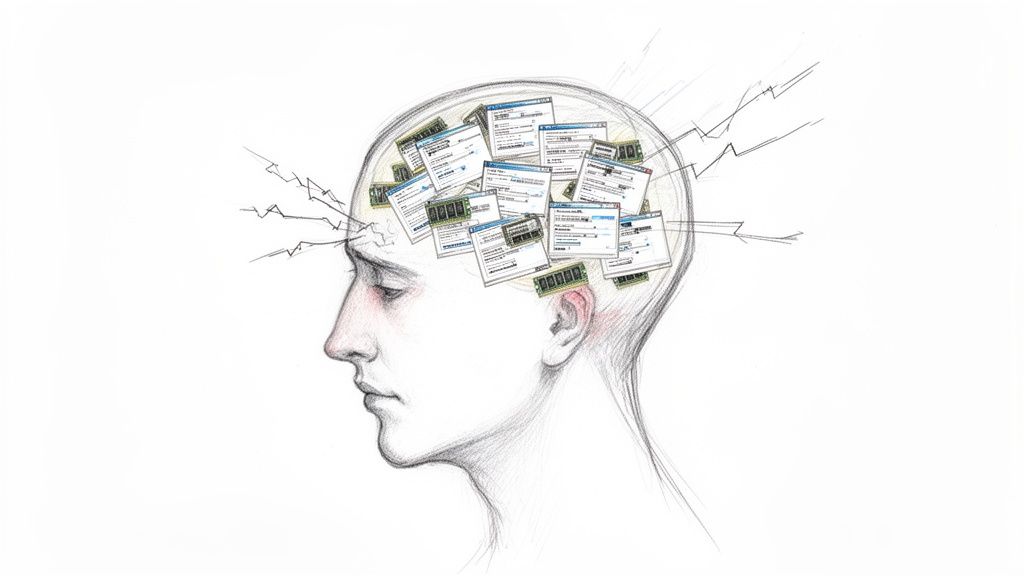
The brain in a constant state of alarm
When we are stressed, our body releases increased amounts of cortisol. This hormone is actually a friend and helper in short-term dangerous situations – it sharpens our senses and prepares us for fight or flight. The problem begins when stress becomes a permanent state. A persistently high cortisol level is poison for our concentration.
Above all, it paralyzes one particular region: the prefrontal cortex. This is essentially the command center of our brain, responsible for all demanding thought processes:
- Controlling attention: Concentrating purposefully on one thing and tuning out unimportant stimuli.
- Planning and organizing: Structuring tasks logically and setting priorities.
- Controlling impulses: Resisting the urge to constantly reach for the phone or jump up.
Under constant stress, our brain essentially switches back into survival mode. The amygdala, our fear center, takes over the helm, while the prefrontal cortex is held back. Conscious, rational thinking then simply no longer stands a chance.
When the working memory is full
We feel this biological chain reaction very directly in everyday life. You read an email for the third time and still have no idea what it says. Your mental working memory is simply already filled to the brim with worries, plans, and to-dos. Or you lose your train of thought mid-sentence because your brain can no longer process the flood of information.
You are not alone in this. In Germany, stress levels have reached a concerning extent. A forsa survey shows that 82 percent of Germans feel stressed. The consequences are noticeable: loss of concentration is one of the most common side effects and, according to estimates, causes economic damage of over 10 billion euros per year. Among those affected, 83 percent complain of inner restlessness and 78 percent of fatigue and exhaustion. This study on stress levels provides more details.
Important: concentration problems caused by stress are not a personal failing. It is a logical biological reaction of your brain trying to protect itself from further overload.
This thought alone can already be enormously relieving. Instead of reproaching yourself, you can tackle the problem at its root: actively reducing stress. By learning how to counter stress and hectic with mindfulness in everyday life, you free up storage space in your head again – for the things that truly matter to you.
Practical strategies for more focus in everyday life that work right away
Knowing the causes of concentration problems is one thing. The other, and far more important, is to finally take action. Forget the search for the one great miracle cure. The real power lies in small but consistent adjustments that add up to an enormous effect over time.
Fortunately, there is a whole range of proven methods with which you can regain control over your attention. Simply see the following strategies as your personal toolkit for a clear head and more productive days. For this, you do not have to turn your whole life upside down – the willingness to try out new habits step by step is enough.

Finding flow with the Pomodoro technique
One of the most effective weapons against procrastination and fluctuating focus is the Pomodoro technique. Why does it work so well? Because it breaks down huge, overwhelming tasks into small, manageable chunks. The principle is ingeniously simple.
Here is how it works:
- One task, one goal: Choose exactly one task that you want to get done now.
- Timer to 25 minutes: Set a timer for exactly 25 minutes. This is your sacred focus block.
- No distractions allowed: Work with full concentration until the timer rings. Phone away, unnecessary tabs closed. No multitasking!
- Short break, real reset: Treat yourself to a 5-minute break. Important: stand up, stretch, get some water – anything but staying at your desk and continuing to stare at the screen.
- The rhythm does it: After four such „Pomodori“ (i.e., four work phases), you have rightfully earned a longer break of 15 to 30 minutes.
With this technique, you train your brain in a very targeted way toward concentration. The regular breaks are like small rewards that keep your motivation fresh.
The Pomodoro technique protects not only against distractions from outside, but also against the greatest distraction of all: your own impulse to want to do something else.
Tuning your environment for concentration
Your environment is not a passive backdrop; it actively influences your concentration. If you sit at a cluttered desk with your smartphone constantly lighting up, you are fighting a battle you can hardly win. So deliberately shape your workspace into a fortress of concentration.
- Clear desk, clear head: A tidy workspace ensures clear thoughts. Anything you don't need for the current task goes away.
- Banish the digital troublemaker: Put your phone in another room or switch it to airplane mode. The mere sight of the device can already cost mental capacity.
- Create a bubble of calm: Noise-cancelling headphones are a fantastic investment. They create an oasis of calm even in the greatest hustle and bustle.
Giving your day stability with routines
In adults, concentration problems are often intensified by a lack of structure. Routines relieve your brain of countless small decisions and thus create a reliable framework that saves energy for what matters.
A simple morning routine can positively shape the entire day. Instead of reaching for your phone right after waking up, take 15 minutes for yourself: a few stretching exercises, a short meditation, or noting down the three most important goals for the day.
Just as crucial is a conscious evening routine. Turn off screens at least one hour before going to bed. Read a book or listen to relaxing music to give your brain the signal to wind down. Because one thing is certain: good sleep is the foundation for a focused next day.
Smart helpers against digital distractions
Let's be honest: our digital devices are often the main cause of concentration problems in adults. They are downright designed to capture our attention – and they do so frighteningly well. But instead of relying solely on our willpower, which can quickly run out on a stressful day, we can make use of clever tools. Tools that help us draw conscious boundaries.
Such tools build a real, physical barrier. They break through the unconscious reach for the smartphone and give us back control by simply switching off our inner autopilot.
The Zenbox: a physical anchor for your focus
Imagine a creative director in the middle of developing an important concept. Again and again her gaze wanders, her hand reaches absent-mindedly for the phone, a quick scroll through the feeds – and just like that, the thread is lost. Her solution is strikingly simple: a Zenbox. This small device is like a physical „off button“ for all those digital troublemakers.
The way it works could not be simpler. It doesn't lock her smartphone away completely, only the apps that really distract her. With the tap of a finger she starts a timer, and the selected apps are blocked for that time. To unlock them again, she would have to consciously stand up and hold her phone to the box once more. It is precisely this small but decisive detour that breaks the habit loop and creates valuable room for true concentration – for what is also called „Deep Work“.
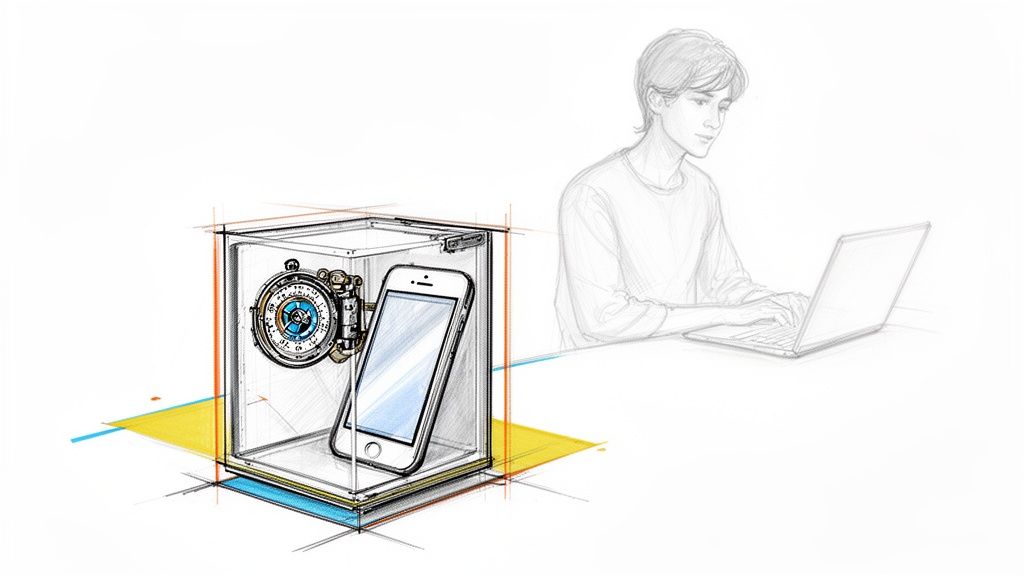
Concrete usage scenarios in everyday life
The areas of application for such focus helpers are incredibly varied and go far beyond the classic working day. They support us wherever we want to be more present again and let ourselves be distracted less.
- Focused work in the home office: Switch off all social media and messenger apps for a full 90 minutes. This way you finally make progress on an important project without constant pings.
- Real family time: Set a phone-free hour after dinner. Your full attention then belongs to conversations with your partner and children. No screen in sight.
- Restful evening routine: Lock all unsettling apps from 9 p.m. This helps you find calm, because the blue light of the displays inhibits melatonin production and disrupts sleep – which directly affects concentration the next day.
The constant fight against the temptations of the smartphone wears on the nerves and consumes mental energy. A physical tool like the Zenbox takes this burden off you and makes it so much easier to actually stick to your own resolutions.
By consciously allowing yourself digital breaks, you not only combat acute concentration problems. You also train your brain again to endure longer phases without constant stimuli and to immerse yourself more deeply in one thing again. If you want to dive even deeper into the topic and break harmful digital habits, we warmly recommend our article on overcoming smartphone addiction.
When it is time for professional help
Self-help strategies and new routines are an excellent start for getting your own concentration back under control. But sometimes you simply reach your limits with them. When your concentration problems as an adult become so severe that they seriously burden your everyday life, your work, or your relationships, it is time to take a closer look.
This is absolutely no sign of weakness. Quite the opposite: it is a courageous and important step for your health. Persistent concentration difficulties can also be a symptom of deeper-lying medical problems that require targeted treatment.
Clear warning signs you should not ignore
Do you notice anything else about yourself besides the pure lack of concentration? Certain accompanying symptoms should be understood as clear alarm signals that call for medical clarification.
Listen to your inner self and pay particular attention to these signs:
- Massive lack of drive: You feel chronically exhausted and lack the energy even for small everyday tasks.
- Extreme mood swings: Your emotions ride a rollercoaster – from strong irritability through deep sadness to an inner emptiness.
- Persistent inner restlessness: This constant feeling of being wired makes it impossible for you to truly find calm.
- Physical symptoms: Suddenly unexplained fatigue, noticeable weight fluctuations, or a changed sensitivity to cold appear.
Such symptoms can point to very different causes, all of which impair concentration. Behind them may be, for example, a thyroid dysfunction, iron deficiency, but also mental illnesses such as depression or a previously undetected adult ADHD.
Seeking professional help means taking responsibility for your own well-being. It is the decisive step to move from mere assumptions to a well-founded diagnosis and to address the true causes of your concentration problems.
Who are the right people to turn to?
Your first step should always lead you to your general practitioner. They are the central point of contact and can rule out or identify physical causes through a thorough examination and blood tests.
If there is a suspicion that the cause lies more in the psychological area or points toward ADHD, they will refer you to a specialist such as a psychiatrist or neurologist. There, targeted diagnostic conversations and psychological tests follow. This comprehensive clarification is crucial in order to make an exact diagnosis and find a treatment that truly suits you. Do not hesitate to take this important step for your mental health.
Frequently asked questions about concentration problems
Finally, here are a few answers to the questions I keep encountering in connection with concentration problems in adults. They summarize the most important points from practice briefly and concisely.
Can concentration even still be trained in adulthood?
Yes, quite clearly! Our brain remains capable of learning and adapting well into old age – this is called neuroplasticity. Simply imagine your concentration like a muscle: the more purposefully you challenge it, the stronger it becomes.
Regular mindfulness exercises, the consistent avoidance of multitasking, or the use of techniques such as the Pomodoro method are classic training methods. They strengthen exactly those neural connections that we need for sustained attention. Even just consciously reducing smartphone distractions helps the brain enormously to get used to deep, undisturbed work phases again.
What role does nutrition play in this?
A pretty big one, to be honest. Our brain is a real high-performance organ and consumes an enormous amount of energy. So it needs the right fuel to function well. A diet with plenty of omega-3 fatty acids (think fish, nuts, or flaxseed), antioxidants (berries, green vegetables), and complex carbohydrates from whole grain products is the perfect foundation.
Sugar and heavily processed foods, on the other hand, do exactly the opposite. They send blood sugar levels on a rollercoaster ride and are often the reason for the dreaded afternoon slump that makes us tired and unfocused. And quite banal, but crucial: drink enough water. A dehydrated brain simply cannot think clearly.
Concentration is not a switch you flip, but a state you actively cultivate. With the right nutrition, enough exercise, and conscious breaks, we have the opportunity every day to improve our mental fitness.
What do I do if I suspect that ADHD is behind it?
If you have the suspicion that your concentration difficulties run deeper and that adult ADHD may possibly be the cause, then the first and most important step is the one to your general practitioner. Be brave and speak openly about your observations and the hurdles in everyday life.
Your doctor can give an initial assessment and, above all, rule out physical causes. If the suspicion is confirmed, they will refer you to a specialist – usually a psychiatrist or neurologist who is familiar with ADHD in adults. A reliable diagnosis can only be made by a specialist, but it is the absolutely necessary foundation for any further help.
Would you like to specifically reduce digital distractions and reclaim your concentration? The Zenbox offers you a simple but effective tool to integrate conscious focus times into your everyday life. Discover at https://www.thezenbox.de how to regain control over your attention.